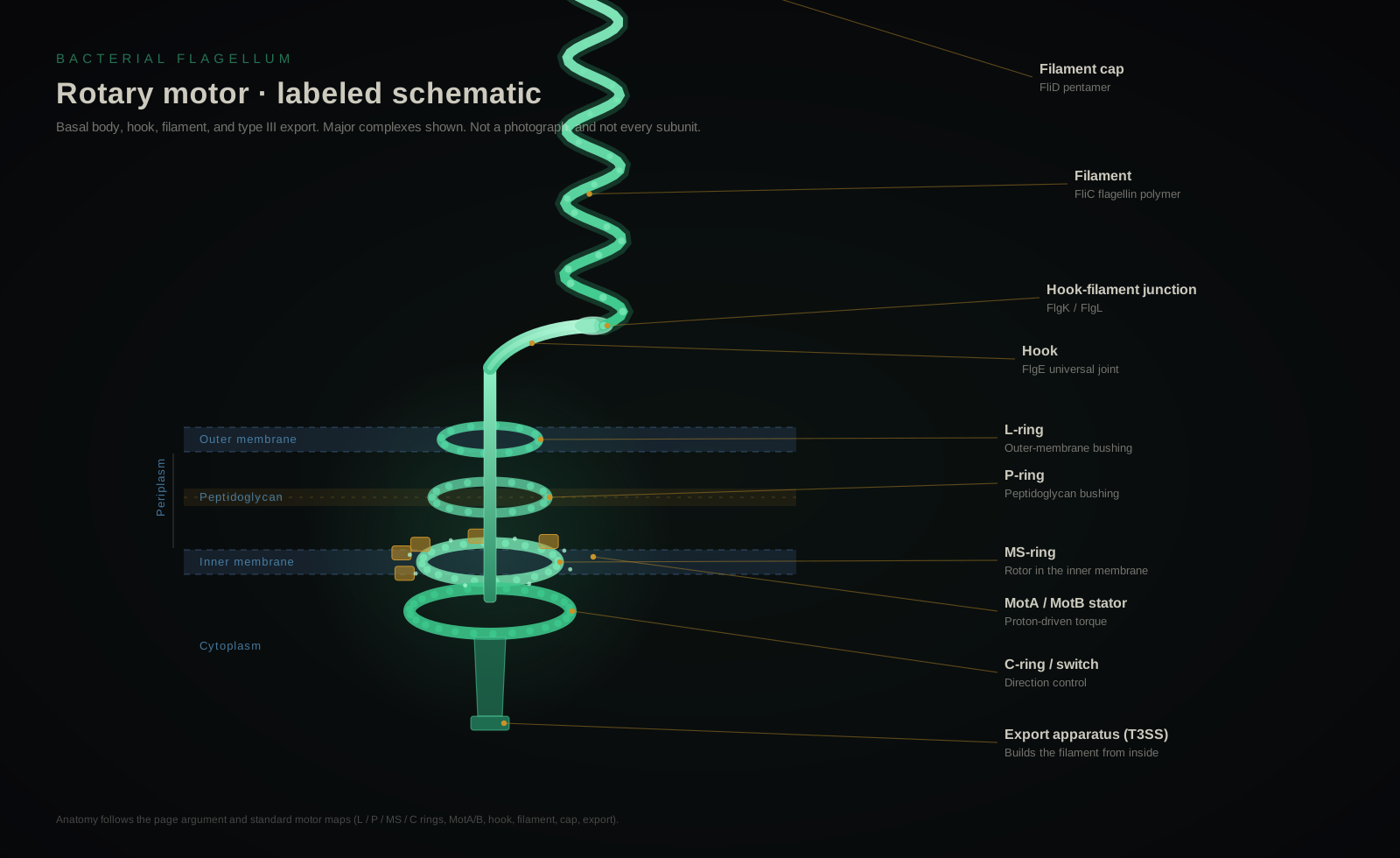
Bacterial Flagellum · Labeled schematic of the rotary motor, hook, filament, and export apparatus
Forty protein subunits. A proton-driven rotary motor spinning at up to 100,000 RPM. Remove one part and it stops immediately and permanently, not gradually.
▼ scroll to explore the animationEvery component rendered below is essential. The basal body anchors in the membrane. The hook transmits torque. The filament acts as a propeller. The type III secretion system exports the subunits. The motor-switch complex controls direction. All of it, simultaneously, or none of it works.
Michael Behe identified the flagellum as the canonical example of an irreducibly complex system. Remove any one of these components and the motor produces zero thrust, not merely reduced thrust.
The motor stator embedded in the cell membrane. L-ring, P-ring, MS-ring, C-ring. Provides structural anchor and ion channel for proton flow.
Stator protein complex. Protons flow through and drive conformational changes that rotate the C-ring. ~8–12 MotA/MotB complexes per motor.
FliM, FliN, FliG proteins form the rotor. CheY-P binds FliM to switch rotation direction. Acts as both motor and signal receiver.
Exports flagellin subunits to self-assemble at the growing tip. Required to build the filament at all. The flagellum builds itself from the inside out.
Universal joint connecting the basal body to the filament. Transmits torque at angles. ~120 FlgE subunits form a helical tube with precise bending stiffness.
Hollow helical tube composed of ~20,000 flagellin monomers. Acts as a propeller. Chirality of the helix determines thrust direction.
Pentameric cap at the growing tip. Required for correct flagellin insertion. Without it, flagellin subunits diffuse away instead of polymerising.
Phosphorylated CheY binds the C-ring switch to reverse rotation from CCW (run) to CW (tumble). Connects sensory input to motor output.
"If it could be demonstrated that any complex organ existed which could not possibly have been formed by numerous, successive, slight modifications, my theory would absolutely break down."
— Charles Darwin, Origin of Species
Irreducible complexity is a specific, testable claim. A system is irreducibly complex if it requires multiple components to function and removing any one of them destroys function entirely — not gradually, but completely. The bacterial flagellum passes this test. Every component shown above is load-bearing. There is no simpler functional version. There is no half-flagellum that confers any motility advantage.
The standard Darwinian reply is that the type III secretion system (T3SS) — which the flagellum uses to export flagellin subunits — could have been co-opted from a simpler ancestral function. This is true. The T3SS is similar to the flagellar export apparatus. But this objection is not an answer to the argument: it explains one component. It does not explain how the remaining 35+ components — the L-ring, P-ring, C-ring, MotA/B complex, hook, filament, cap, and chemotaxis integration — all arrived, were integrated, and began functioning simultaneously. Co-optation is a label. The flagellum requires simultaneous assembly of many distinct systems into a single coordinated machine. Calling that process "co-optation" does not explain how pre-specified components found each other, recognised each other, and self-organised into something that had never existed before. That is the unsolved problem.
The flagellum requires ~40 distinct proteins, encoded by ~40–50 genes, expressed in a precise temporal sequence during assembly. Each protein must fold correctly, interact specifically with its binding partners, and be delivered in the correct order. The probability calculations for this occurring by chance — even given the maximum time available under any cosmological model — run into numbers that are not merely improbable but physically impossible. This is not a god-of-the-gaps argument. It is a calculation. The flagellum is not just very complicated. It is combinatorially impossible by random search.
Darwin set the test himself. If any complex organ cannot be explained by numerous, successive, slight modifications — his theory breaks down. Fifty years after Behe's 1996 identification of the flagellum as that organ, no credible Darwinian pathway has been proposed that accounts for all components simultaneously. The evasion has been consistent: point to one component, claim co-optation, and ignore the integration problem. Darwin's test stands. The flagellum has not been explained.