The human body is the most studied aesthetic object in recorded civilization. Every major art tradition, Greek, Renaissance, Asian, African, returns to it. The universality is not accidental. The male and female forms are two distinct aesthetic architectures rather than interchangeable biological variations. And the fact that both are cross-culturally legible without instruction, that a person from any culture reads them correctly, is evidence that the reading system was built before any culture had the chance to build it.
I. The Human Standard: What the Data Actually Shows
The claim that beauty is purely constructed by culture, that all body types are equally beautiful and only social conditioning produces preference, is now in direct conflict with the empirical record. This is not a claim about moral worth, social treatment, or human dignity (those arguments stand independently). It is a claim about what the data shows regarding biological beauty signaling, and the data is consistent.
Bilateral facial symmetry · Clear skin · Waist-to-hip ratio ~0.7 (female) · Waist-to-shoulder ratio ~0.75 (male) · Bright eyes · Dental health · Erect posture · Full-range movement · Low adiposity signaling metabolic health
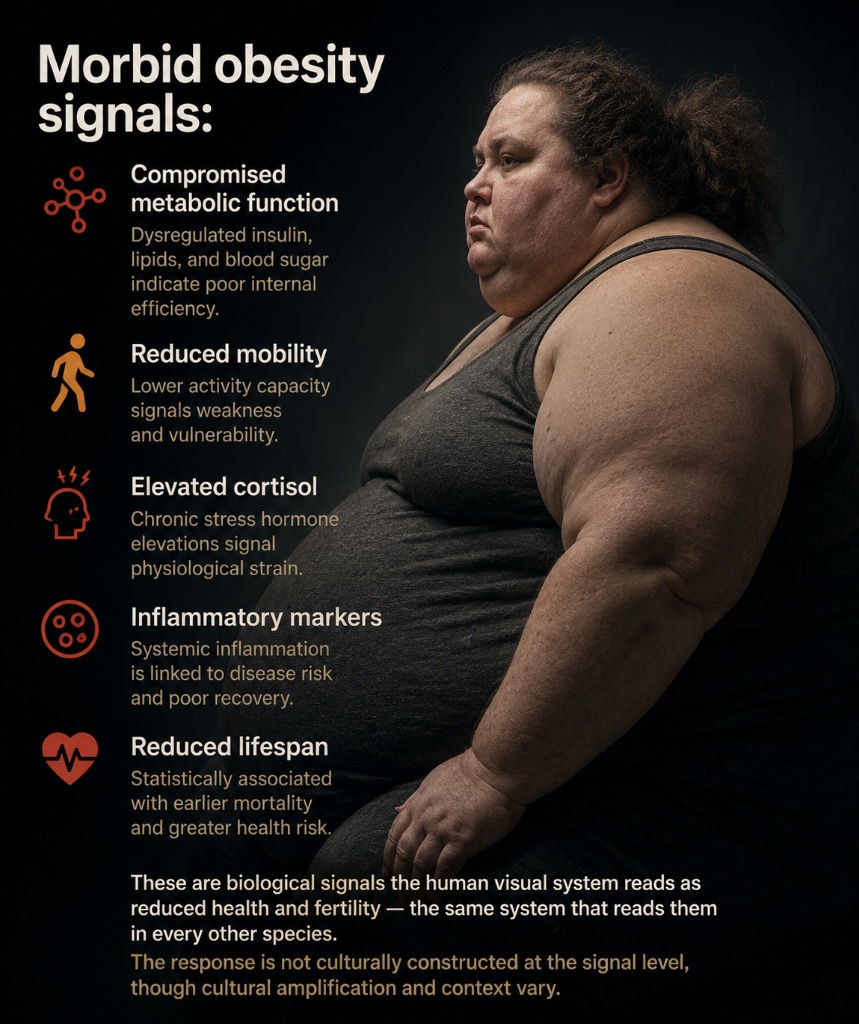
Morbid obesity signals: compromised metabolic function, reduced mobility, elevated cortisol, inflammatory markers, reduced lifespan. These are biological signals the human visual system reads as reduced health and fertility, the same system that reads them in every other species. The response is not culturally constructed at the signal level, though cultural amplification and context vary.
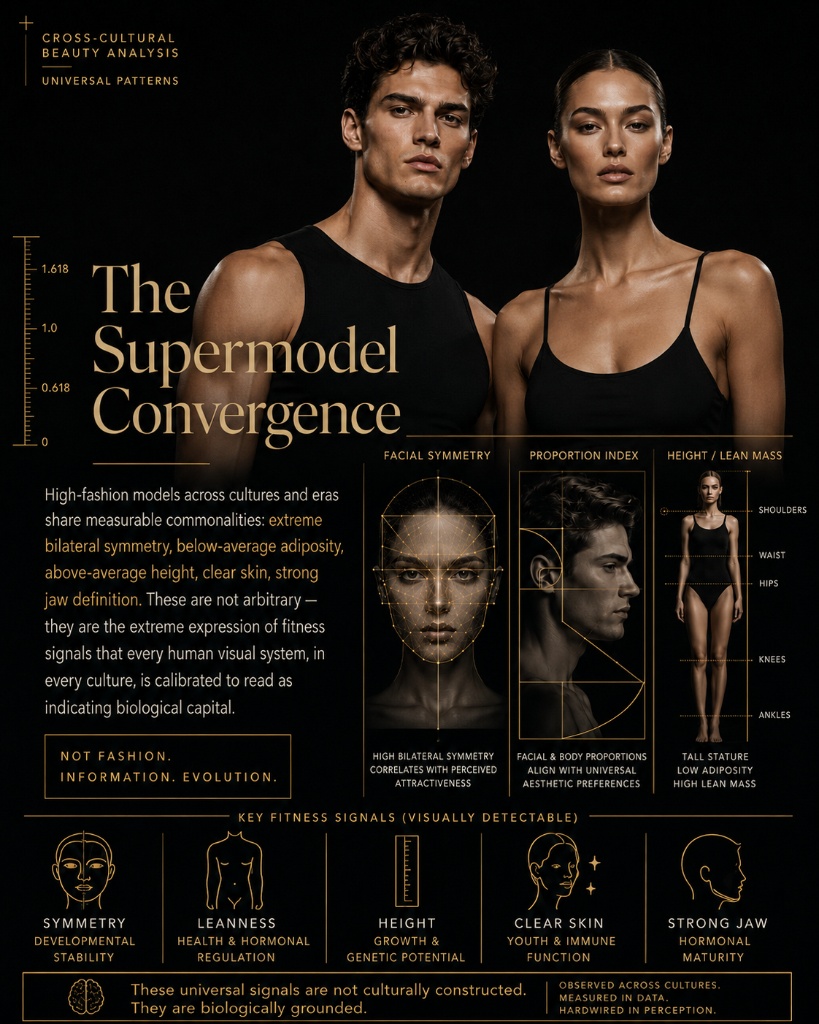
High-fashion models across cultures and eras share measurable commonalities: extreme bilateral symmetry, below-average adiposity, above-average height, clear skin, strong jaw definition. These are not arbitrary: they are the extreme expression of fitness signals that every human visual system, in every culture, is calibrated to read as indicating biological capital.
Body positivity as a moral claim (all people have equal dignity regardless of physical form) is defensible. Body positivity as an empirical claim (the human beauty perception system treats all body types identically and preference is purely constructed) contradicts the cross-cultural record. The Singh (1993) waist-to-hip data was collected in populations with no shared media culture. The convergence was not taught.
Note: This section addresses biological beauty signaling as an empirical phenomenon, the same framework applied to the peacock and the mandrill. It does not address the moral question of how people should be treated, which is a separate argument entirely. The GODISNOWHERE position is that human dignity is unconditional, and that the existence of beauty signals as biological data is compatible with, not contradictory to, that position.
The deeper question: if beauty perception is a reading faculty, and if what it reads in human faces and bodies is a biological signal of health, symmetry, and fitness, then who calibrated the reading system to those particular parameters? The parameters track real biological outcomes (fertility, disease resistance, longevity). The correlation is too precise and too universal to be an accident of cultural transmission. The faculty is built in. The question is who built it.
II. Designed Difference: Two Grammars, One Species
The human body is the most studied object in art history, anatomy, and philosophy. From the Vitruvian Man to the Venus de Milo, from Michelangelo’s David to the photographic portrait, the human form has generated more beauty response per square inch than any other subject in recorded civilization. This is not accidental. The male and female forms are not interchangeable biological variations: they are distinct aesthetic architectures, each carrying a different visual grammar, a different signal structure, and a different form of beauty. That those grammars are universally legible is the argument from designed difference.
Best on a large screen. This gallery reveals the full beauty of the male and female forms on a wider display.
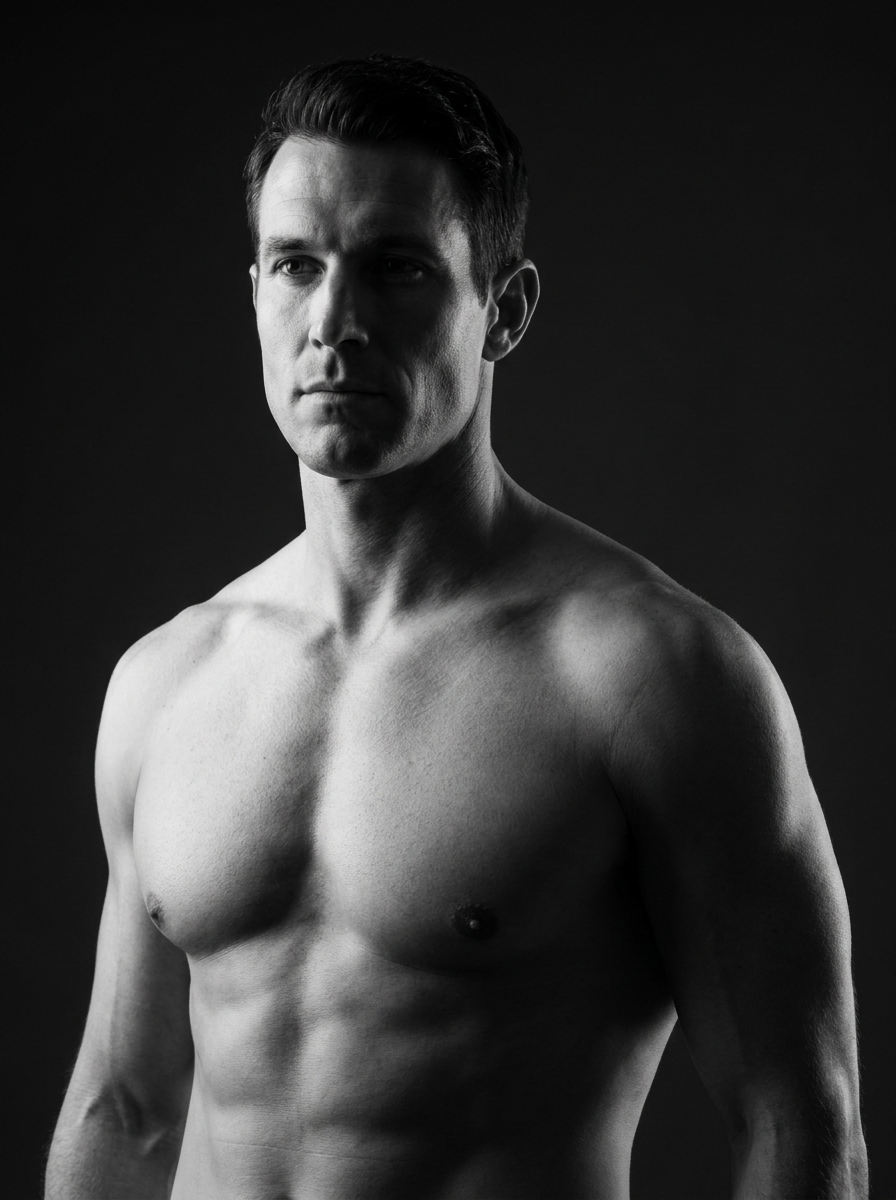
The male form is characterized by angular geometry: broad shoulders, narrow hips, defined jaw structure, and musculature that reads as external capacity. The visual grammar is one of strength made visible.
- Shoulder-to-waist ratio ~0.75
- Jaw prominence
- Angular silhouette
- Defined musculature
- Brow ridge

The female aesthetic grammar is built on bilateral symmetry, curvature, and the waist-to-hip ratio near 0.7, documented across every measured culture as a signal of health and fertility.
- WHR ~0.7
- Bilateral symmetry
- Skin clarity
- Facial averageness
- Grace of movement
III. The Face: The Most Information-Dense Signal
A prominent jaw signals testosterone and immune competence. A strong brow ridge signals dominance. Skin quality signals health. The male face is a readout of biological capacity, legible in 200 milliseconds, documented by response-time studies across cultures.
Bilateral symmetry in the female face is the single most cross-culturally universal beauty signal. Luminous skin signals hormonal health. Large eyes and full lips signal youthful fertility. These are biological readouts that the human visual system was built to read.
"The male face and the female face are not arbitrary variations on a neutral template. They are two distinct aesthetic languages, each carrying a distinct grammar, a distinct set of signals, and a distinct form of beauty. The fact that both grammars are cross-culturally legible, that a man or woman from any culture reads them correctly without instruction, is evidence that the system was calibrated before the cultures existed to calibrate it."
— GODISNOWHERE · The Origin of Beauty


Three thousand years of art, from the Vitruvian Man to contemporary dance, return to the same two grammars. The standard predates every culture that applied it.
IV. The Argument: Who Calibrated the Reading Faculty?
The evidence establishes three things that require explanation. First: the human visual system has a built-in beauty-reading faculty that fires before conscious reasoning in 200 milliseconds. Second: the parameters it reads, WHR 0.7, bilateral symmetry, skin clarity, track real biological outcomes reliably enough to be universal across cultures. Third: the same aesthetic grammar is legible in Greek sculpture, Renaissance painting, and contemporary photography with no cultural mediation required. This is the core of the argument from beauty.
The materialist explanation: the reading faculty is a byproduct of fitness assessment. The parameters that read as beautiful track genuine fitness indicators, so the brain learned to label fitness signals as beautiful to ensure selection for them. On this account, the beauty response is the fitness assessment — nothing more.
The problem is that account cannot explain why the reading is experienced as beauty — why it produces involuntary arrest, desire, recognition — rather than a neutral fitness assessment. The beauty response is something added to the fitness assessment, more than the assessment itself. Something that turns “this signals fitness” into “this is stunning.” That addition is what requires explanation. Evolution selects for what is useful. The experience of beauty as beauty — as something that stops you, that produces recognition, that leaves you different — is the gratuitous part rather than the useful part. And the gratuitous part is what points somewhere. This is the design argument applied not to complexity but to beauty.
"Two distinct forms. Two distinct beauty grammars. Both cross-culturally legible without instruction. The reading faculty is built in — and what it reads is not arbitrary. The system was calibrated by something external to the cultures that use it."
V. The Human Form as Designed Difference
The human body stands as the most information-dense aesthetic object in existence rather than an accidental byproduct, because it was meant to be read. Two distinct grammars — male strength made visible, female grace and fertility made visible — both universally legible without instruction. The reading faculty was built in. The parameters it reads track reality with uncanny precision. And the experience it produces is not merely useful; it is beautiful. This is the human form as designed difference.
That gratuitous beauty — the part evolution cannot explain — is the signature of the Designer who chose to take on this very form. The same form that stops us in our tracks is the form He chose to enter. The human form is not just evidence of design. It is the place where the Designer became visible. That is the theological conclusion of the Incarnation.
"The form that arrests us with its beauty is the form the Word chose to inhabit. This is not incidental. The Incarnation did not happen in spite of the human form's beauty — it happened through it. God did not become a concept. He became this."
Continue the Beauty Series →
The Argument — The Origin of Beauty →Sources & References
- Singh, D. (1993). "Adaptive significance of female physical attractiveness: role of waist-to-hip ratio." Journal of Personality and Social Psychology, 65(2), 293–307. Cross-cultural study establishing WHR 0.7 as universally preferred across cultures without shared media exposure. Foundational evidence that beauty standards are not purely culturally constructed. Find →
- Thornhill, R. & Gangestad, S.W. (1999). "Facial attractiveness." Trends in Cognitive Sciences, 3(12), 452–460. Cross-cultural universality of bilateral symmetry preference in facial attractiveness. Symmetry as a health and genetic quality signal documented across populations. Find →
- Langlois, J.H., et al. (1987). "Infant preferences for attractive faces: Rudiments of a stereotype?" Developmental Psychology, 23(3), 363–369. Infants as young as 2–3 months prefer attractive faces — before cultural conditioning is possible. Establishes the pre-cultural, built-in nature of the beauty-reading faculty. Find →
- Etcoff, N. (1999). Survival of the Prettiest: The Science of Beauty. Doubleday. Harvard psychologist synthesizing cross-cultural beauty research. Argues beauty perception is a hard-wired faculty with universal parameters — not a cultural construction. Find →