A material universe has no need for beauty. Survival requires fear, hunger, desire: responses calibrated to keep you alive and reproducing. It does not require transcendence. It does not require the peacock's iridescent train. It does not require the corona of a total eclipse. It does not require Beethoven's Seventh or the face of a woman who stops traffic. Yet these things exist, in extraordinary abundance, at extraordinary precision, and the attempt to reduce them to survival mechanics has been failing since 1860.
I. The Problem Darwin Couldn't Stomach
Charles Darwin was honest about this. In his correspondence he admitted that beauty presented a genuine problem for his framework. He wrote to Asa Gray that the sight of a peacock's tail made him physically ill, and the problem was theoretical rather than aesthetic. Natural selection selects for survival and reproduction. It does not select for transcendence, for iridescence, for the particular shade of blue in a morpho butterfly's wing that has no function except to be seen and found astonishing.
"The sight of a feather in a peacock's tail, whenever I gaze at it, makes me sick!" His discomfort was not aesthetic. It was theoretical. Beauty at that scale, that precision, that gratuitousness exceeded what selection pressure could explain. He proposed sexual selection as a partial solution. One hundred and sixty-five years later, it remains partial.
Sexual selection explains why a peahen might prefer a peacock with a more symmetrical tail. It does not explain why a human being, observing that tail, experiences something that feels like contact with the infinite. The peahen is selecting a mate. The human is experiencing awe. That gap, between reproductive preference and transcendent response, is the argument.
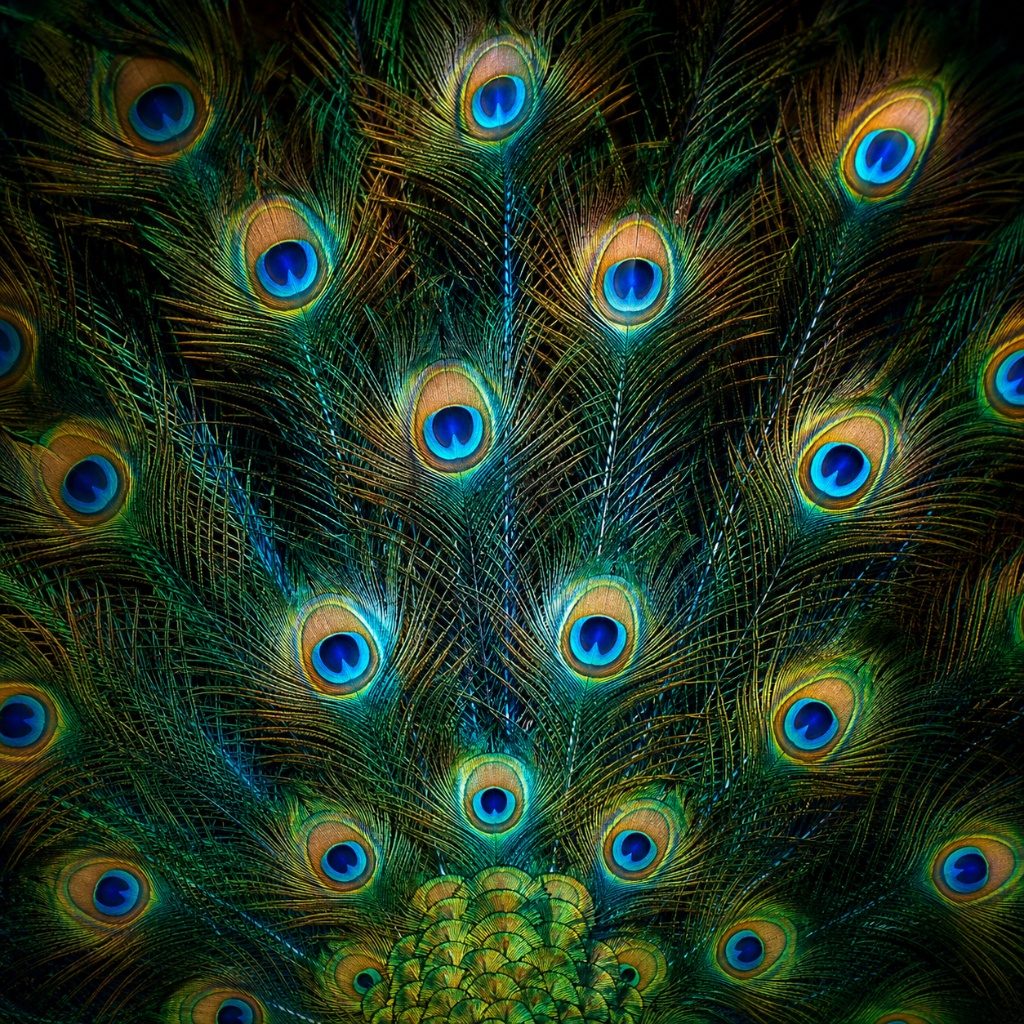
The male's train is metabolically expensive, makes him slower, and is useless in every context except display. Natural selection should eliminate it. Instead it elaborated it to a degree that has no parallel in engineering: structural color at nanoscale precision, not pigment.
The female selects. But who selected the capacity for the male to produce beauty, and the female to recognize it?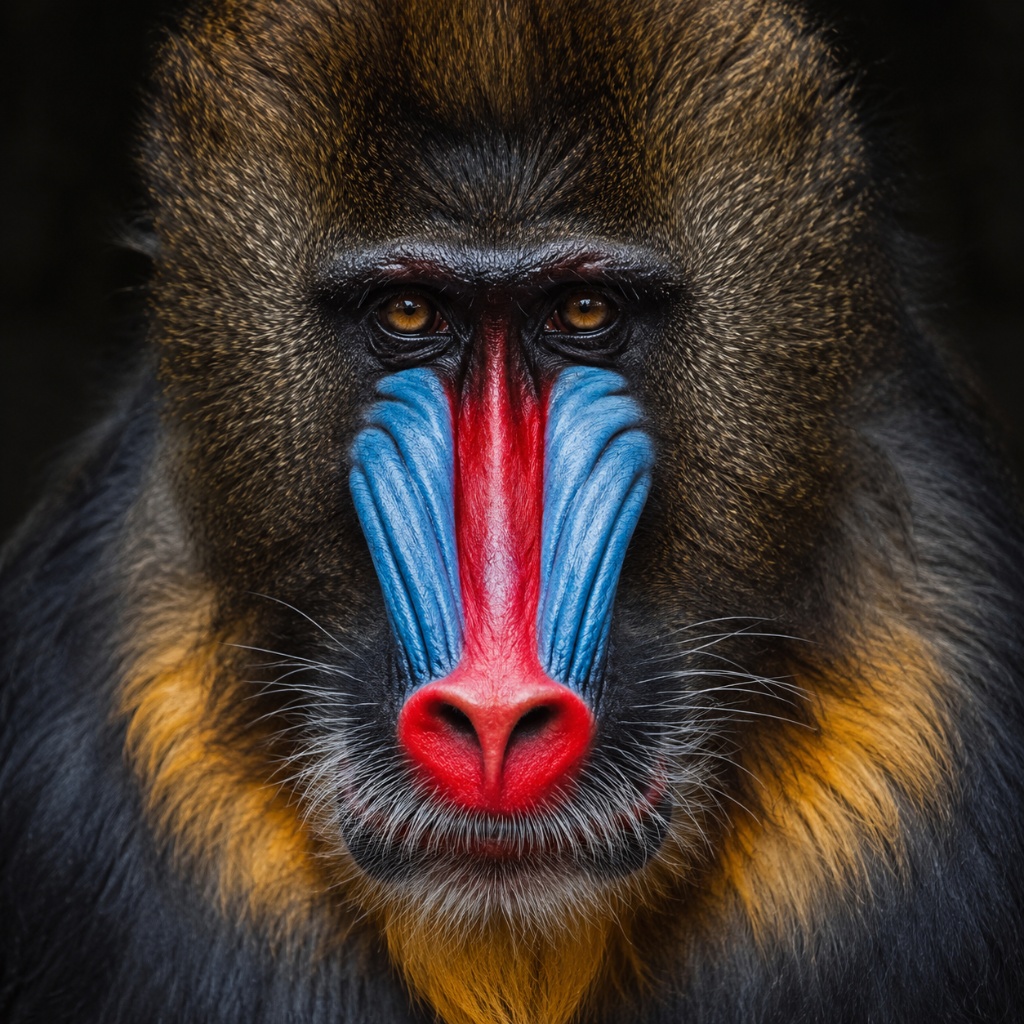
The mandrill male's face is the most colorful face of any mammal on Earth. The coloration does the opposite of camouflage. In a forest, it announces. The saturation of color is directly proportional to dominance and health. It is a walking biological readout, legible to females across 50 meters of dense canopy.
The capacity to read color as a fitness signal requires a shared aesthetic standard. Who set the standard?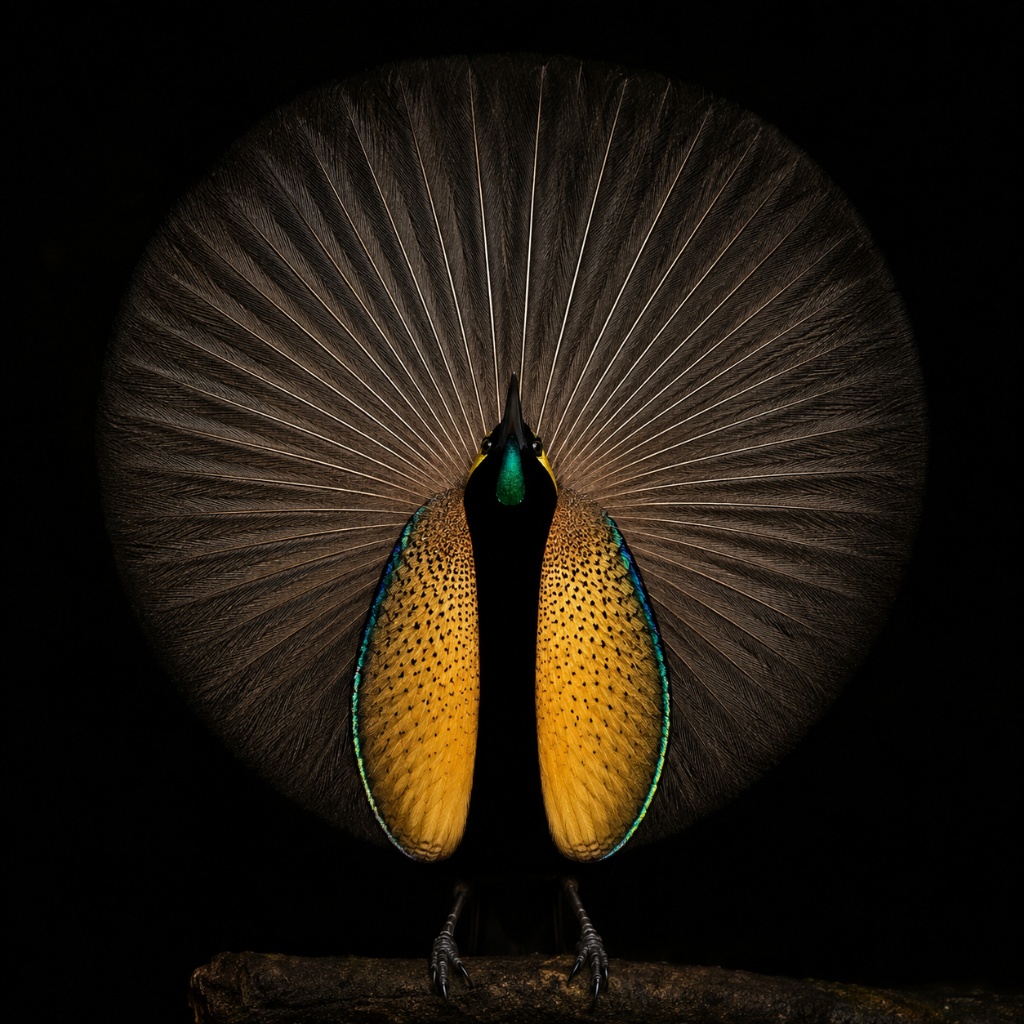
During display, the male expands his plumage into a geometric form, a circle of blue-green against perfect black, that triggers a human response of face recognition. Cornell ornithologists documented this in 2017. The bird evolved what the human visual system finds uncannily organized. The two systems had no common origin. They converged on the same visual grammar.
Visual grammars that converge across unrelated species suggest a shared standard, external to both.
The blue of the morpho wing is architecture rather than a color. Microscopic scales are arranged at angles that constructively interfere with specific wavelengths of light. The effect is angle-dependent, shifts with movement, and cannot be replicated at this precision by any synthetic process. No pigment involved. Pure structural optics.
Nanostructure producing perceived beauty: the medium is information, not chemistry.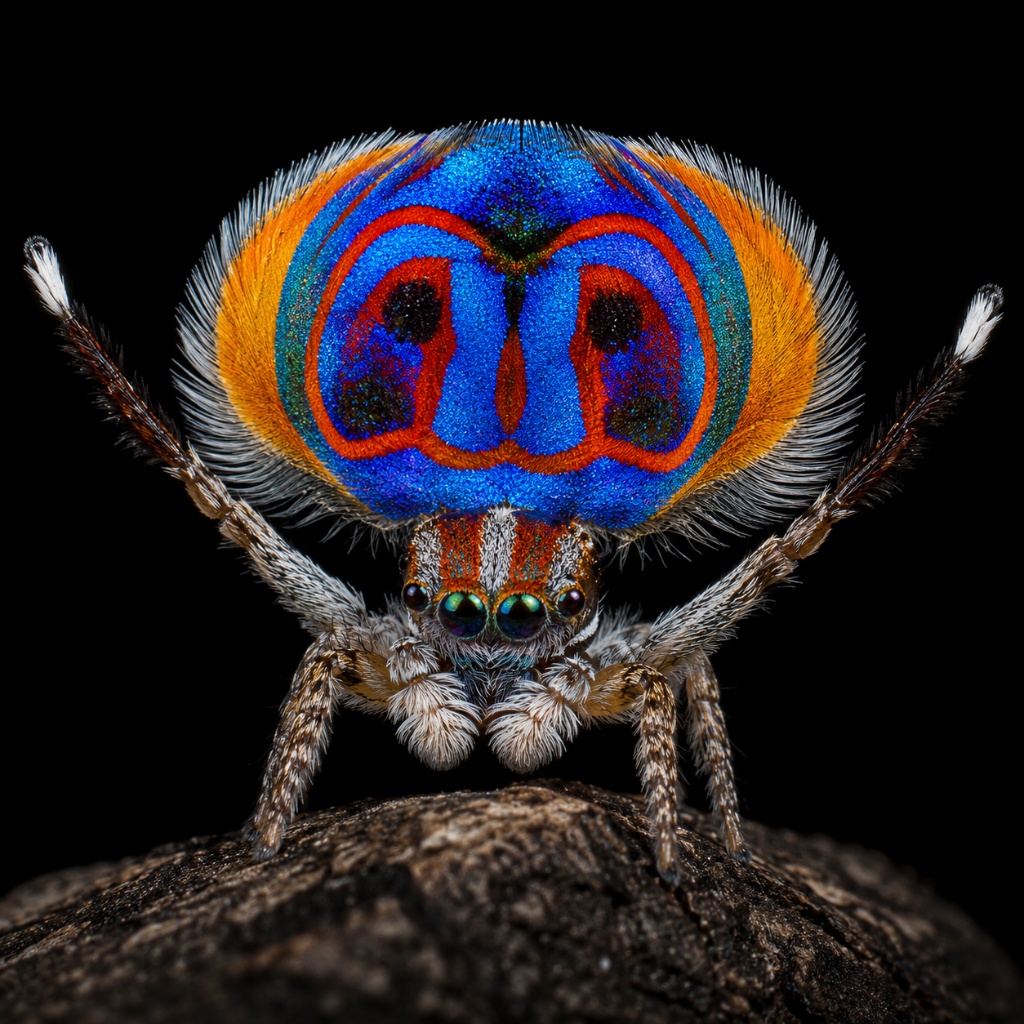
The peacock spider is the size of a pencil eraser. Its abdominal display, expanded during courtship, contains more distinct color regions per body area than any other known organism. Females watch the display and reject immediately if a single element fails. The selection pressure for precision in a 5mm canvas is inexplicable without invoking an aesthetic standard that pre-exists the behavior.
Aesthetic precision at 5mm scale. Selection pressure toward beauty this small has no survival justification.
Human beauty perception is both hardwired and culturally modulated. The hardwired layer is universal: bilateral symmetry, facial averageness, clear skin, and in females specifically a waist-to-hip ratio near 0.7, documented as preferred across all measured cultures including those without exposure to Western media.
Cross-cultural universality of beauty standards in humans suggests a signal, not a preference. Something being read, not invented.II. What Beauty Is Not. What It Is.
Merely Subjective
If beauty were purely subjective, cross-cultural convergence would be impossible. But it isn't. Bilateral symmetry is preferred in faces across every studied population. The waist-to-hip ratio 0.7 is preferred across cultures with no media exposure to each other. Beauty has a hardwired layer, which means something is being read, not invented.
Purely Adaptive
Some beauty correlates with fitness. But the peacock's train is adaptive in exactly zero survival contexts: it makes the bird slower and more visible to predators. The morpho butterfly's structural blue serves no camouflage function. Beethoven is not an adaptation. The survival explanation reaches a ceiling that the data does not.
Cultural Construction
Culture modulates beauty. It adjusts the channel but does not create the signal. The underlying universals persist across radically different cultures. You can add adornment, modify emphasis, shift fashion. You cannot invent the capacity itself, and you cannot override the hardwired universals by cultural decree alone.
A Reading Faculty
Beauty perception is a faculty — like pain perception or hunger — calibrated to track something real. Pain tracks damage. Hunger tracks caloric deficit. The question is: what does beauty track? The cross-cultural data, the animal evidence, and the transcendent response all suggest the same answer: something that pre-exists the organism doing the perceiving.
The eclipse, Rudolf Otto, C.S. Lewis. The involuntary argument no one taught you to make.
The Control Experiment BrutalismWhat happened when governments deliberately built without beauty — for thirty years, at scale.
The Data The Human FormWHR 0.7, bilateral symmetry, the male and female aesthetic grammars — and who calibrated the reading faculty.
III. The Brutalism Experiment — What Happens When Governments Try to Remove Beauty
Between 1950 and 1980, governments built without beauty — deliberately, ideologically, at scale. Pruitt-Igoe. Cabrini-Green. Boston City Hall. The J. Edgar Hoover Building. In every case the documented human cost was the same: anxiety, avoidance, vandalism, flight. The experiment ran for thirty years. It failed. The failure is not a design anecdote — it is the strongest single piece of evidence for beauty as a human requirement rather than a preference.
IV. The Human Form — Designed Difference
WHR 0.7. Bilateral symmetry preferred in every measured culture. Two distinct aesthetic grammars, the angular male and the curved female, both cross-culturally legible without instruction. The beauty-reading faculty is built in. Infants prefer attractive faces before they can speak. The Singh (1993) data was collected in populations with no shared media culture. The convergence was not taught. The faculty is built in. The question is who built it.
V. Awe — Where Beauty Becomes Argument
In Ohio, April 8, 2024 — totality. The animals went silent and then resumed. The humans went silent and were not quite the same. The difference between those two silences is the entire argument. Rudolf Otto named it in 1917: the mysterium tremendum et fascinans — the mystery that is simultaneously terrifying and irresistibly attractive. C.S. Lewis followed it out of atheism. The awe response is a faculty tuned to something, well beyond decoration.
VII. The Full Comparison — Beauty vs. Its Absence
The beauty argument is most powerful when the contrast is direct. Here is what the evidence shows when you place beauty and its deliberate absence side by side — in animals, in buildings, in human bodies, in music, and in the government's own experiment with ugliness:
Response: Recognition, Approach, Arrest
The peacock is approached. The eclipse produces arrest. The symmetrical face draws the gaze and holds it. The cathedral produces reverence in people with no religious belief. The Great Barrier Reef produces silence in people who came to party. The newborn face triggers a hormonal response in adults who have never met the child. Beethoven's Seventh produces tears in people who have never heard it before and cannot explain why.
Pattern: involuntary positive arrest — the organism stops and orients toward.
Response: Avoidance, Anxiety, Aggression
Pruitt-Igoe produced crime rates that exceeded its catchment area before the buildings were fully occupied. Boston City Hall produces documented visitor avoidance. Brutalist university buildings were vandalized by students within years of opening. Malls without natural light produce measurably reduced dwell time. Hospitals without windows produce measurably poorer patient outcomes. Industrial factory farming environments produce measurably higher stress hormones in both workers and animals.
Pattern: involuntary negative response — the organism leaves or deteriorates.
Maximum Investment in Beauty That Harms Survival
The peacock invests 1.5 meters of iridescent train that slows him, makes him visible, and requires metabolic resources better spent elsewhere. The bird-of-paradise invests months of display practice. The peacock spider invests the majority of its 5mm body surface in visual display. In every case, the investment exceeds survival rationality. The organism is spending resources on beauty that would be more efficiently spent on strength or camouflage.
Implication: the pressure toward beauty in nature exceeds what survival mechanics require.
Aesthetic Selection Beyond Fitness Correlation
The peahen selects for tail quality. But the precision of peacock tail elaboration exceeds what fitness correlation requires — a simpler signal would convey the same genetic information with less metabolic cost. The female is selecting for beauty beyond minimum viable fitness signal. This is documented in multiple species. The selection pressure is for beauty itself, not merely its proxies.
Implication: in nature, beauty is selected for beyond its fitness proxy function. Something in the selection process values beauty as beauty.
The pattern is consistent across every domain where it has been studied. Beauty produces recognition and approach. Its absence produces anxiety and avoidance. The response arrives untaught, present in infants, in every measured culture, and in every species whose behavior has been studied in sufficient detail. Something in the structure of reality is calibrated toward beauty. The question is whether that calibration is an accident or a feature.
VIII. Beauty Will Save the World
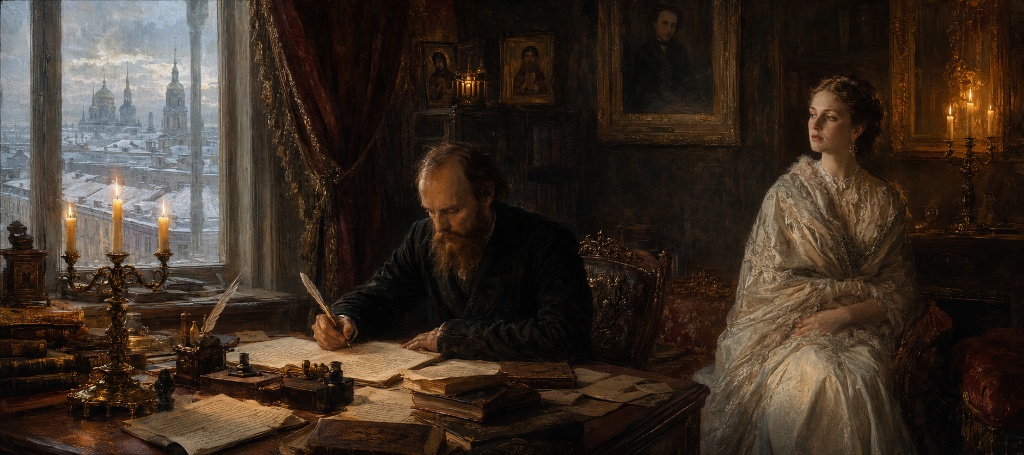
Fyodor Dostoevsky's Prince Myshkin, in The Idiot, makes a statement that has puzzled readers for 150 years: "Beauty will save the world." He does not explain it. He cannot. It is not the kind of claim that submits to explanation. But in the context of the brutalism data and the eclipse response, something of what he meant becomes accessible.
"Beauty will save the world."
Fyodor Dostoevsky · The Idiot (1869) · Prince Myshkin · not argued, simply placed
The governments that tried to build without beauty: Pruitt-Igoe, Cabrini-Green, the J. Edgar Hoover Building, Corbusier's urban renewal plans. They did not destroy the human need for beauty. They demonstrated it by its absence. The residents of Pruitt-Igoe voted with their behavior: vandalism, flight, social disintegration. The architects believed beauty was a bourgeois conceit. The residents demonstrated it was a human requirement.
The materialist answer is that beauty is a pattern-recognition reward: the brain flags certain configurations as useful (symmetry = health, open landscape = safety) and labels that response "beautiful." The eclipse response, on this account, is a misfiring of the landscape-detection system at unusual scale. The peacock's tail is a fitness signal operating at elaborated intensity. Beethoven is neural pattern-matching in the auditory cortex. Brutalism failed because it violated the feng shui of ancestral environment expectation.
The problem with that answer is that it does not match the phenomenology. And it does not match the data. If beauty were purely a fitness proxy, it would not be selected for beyond the minimum viable signal. The peacock spider's display goes far past minimum viable, elaborated to a degree that reduces the spider's survival odds while increasing the precision of the aesthetic signal. If beauty were purely a pattern-recognition reward, you could satisfy it with optimal pattern. Yet people consistently prefer natural beauty over optimized artificial pattern. No photograph of a sunset has ever produced in a viewer what the sunset itself produces.
"Beauty is not decorative. It is evidence. Every organism that has ever elaborated beauty beyond what survival requires, every human who has stood in front of something vast and felt their categories dissolve, every government that tried to remove beauty and documented the human cost of doing so. They are all pointing at the same thing. The question is whether you are willing to follow the pointer."

In Ohio, looking up at the corona, the question was impossible to avoid. The eclipse was not beautiful the way a painting is beautiful. It was beautiful the way something real is beautiful: something that existed before you arrived, will continue after you leave, and does not require your approval. The animals went quiet and resumed. We went quiet and were not quite the same. The difference between those two silences is the argument.
Sources & References
- Darwin, C. (1860). Letter to Asa Gray, April 3, 1860. Darwin Correspondence Project, Letter 2743. Darwin's admission that the peacock's tail made him "sick." His acknowledgement that gratuitous beauty exceeded what selection pressure could cleanly account for. Source →
- Singh, D. (1993). "Adaptive significance of female physical attractiveness: role of waist-to-hip ratio." Journal of Personality and Social Psychology, 65(2), 293–307. Cross-cultural study establishing WHR 0.7 as universally preferred across cultures without shared media exposure. Foundational evidence that beauty standards are not purely culturally constructed. Find →
- Thornhill, R. & Gangestad, S.W. (1999). "Facial attractiveness." Trends in Cognitive Sciences, 3(12), 452–460. Cross-cultural universality of bilateral symmetry preference in facial attractiveness. Symmetry as a health and genetic quality signal documented across populations. Find →
- Prum, R.O. (2017). The Evolution of Beauty: How Darwin's Forgotten Theory of Mate Choice Shapes the Animal World — and Us. Doubleday. Yale ornithologist. Argues that beauty in animals is selected for its own sake — beyond fitness proxy — and that Darwin's second theory (aesthetic selection) was suppressed by the 20th century neo-Darwinian synthesis. The peacock spider, bird-of-paradise, and bowerbird evidence in detail. Scholar →
- Keltner, D. & Haidt, J. (2003). "Approaching Awe, a Moral, Spiritual, and Aesthetic Emotion." Cognition & Emotion, 17(2), 297–314. First systematic psychological research on awe. Key findings: awe involves vastness + need for accommodation; reliably produces prosocial outcomes; not reducible to fear or pleasure. Find →
- Otto, R. (1917). Das Heilige [The Idea of the Holy]. Translated John W. Harvey (1923). Oxford University Press. Coined "numinous" and "mysterium tremendum et fascinans." Argues the sacred is sui generis — irreducible to ethics, aesthetics, or evolutionary biology. Archive →
- Lewis, C.S. (1955). Surprised by Joy: The Shape of My Early Life. Geoffrey Bles. Lewis's autobiography of conversion, centered on the Joy experience — the involuntary stab of longing that kept arriving. The most intellectually honest account of the awe-to-theism trajectory by a former committed atheist. Library →
- Bristol, G. & Saliga, P. (2012). The Pruitt-Igoe Myth [Documentary]. First Run Features. Documentary examining the demolition of Pruitt-Igoe and the documented social consequences of modernist public housing design. Addresses and refutes the mismanagement hypothesis directly — the social failure preceded management breakdown. Site →
- Executive Order 13967 (December 18, 2020). "Promoting Beautiful Federal Civic Architecture." The White House. Federal order favoring classical and traditional architecture for new federal buildings. The debate surrounding its issuance and rescission is the most recent political document of the government's formal engagement with the question of whether beauty should be an architectural requirement. Federal Register →
- Kant, I. (1790). Critique of the Power of Judgment. Cambridge University Press (2000 trans.). Analysis of beauty and the sublime. The eclipse is a canonical Kantian sublime event. Points to the supersensible domain beyond the physical. Archive →
- Dostoevsky, F. (1869). The Idiot. Originally serialized in The Russian Messenger. "Beauty will save the world." Not argued — placed. Dostoevsky's conviction that beauty has moral force and is evidence of transcendent order. Gutenberg →
“Beauty will save the world.”