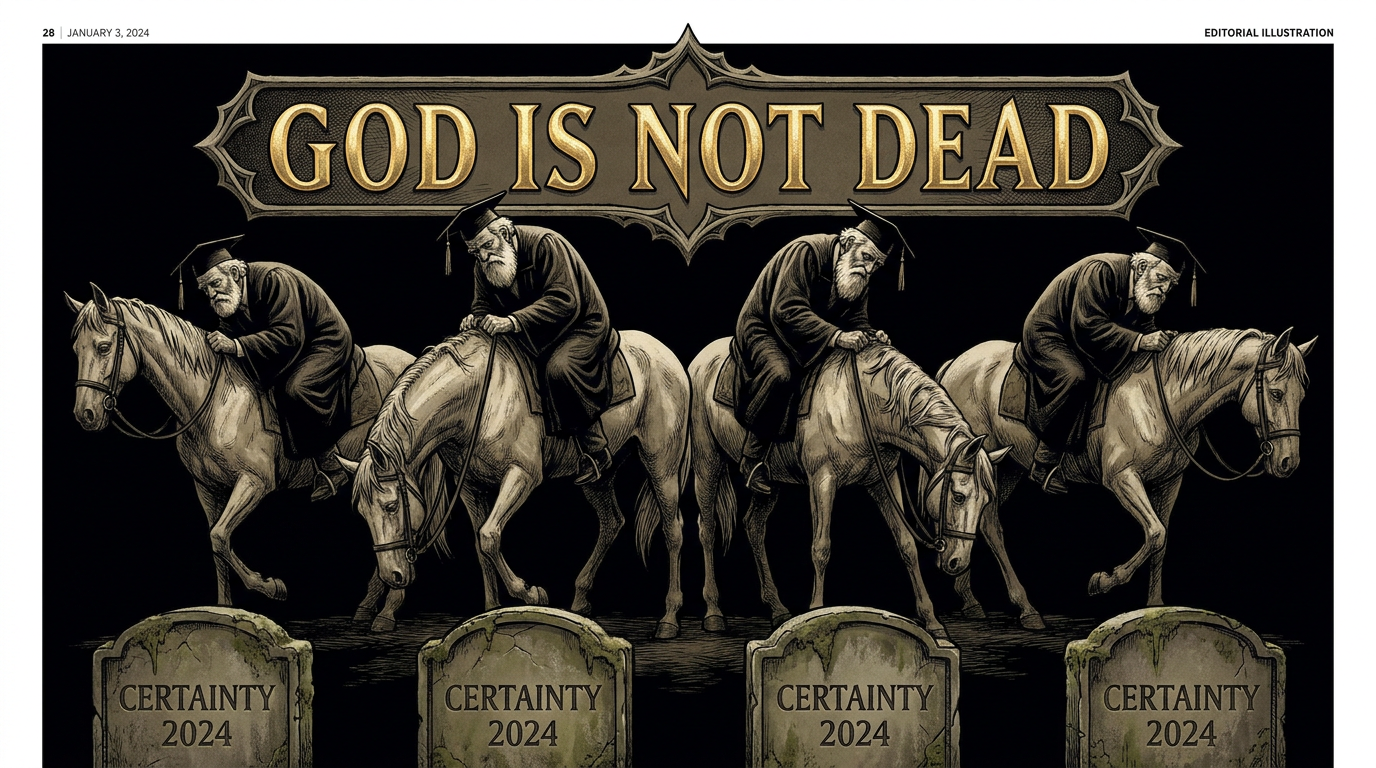
The confident dismissal of God has a history. It runs approximately one hundred years, from Bertrand Russell's 1927 essay "Why I Am Not a Christian" through the Four Horsemen's 2007 roundtable to Alex O'Connor's 2024 public retreat from confident atheism. In that arc, the movement gained universities, lost philosophers, buried two of its four generals, and watched its most celebrated academic predecessor announce, after fifty years, that the evidence had changed his mind. This is that story.
"Thou believest that there is one God; thou doest well: the devils also believe, and tremble."
James 2:19 · King James Version · Written ~AD 49
Belief in God's existence is not the finish line. Even the demonic acknowledge the fact.
The question was never whether He exists. The question is what you do with that.
I. The Century of Confident Atheism: A Timeline
Modern atheism as a cultural movement did not begin with Dawkins. It has a philosophical lineage stretching back through the 20th century's most formidable minds, and that lineage tells a story that the movement's popularizers preferred not to tell.
II. The Four Horsemen: Where Are They Now?
In 2007, the four published books that became the New Atheist canon. The tone was triumphalist. The God question was considered closed. Here is where that confidence stands today.

Oxford biologist. His selfish gene framework has been publicly challenged by colleagues at Cambridge and the Royal Society. His public authority has narrowed considerably. Now describes himself as a "cultural Christian."

Journalist and polemicist. The movement's most formidable debater. Died of esophageal cancer at 62. Refused to recant, a position worthy of respect even in disagreement.
Philosopher of mind at Tufts University. Argued religion is a natural phenomenon explicable by evolution. Died February 2024. Two of the four are now gone.
Neuroscientist and podcaster. Now focused on AI, consciousness, and meditation. His strict materialism has softened toward acknowledged agnosticism on consciousness.
Of the four: one is dead. One died in 2024. One has seen his scientific foundations crumble within evolutionary biology itself. One has drifted toward consciousness studies that make strict materialism difficult to maintain. The movement that was going to end religion has not ended religion. It has ended itself.
III. Alex O'Connor: The Next Generation Retreats
O'Connor was the face of a younger, more intellectually serious generation of atheism. Oxford-educated. Careful. Willing to engage theology on its own terms. In October 2024 he published a landmark video titled "Outgrowing New Atheism", a frank recounting of why he could no longer hold the confident, dismissive atheism he had grown up with.
He has since explored Catholic theology, Advaita Vedanta (Hindu non-dualism), and the philosophy of consciousness in a way that takes seriously the possibility of a transcendent reality. He has said publicly, as a self-described agnostic: "I, an atheist, am afraid of hell." That is not a sentence a person of settled conviction writes.
He has not converted. He has not claimed belief in God. But he has done something arguably more significant for the argument: the most intellectually honest spokesperson of the new atheist generation looked at the evidence carefully and found he could not maintain the certainty the movement required.
In April 2024, in an interview with Times Radio, Dawkins was asked about Britain becoming a majority non-Christian country for the first time. His response stunned his own supporters:
This is the author of The God Delusion, the book that argued religious belief was delusional and morally equivalent to child abuse, now saying he would be sad if the Christian ethos were lost. He prefers the fruits of Christianity to the alternative. He cannot bring himself to prefer the root. But the preference for the fruit, while denying the root, is a philosophically unstable position. You cannot want civilization and refuse its foundation.
The Challenge That Was Never Answered · Real Science Radio
The Dawkins 3-to-1 Evolution Challenge
Bob Enyart and Fred Williams of Real Science Radio (Denver, Colorado) issued a direct, public challenge to Richard Dawkins, one of the most specific and unanswered challenges in the public evolution debate. The challenge focuses on a single, foundational question about the genetic code itself:
The 3-to-1 codon ratio (three nucleotide bases encoding one amino acid) is one of the most basic structural features of all life on Earth. It is universal across every domain of biology. Every ribosome in every cell on the planet operates on this code. And yet no naturalistic account explains why three letters map to one amino acid rather than two, or four, or any other number. The ratio is not chemically determined; it is a convention. It is, by definition, a symbolic system.
Enyart's framing was precise: he asked for the explanation in "as vague terms as you'd like." He was not demanding mathematical proof. He was asking for a plausible conceptual account. A sketch. A direction. Dawkins did not respond. No one from the materialist camp answered the challenge.
RSR's own summary of the challenge: "Because we are creationists here in Denver at Real Science Radio, we can readily acknowledge that the laws of physics have no symbolic logic functions. Thus, a half century of trying by naturalists was doomed to fail, because just as you will have no answer to this challenge, there is no conceivable answer, because it cannot ever happen, even given infinite time."
Note carefully what this challenge asks. It does not ask Dawkins to disprove God, nor to solve the entire origin-of-life problem. It asks for a materialist account of one ratio in the genetic code, the simplest structural feature RSR could isolate. If that cannot be answered in vague terms, the claim that evolution explains biological complexity without a designer stands on no foundation at all.
Of the four living horsemen at the movement's peak, Harris has proven the most philosophically restless. His work on consciousness, particularly his acknowledgment that subjective experience cannot be explained by neuroscience alone, has pulled him toward terrain that strict materialism cannot map. He practices meditation. He acknowledges that the first-person perspective is anomalous within his own framework.
Harris has not moved toward theism. But his acknowledgment that materialism cannot explain consciousness is significant, because the same argument that convinced Flew about DNA applies here: information that precedes its physical substrate requires a non-physical explanation. Harris knows the problem exists. He has not yet followed it to its logical terminus.
Thomas Nagel is not a theist. He is not a creationist. He is one of the most respected analytic philosophers of the 20th and 21st centuries, the man who wrote the famous 1974 paper "What Is It Like to Be a Bat?", which established the hard problem of consciousness as the central unsolved problem in philosophy of mind. He is a self-described atheist.
In 2012, he published Mind and Cosmos, and the reaction from the materialist academic establishment was fury. The book's argument, in plain terms: the dominant materialist, neo-Darwinian framework for understanding nature is almost certainly false, and the reasons it is false include precisely the phenomena the New Atheists built their case on: consciousness, cognition, and value.
From the Book · Chapter 3: Consciousness
"Consciousness is the most conspicuous obstacle to a comprehensive naturalism that relies only on the resources of physical science. The existence of consciousness seems to me to be a datum that a materialist theory cannot accommodate… Each of our lives is a part of the lengthy process of the universe gradually waking up and becoming aware of itself."
"The failure of evolutionary naturalism to provide an adequate account is not just a matter of the quantitative complexity of the universe's biological history but of the qualitative character of the natural order itself. The natural order is not merely a physical order; it is a psychophysical order."
Thomas Nagel, Mind and Cosmos, Chapter 3, Oxford University Press, 2012
Nagel's three targets are consciousness, cognition, and value: the three things that a purely physical, evolutionary account cannot explain without assuming what it is trying to prove. His argument is not that God therefore exists. His argument is that materialism, the philosophical foundation of New Atheism, is not up to the job of explaining what we most certainly know: that there is experience, reason, and the apprehension of moral truth.
The response from materialist philosophers and scientists was instructive, and revealing. The Nation called it "the most despised science book of 2012." Steven Pinker tweeted that it was "the shoddy reasoning of a once-great thinker." Brian Leiter and Michael Weisberg published a formal rebuttal in The Nation. The philosopher Daniel Dennett, one of the Four Horsemen, dismissed it as "the shoddy thinking of a man in his dotage." The ferocity of the reaction to a careful, book-length argument from a tenured NYU professor, not a creationist, not a Christian, not a conservative, not a theist, tells you something about the philosophical security of the materialist position. When the argument cannot be answered, the man is attacked instead. We have seen that pattern before. Flew. Tour. And now Nagel.
Consequences of the Work
- Academic ostracism. Colleagues who had praised Nagel's earlier work publicly distanced themselves. The book was treated as an act of apostasy rather than a philosophical argument.
- No serious published refutation of the central argument. The responses attacked Nagel's conclusion and his standing, but no peer-reviewed paper successfully demonstrated that materialism can account for consciousness, cognition, and value in the way Nagel demands.
- The hard problem of consciousness moved to the centre of public debate. David Chalmers, who coined the term "hard problem," cited Nagel's work as reinforcing the insurmountable difficulty for physicalism. The problem has not been solved in the decade since.
- Legitimized the design inference among secular philosophers. By arguing from secular premises that neo-Darwinism is insufficient, Nagel made it intellectually respectable for non-theist philosophers to question the reigning framework, without being dismissed as religious.
- Nagel remains without a replacement framework. He has said in subsequent interviews that he has no positive alternative. He simply knows materialism fails. This is intellectually honest, and structurally identical to the position of every honest atheist confronting the origin of information in DNA: the answer is not here, but we will not look there.
That second quotation, from fifteen years before Mind and Cosmos, is among the most candid admissions in modern atheist literature. Nagel is confessing what this site calls the prior-commitment problem: the conclusion is preferred before the argument is complete. He wants atheism to be true. He finds the evidence for consciousness, reason, and value pointing somewhere he does not want to go. He follows it anyway, and his honesty earns him the contempt of the movement he has served for fifty years.
Nagel has not converted. He remains, as of his last published work, a secular philosopher who cannot accept materialism and cannot accept theism, and who is honest enough to say so. That position is more intellectually serious than the confident dismissal of either side. He is the clearest example in contemporary philosophy of a mind that followed the evidence to the edge of materialism, and found it insufficient. The next step has a name.
IV. Antony Flew: The World's Most Notorious Atheist Changes His Mind
Flew was not a popular atheist. He was an academic's academic, the philosopher who developed the presumption of atheism as a formal philosophical position, who debated theologians for five decades, and who was considered the most rigorous intellectual opponent of theism in the English-speaking world.
In 2004, Flew announced he had become a deist, not a Christian, not a theist in the full sense, but a believer in a designing intelligence behind the universe. The mechanism that persuaded him was DNA. The same argument this site presents in technical detail in the Biological Coherence brief.
He published There Is a God: How the World's Most Notorious Atheist Changed His Mind in 2007. The response from the New Atheist movement was dismissal and personal attack, suggesting, without evidence, cognitive decline. His argument was not answered. It was not seriously engaged. This is worth noting.
V. The Three Great Claims of Atheism, and Their Answers
New Atheism rested on three arguments presented as decisive. Each is answerable. Each has been answered. The answers are on this site, built from primary sources, peer-reviewed data, and the statements of the movement's own scientists.
"Evolution explains the complexity of life without requiring a designer. God is the gap, and science is closing the gaps."
The answer: Evolution does not address the origin of life, the origin of the genetic code, or the origin of the information that DNA encodes. These are not gaps; they are the central question. The Darwinian mechanism (variation + selection) operates on replicators that already exist. It has nothing to say about how the first replicator came to contain 3.2 billion base pairs of specified, error-correcting, context-sensitive digital information.
Antony Flew followed this argument to its logical end in 2004. James Tour, organic chemist at Rice, one of the world's most cited scientists, has publicly stated that origin-of-life research cannot yet build a protocell and that popular accounts of progress are, in his word, dishonest. This is the assessment of the leading scientists in the field, not a creationist claim.
Peer-Reviewed Evidence · Journal of Molecular Biology · 2004
Douglas Axe: The Protein Sequence Space Problem
Douglas Axe is a molecular biologist with a Ph.D. from Caltech who spent years at the University of Cambridge and the Babraham Institute (Cambridge) before founding the Biologic Institute in Seattle. His 2004 paper in the Journal of Molecular Biology, one of the most prestigious peer-reviewed journals in the field, produced what is now called the Axe estimate:
To put that number in context: there are an estimated 1080 atoms in the observable universe. The probability of a random sequence producing a functional protein by chance is comparable to selecting one specific atom from the entire universe, blindly, on the first try. For every functional protein that exists, there are 1077 non-functional decoys in the surrounding sequence space.
In his 2016 book Undeniable: How Biology Confirms Our Intuition That Life Is Designed (HarperOne), Axe extended this argument. His central claim: the intuition that life looks designed is not a cognitive bias to be explained away; it is a rational response to the evidence. His concept of "functional coherence" (the property of systems where multiple parts must be present simultaneously) describes exactly the problem Darwin's mechanism cannot solve. You cannot build toward a function that doesn't exist yet.
Axe has also been interviewed extensively by Real Science Radio on these findings: the impossibility of random sequences producing proteins, the failure of directed evolution experiments to produce novel protein folds, and what the biology actually shows versus what the textbooks claim.
More: Deep Sophistication: NOW · I · Origin of Life: We Are Clueless · Information Theory & DNA
"The universe is fine-tuned? So what, a multiverse could explain it. And deep time explains everything else."
The answer: The multiverse is not a scientific theory. It is a philosophical escape hatch: unobservable, unfalsifiable, and invoked specifically to avoid the design inference. By the epistemological standards the same scientists apply to every other domain, the multiverse hypothesis should not be taken more seriously than the theistic hypothesis. Both are beyond current observation. One has the advantage of having been proposed across every human culture independently and simultaneously.
As for deep time: more time does not generate more specified complexity; entropy runs one direction. The Cambrian Explosion produced 34+ animal phyla in under 10 million years. Paleontologists call this an "explosion" because it is the opposite of what the gradual Darwinian model predicts. More time makes the problem harder, not easier.
More: The Fine-Tuned Universe · Deep Time (and its inversion)
"Religion is the source of most human suffering. We would be more moral without it."
The answer: The 20th century's three most catastrophic regimes: Soviet Russia, Maoist China, Nazi Germany, were explicitly atheistic, secular, or anti-clerical. They produced more deaths in 100 years than all religious wars combined over the preceding 1,000. This does not prove atheism causes atrocity. But it permanently destroys the claim that removing religion removes the engine of human cruelty. The engine is in the human, not the belief system.
The deeper problem: on a materialist worldview, moral claims are not objectively true; they are evolutionary adaptations that increased group survival. To say "religion causes suffering" is to invoke moral categories (suffering matters, cruelty is wrong) that materialism cannot ground. The New Atheists borrowed Christian moral intuitions to condemn Christianity. Dawkins' own admission that he prefers "Christian civilization" is the full expression of this contradiction.
More: The Problem of Evil: and its inversion · What Is Evidence?
VI. The God Promotion: A Thought Experiment
This argument comes from personal debate experience. It has never been answered without the respondent building something that looks remarkably like what they were rejecting.
You are an atheist. You have just been promoted to God. You must now design the universe from first principles. The position requires you to answer a series of operational questions:
- You will create beings capable of love. Love requires the capacity to reject. Will you grant free will?
- If yes: those beings will harm each other. What is your response to that harm?
- Will you communicate with them? If so, how? Direct speech? Prophets? A written record?
- What will you require of them? What counts as faithfulness? What counts as rebellion?
- What are the consequences of permanent, wilful rejection of your authority? Is there a permanent consequence?
- How will you measure whether they are genuinely seeking you versus performing compliance?
- Will you reward the faithful? How? When?
- Will you define moral law? If so, what is its basis: your nature, or your will?
In every debate where this exercise has been conducted, the respondent, without consulting any religious text, reconstructs, in rough outline, the Ten Commandments, a concept of hell, the necessity of revelation, the problem of grace, and the logic of judgment.
The point is not that they arrive at Christianity. The point is that they arrive at the same structural answers, because the questions have the same structural logic. If you were God, you would face the same problems the Bible describes God as facing. The solutions you would reach are the solutions the Bible describes. This is not an accident.
VII. Define God First: The Prior Commitment Problem
The second argument from personal debate experience. It has a different structure: it is not a thought experiment; it is an epistemological challenge.
You cannot meaningfully claim that God does not exist until you have agreed on what you mean by God. This seems obvious. It is almost never observed in practice.
Ask the atheist: which God do you not believe in?
- The old man on a cloud of folk Christianity? That's a strawman; serious theologians haven't believed that since the Middle Ages.
- The interventionist deity who suspends physics on request? That is one specific position, not the theistic claim in general.
- A God who would behave exactly as a morally perfect being would behave: omniscient, omnipotent, omnipresent, eternal? That requires very different arguments.
- The Logos of John 1:1: the ground of being, the reason behind rationality, the source from which information flows? That is a different claim again.
In almost every debate, the atheist is not disbelieving in the God of serious theology. They are disbelieving in a God they have constructed, usually from the worst examples of religious behavior, the least defensible popular conceptions, and the parts of the Bible they have read out of context.
The God of this site: the God of John 1:1, of Logos, of fine-tuned constants, of DNA as language, of the resurrection as historical fact; is not the God being rejected in most atheist arguments. Define the God you are rejecting. Then we can have a real conversation.
VIII. Lee Strobel: The Journalist Who Set Out to Disprove It
Strobel was legal affairs editor at the Chicago Tribune, a trained investigator, not a theologian. When his wife converted to Christianity, he set out to disprove it. He interviewed New Testament scholars, archaeologists, medical experts, and philosophers of science, specifically looking for the weakest points in the historical case for Christ.
The investigation converted him. He has since noted that his atheism was not purely intellectual; it was convenient. A world with no God had no moral authority over his choices. He followed the evidence anyway. The Case for Christ has sold more than 14 million copies.
IX. What This Means: and What It Doesn't
None of this proves God exists. The retreat of New Atheism's most prominent voices is not an argument; it is a data point about where the honest intellectual momentum is moving. What it does demonstrate:
The New Atheist claim was not that God probably doesn't exist; it was that believing in God was equivalent to believing in a flying spaghetti monster. That level of certainty has not survived contact with serious philosophy of science.
Flew followed DNA. Strobel followed historical testimony. O'Connor followed the limits of materialist epistemology. In each case, the honest mind went where the evidence pointed, not where its prior commitments wanted it to go.
James 2:19 makes a devastating point: belief in God's existence is not the achievement. Even the demonic believe, and respond with fear. The question is not intellectual assent. The question is what follows from it.
"The devils also believe, and tremble."
Belief is the beginning, not the destination.
The question is not whether the evidence points somewhere.
The question is whether you are willing to follow it all the way.
Define the God you are rejecting.
Then sit across from the evidence.
Then answer: what would it cost you if you were wrong?
Antony Flew followed the argument wherever it led, after fifty years of leading
the other side. Thomas Nagel wrote a book confessing that materialism cannot account
for consciousness, reason, or value; and admitted he wants atheism to be true,
which is a different thing from it being true. Alex O'Connor sat across from John Lennox
and could not hold the line. Dawkins admits he would be sad to lose the civilization
Christianity built. Harris admits consciousness is the one thing materialism cannot explain.
Not one of them has yet taken the final step: from the evidence to the Person.
But the direction of intellectual honesty is clear.
This is what the evidence looks like when it is followed without prior commitment to the conclusion.
Seek Him and you will find Him. That is the standing offer.
X. Primary Sources
Antony Flew with Roy Abraham Varghese · HarperOne
Flew's account of his conversion: the arguments that moved him, the DNA evidence, and the philosophical case for an intelligent first cause. Read alongside the atheist critiques to assess it fairly.
Lee Strobel · Zondervan
A legal journalist's structured investigation of the historical evidence for Jesus. Each chapter interviews a specialist. Applies courtroom standards of evidence to the resurrection question.
Alex O'Connor · @CosmicSkeptic · YouTube
O'Connor's frank account of why he can no longer hold confident atheism. Required viewing for anyone who dismisses the God question as settled. Watch it before forming an opinion about whether New Atheism won.
Thomas Nagel · Oxford University Press
An atheist philosopher's rigorous case that materialist neo-Darwinism cannot account for consciousness, reason, or value. Not a theist argument; a philosopher's honest admission that the dominant framework is insufficient. The most important book written against materialism by someone who does not want to be writing it.
Thomas Nagel · The Philosophical Review, Vol. 83, No. 4
The paper that established the hard problem of consciousness as philosophy's central unsolved question. Nagel's argument: subjective experience cannot be reduced to third-person physical description. This is the crack in materialism's foundation. Everything in Mind and Cosmos follows from it.
Douglas Axe · Journal of Molecular Biology, Vol. 341, pp. 1295–1315
The paper behind the Axe estimate: 1 in 1077 random amino acid sequences produces a stable, functional protein fold. Published in one of the field's most prestigious journals. The finding has not been overturned. It quantifies exactly why random search through sequence space cannot produce new protein functions; the space is too vast, and functional islands are too rare.
Bob Enyart & Fred Williams · Real Science Radio · Denver, Colorado
A direct, public challenge to Richard Dawkins asking for a materialist explanation of a single, simple feature of the genetic code: why three nucleotide letters encode one amino acid. The challenge was issued in as-vague-as-you-like terms. It remains unanswered. RSR's case: the laws of physics have no symbolic logic functions; the 3-to-1 codon convention cannot arise by any undirected process, even given infinite time.