There are 160,000 children who will not see tomorrow. Not because of war or human negligence alone - but because the planet we inhabit, the bodies we were born into, the bacterial world we share, operate with no observable preferential treatment for the innocent. This is not an emotional appeal. It is the datum. And it has a name: the problem of evil.
I. The Architecture of the Dilemma
Epicurus formulated it in the third century BC, and no one has honestly dismissed it since. His triad is brutal in its simplicity: if God is willing to prevent evil but unable, He is not all-powerful; if able but unwilling, He is malevolent; if both willing and able, why does evil exist? If neither willing nor able, why call Him God at all?
The logical form of this argument held dominance for centuries. J.L. Mackie (1955) argued that the simultaneous truth of "God exists," "God is all-powerful," "God is wholly good," and "Evil exists" constitutes a formal logical contradiction - a set of propositions that cannot all be true at once. He was not writing polemic. He was doing philosophy with the precision of a logician. And the academic world treated it as such.
A note on the argument's premise: Mackie's logical version depends on framing God as logically boundless in power - "omnipotent" in the strictest classical sense. If that framing is itself an overstatement, the logical contradiction dissolves - without resolving the evidential weight of suffering. This site's position: God is Ultra Powerful and Ultra Knowledgeable, but these attributes operate within His own nature and within the relational framework of genuine creaturely freedom. See: What Time is it? →
Alvin Plantinga's Free Will Defense - the most celebrated theistic response - argued that a world with genuinely free creatures capable of choosing good is more valuable than a world of moral automatons, and that God, in creating free beings, necessarily permitted the possibility of moral evil. It satisfied many. It satisfied Mackie's strictly logical objection. But it answered nothing about nature - about earthquakes, cancer, parasitic wasps, and the deaths of children who never made a moral choice.
II. The Evidential Turn - and Why It Changes Everything
Paul Draper's 1989 paper "Pain and Pleasure: An Evidential Problem for Theists" shifted the ground permanently. Draper was not asking whether God's existence is logically incompatible with suffering. He was asking a simpler, more devastating question: given what we actually observe about the distribution of pain and pleasure across biological life, which hypothesis makes the observed data more probable - theism or indifference?
His answer: indifference wins. The distribution of suffering in the natural world - the ratio of pain to pleasure in the animal kingdom, the randomness of who suffers and who does not, the fact that most creatures that have ever lived died in agony through predation, starvation, or disease - is precisely what you would expect if no mind were attending to the process. It is not what you would expect of a mind that is omnipotent, omniscient, and wholly benevolent.
This is the evidential problem. Not "why does evil exist" - but "why does the pattern of evil exist?" The pattern is what makes free will insufficient as an answer. A theodicy that explains individual instances of suffering through free will or soul-making does not explain why a parasitic wasp lays its eggs inside a living caterpillar so that its larvae can feed from the inside out, consuming non-vital organs first to keep the host alive as long as possible. No human freedom is at stake. No soul is being refined. The caterpillar has no theology.
The argument in its current form can be heard being made. On Within Reason, Alex O'Connor and his guest Joe Schmid rank the arguments for atheism, and both place the problem of evil in the top tier, the only argument either of them puts that high. What follows in their discussion is the distinction this section has been drawing: the logical form, which they concede is generally not considered successful, and the evidential form built on evolutionary suffering, which they treat as the argument still standing. Schmid makes that case from roughly the six minute mark.
Within Reason · Alex O'Connor with Joe Schmid (Majesty of Reason) · 2024 · "Arguments For Atheism Tier List"
The evolutionary animal suffering argument is delivered by Schmid, from approximately 6:00 to 11:00.
Two things in that exchange are worth marking, because they set the terms for everything that follows in this article. The first is the shape of the claim. Natural selection does not merely involve the death of the weak, it requires it, which means the mechanism itself is the difficulty rather than any particular tragedy inside it. The second is the location of the burden. Because the overwhelming majority of that dying happened before any human existed, the appeal to human freedom cannot reach it, and the theist is left with skeptical theism, the position that the justifying goods are real but not visible from where we stand. That is a serious answer. It is also a costly one, and the cost is the subject of section V.
III. Natural Evil and the Limits of Theodicy
Theodicy - the project of justifying God's ways in the face of evil - has been the most ambitious sustained effort in philosophical theology for two thousand years. Its greatest practitioners - Augustine, Aquinas, Leibniz, Plantinga, Swinburne - are formidable minds. Their arguments deserve respect. They do not deserve the credulity they have not earned.
Augustine proposed that all natural evil is either the consequence of the Fall or permission for greater goods we cannot perceive. Swinburne argues that natural suffering provides the epistemic distance necessary for genuine faith - that a world in which God's presence was self-evident would eliminate freedom of belief, and therefore freedom itself. These are serious positions. They are also, in their specific claims, unfalsifiable by design.
The critical concept is gratuitous evil - suffering that serves no greater purpose, that no justifying reason could account for. William Rowe (1979) argued that such evils exist - a fawn dying slowly over five days in a forest fire started by lightning, with no human witness, no soul to be refined, no freedom at stake - and that the probable existence of even one genuinely gratuitous evil is sufficient to make theism improbable.
The theistic response - called "skeptical theism" - holds that we cannot know whether any evil is genuinely gratuitous, because we cannot perceive the full causal-moral structure of the universe. This is logically available. But it purchases its victory at a cost: it concedes that our moral intuitions cannot be trusted to track reality. And if our moral intuitions cannot be trusted when we judge suffering to be gratuitous, it is not obvious why they should be trusted when we judge anything to be good - including the goodness of God.
IV. The Scale Is Not a Detail: It Is the Argument
It is tempting to treat the problem of evil as a puzzle about edge cases, rare, extreme, or philosophically constructed scenarios. The fawn in the forest. The child with cancer. These are the norm rather than edge cases. And the norm now has a price tag, a manufacturer, a software update schedule, and a congressional budget line. Let us be precise about the norm. Ukraine. Gaza. Lebanon. Three conflicts. Three ongoing campaigns. All happening simultaneously, in real time, on a planet governed, if theism is true, by a God described as present, attentive, good, and capable of intervention.
Each of the drones pictured above costs under $2,000 to build and field. The operator watches the detonation through a first-person camera at the moment of impact. This is the technology that replaced the Hellfire missile for single-target kills at 1/75th the cost. The God described as omnipresent was present at every feed.
This is a frame from an FPV drone's first-person camera at the moment of detonation. The operator, kilometres away, watched this through a headset. The debris pattern in the upper portion of the frame is mid-blast. The white areas are heat signature. The dark mass at centre is the target and the shock wave moving outward from it.
"A moment the world should never forget." The caption on the post. The God described as omnipresent and omniscient was present at this moment, not as a distant observer but as a being with full knowledge of every photon in that frame: the trajectory of each fragment, the consciousness being extinguished at the moment of detonation, the person behind the headset, the child of whoever built the drone. The evidential problem of evil is not an abstraction. It has a frame rate.
On the Ground: What the Numbers Look Like in Flesh and Concrete
UKRAINE, Eastern Front · 2022–2026

Drive through any frontline city in eastern Ukraine and the new normal stares back at you: entire neighborhoods draped in layers of heavy camouflage netting and razor wire, miles of fiber-optic cable snaking across rubble like exposed veins. Apartment blocks stand gutted, their concrete floors collapsed into jagged shelves. Soldiers move through the ruins with almost nowhere to hide; every open street, every shattered window watched from above by drones that never sleep. By 2026 the war has consumed an estimated $700 billion in material destruction on both sides, while international arms exporters posted record revenues.
GAZA, Oct 2023 through 2026 · Still Ongoing

Gaza was methodically unmade, well beyond ordinary bombardment. By late 2024 satellite analysis confirmed that 92% of structures in northern Gaza had been damaged or destroyed, a rate of destruction that has no modern precedent except Aleppo and Dresden. By 2025, the campaign had resumed after a brief ceasefire, with Israeli forces pushing into Rafah, the last strip of habitable land where over a million displaced people had sheltered. By early 2026, the UN Special Rapporteur on Human Rights formally used the word genocide in reporting to the General Assembly. The question here is evidential rather than political: this happened in a world governed by a good God, under the eyes of governments that describe themselves as Christian nations, funded in part by the largest self-described Christian democracy on earth.
Church of Saint Porphyrius, Gaza City, the oldest active Christian church in the world (founded ~407 CE), struck by Israeli airstrike on October 19, 2023. At least 18 civilians sheltering inside were killed. The church had stood through the Crusades, the Ottoman Empire, two World Wars, and five previous Israeli-Gaza conflicts. It did not survive the sixth.
Greek Orthodox compound, Latin Patriarchate of Jerusalem: also struck. The Vatican formally protested. The IDF said the adjacent area was a military target. The building was a church. The people inside were Christian.
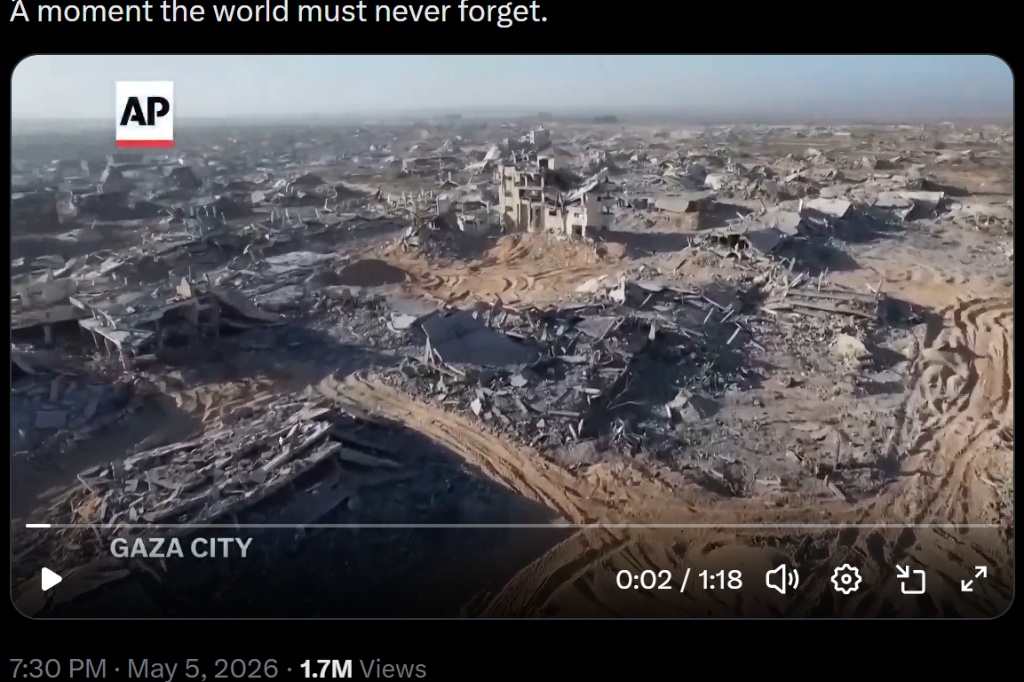
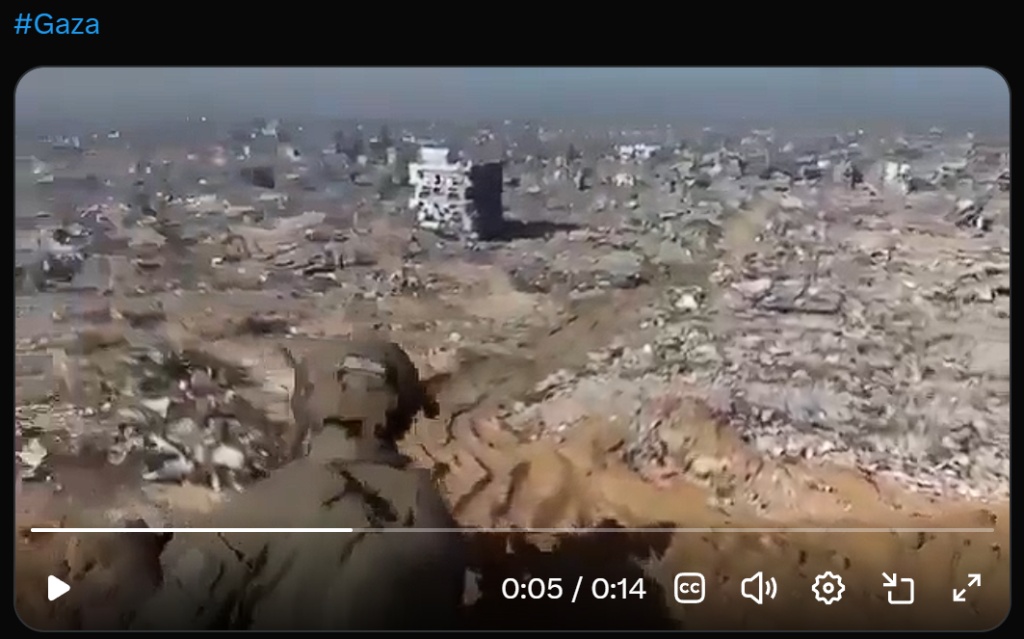
Both clips are aerial footage of Gaza City, May 2026. The AP video has 1.7 million views. The second is 14 seconds long. Neither requires narration. This is now. The God described as omnipresent was present at every frame.
LEBANON, Dahiyeh / South Lebanon · 2024–2026
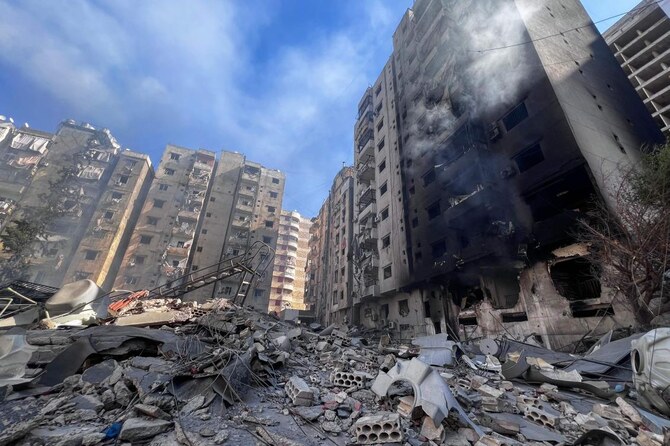
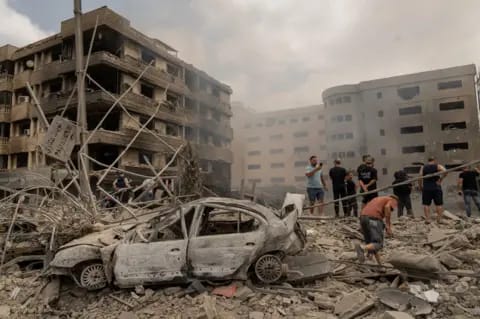
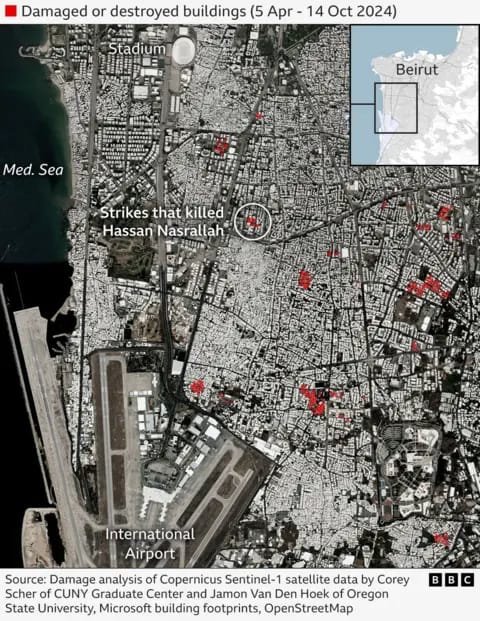
Lebanon in 2024 became what Gaza became in 2023: a laboratory for what modern air power does to dense civilian populations when it is unconstrained. The southern suburbs of Beirut, Dahiyeh, were built and rebuilt three times in the last fifty years. After 2006, the neighborhood was reconstructed block by block. By November 2024, it was rubble again. Satellite data confirmed the demolition of entire residential districts, flattened grids where buildings used to stand. The campaign did not distinguish between fighters and the families living above them. It was not designed to. By 2025, Israeli operations expanded into the Bekaa Valley. The BBC satellite team's analysis documented that the destruction in parts of southern Lebanon matched or exceeded the proportional scale of Gaza. Lebanon has 5.5 million people. It is a nation with one of the oldest continuous Christian communities on earth: Maronite Catholics whose Church predates the Crusades, Greek Orthodox parishes that were ancient when Islam was young. They too are now refugees in the rubble.
Lebanon is approximately 33% Christian, including Maronite Catholics (the largest group), Greek Orthodox, Armenian Orthodox, and Syriac communities. Many of the displaced in the 2024 campaign were Christian families from villages in southern Lebanon that have been Christian since the 4th century. The Maronite Patriarch formally condemned both the destruction of civilian infrastructure and the lack of international response. The silence from Western evangelical Christianity, which had loudly supported the Israeli military campaign, was, to Lebanese Christians, deafening.
Updated May 2026. Statistics are current as of publication. The conflicts described are ongoing. Numbers will be higher by the time you read this.
The problem is not merely that people die in war. The problem is that this is statistically predictable, industrially optimized, and annually budgeted. Anomalous cruelty and random catastrophe do not account for it. It is the structural output of human civilization operating exactly as it has for recorded history, scaled now by technology that compresses the distance between intent and execution to the length of a fiber-optic cable. The drone operator does not smell the death. The algorithm does not grieve. The invoice is paid on net-30 terms. Gaza was funded by the United States Congress, the same Congress whose sessions open with prayer. Lebanon was struck by weapons manufactured in the United States, contracted under Foreign Military Sales agreements, shipped while churches burned. Ukraine is defended partly by weapons systems whose procurement was blessed by defense contractors who sponsor Christian ministries. In either case, designed world or undesigned, we are left with an enormous inferential task.
If a good God designed this system, then the suffering of combatants and civilians alike, including the 18 people killed in the Church of Saint Porphyrius on October 19, 2023, the oldest active Christian church in the world, was anticipated, chosen, and permitted on a daily basis by an Ultra Powerful agent with full knowledge of every targeting algorithm, every misidentified vehicle, every child in the blast radius. If no God designed the system, the suffering is terrible but not a theological problem. The question is which of these two explanations better fits the data. That is an evidential question rather than an emotional one.
The philosopher Marilyn McCord Adams has argued for a "defeat" model of theodicy - that God does not prevent all horrors but works within them, defeating their negative meaning through ultimate redemption in the eschaton. This is a sophisticated and theologically mature position. It requires, however, a level of confidence about life after death, about the nature of ultimate reconciliation, and about the moral economy of the universe that the observable evidence simply does not supply. It asks us to trust a God who has, in the observable record, remained silent during the deaths of a hundred trillion conscious creatures.
V. Where the Argument Stands - and What It Demands of You
The problem of evil does not prove God's non-existence. It does not need to. What it does is establish that the prior probability of theism, given the full evidential picture of biological life, is significantly lower than it would be if suffering were distributed as a benevolent designer's product should be. That is a precise, limited claim. It is also an honest one.
The honest epistemic position here is not comfortable. The theodicies are serious. The problem is serious. Neither side can claim decisive victory. But the person who believes in a good God and looks squarely at the fossil record, at the distribution of childhood mortality, at the behavior of the parasitic world - that person is carrying a burden of explanation that cannot be discharged by sentiment, by tradition, or by the observation that the question is hard.
Hard questions demand honest answers. The argument from evil is not an attack on God. It is an argument about what the evidence says - and what it does not say. Truth is knowable. But it demands the courage to look at the evidence without flinching. We are the ones who choose whether to look.
The following sources constitute the primary intellectual foundations for reviewing and preparing for this kind of argument.
- Draper, P. (1989). "Pain and Pleasure: An Evidential Problem for Theists." Noûs 23(3), 331–350. The seminal paper establishing the evidential form of the problem. Draper introduces the Hypothesis of Indifference and argues it explains the pain/pleasure distribution better than theism. The cleanest formulation of the evidential argument. Search this source ↗
- Rowe, W.L. (1979). "The Problem of Evil and Some Varieties of Atheism." American Philosophical Quarterly 16(4), 335–341. Introduces gratuitous evil via the fawn thought experiment. Argues that the probable existence of even one genuinely gratuitous evil is sufficient to make theism improbable. Rowe later moderated his position - the evolution of his thinking is itself instructive. Search this source ↗
- O'Connor, A., & Schmid, J. (2024). "Arguments For Atheism Tier List." Within Reason. The video embedded in section II. O'Connor hosts, Joe Schmid (Majesty of Reason) is the guest, and the evolutionary animal suffering argument from roughly 6:00 to 11:00 is Schmid's, not O'Connor's. Useful for hearing the logical form conceded and the evidential form pressed by two people who both rank the problem of evil in the highest tier. Note the four counterfactual designs raised, and Schmid's three replies to the objection that the atheist must borrow an objective moral standard to run the argument at all. Watch this source ↗
- Sterba, J.P. (2019). Is a Good God Logically Possible? Palgrave Macmillan. The most serious recent attempt to revive the logical problem of evil after Plantinga was widely taken to have closed it. Sterba derives constraints on divine action from minimal principles about preventing significant and easily preventable harm. Read it against the consensus that the logical form is dead, and decide whether the consensus was too quick. Search this source ↗
- Plantinga, A. (1974). The Nature of Necessity. Oxford University Press. The definitive statement of the Free Will Defense. Required reading for anyone who wishes to understand why Mackie's logical formulation did not end the debate. The theistic counter-move that forced the evidential turn. Search this source ↗
- Mackie, J.L. (1955). "Evil and Omnipotence." Mind 64(254), 200–212. The classic logical problem of evil. Read this before reading Plantinga. The argument Mackie thought was decisive, and the response that demonstrated he had underestimated the options. Search this source ↗
- Swinburne, R. (1998). Providence and the Problem of Evil. Oxford University Press. Argues that natural evil provides the epistemic distance necessary for genuine faith. The most systematic theistic treatment of the problem. Disagree with it thoughtfully - don't dismiss it easily. Search this source ↗
- Adams, M.M. (1999). Horrendous Evils and the Goodness of God. Cornell University Press. Proposes the "defeat" model - God does not prevent all horrors but defeats their meaning through eschatological redemption. The most sophisticated contemporary theodicy. Engage it seriously. Search this source ↗
- UNICEF. (2024). The State of the World's Children. United Nations Children's Fund. Current empirical data on child mortality. The statistical dimension of suffering as a matter of public record - not as polemics, but as the datum that any theodicy must account for. Read source ↗
- SIPRI. (2024). Military Expenditure Database. Stockholm International Peace Research Institute. Documents global military spending at a record $1.8 trillion in 2023, with the U.S. at $916 billion. The industrialization of violence is not a side-effect of civilization; it is a primary budget line. Any theodicy must account for deliberate, sustained, funded evil, not merely natural evil. Read source ↗
- Bureau of Investigative Journalism. (2023). Drone Warfare Database. London. Tracks U.S. drone strikes across Pakistan, Afghanistan, Yemen, and Somalia from 2004–2023. Over 14,000 confirmed strikes. Civilian casualty estimates disputed upward by multiple independent researchers. The definitive open-source record of industrialized killing from altitude. Read source ↗
- Watling, J. & Reynolds, N. (2023). Meatgrinder: Russian Tactics in the Second Year of Invasion. RUSI Special Report. Royal United Services Institute, London. Analysis of FPV kamikaze drone deployment on the Ukraine front, approximately 10,000 drones lost per month by late 2024. Documents the cost-per-kill economics that have made drone warfare the defining military technology of the 2020s. Read source ↗
- Chafer, L.S. (1922). "The Problem of Pain and the Goodness of God." Bibliotheca Sacra 79. Chafer distinguishes the logical from the evidential problem of evil before those terms existed. Dallas Theological Seminary founder engaging the hardest objection with full philosophical rigor. From the 180-year archive curated in The Stacks → Internet Archive · Vol 79 ↗
- Hodge, C. (1866). "The Argument from Evil: A Comprehensive Reply." Bibliotheca Sacra 23. The 19th century's finest Reformed theologian provides a comprehensive treatment of natural and moral evil, engaging Hume, Mill, and Mansel with philosophical precision. See also The Stacks → HathiTrust · Vol 23 ↗
- Nash, R.H. (1988). "The Evidential Problem of Evil — A Survey." Bibliotheca Sacra 145. Dallas Theological Seminary. Nash maps Rowe vs. Mackie with clarity few achieve. Argues the evidential form fails to meet its own burden of proof. Contemporary DTS scholarship engaging the current form of the debate. Full entry in The Stacks → Internet Archive · Vol 145 ↗
Where Does This Argument Lead You?
Select the conclusion that most honestly reflects your assessment of this evidence.
The Problem of Evil is the most personally felt objection to theism, and the hardest to answer from a distance. But the evidence arc does not leave you here. The NOW side shows that the machinery of life, including suffering, required intentional architecture. And the historical record names the Architect who entered the suffering himself.