"Evolution is a fact, not a theory." You have heard this. It is said with the confidence of someone who has never been asked to defend it. It is true in the way that "the Earth orbits the Sun" is true, and false in the way that "we understand exactly how the first cell built itself" is false. The word "evolution" is doing enormous work in that sentence, and almost no one who says it has read the full title of the book it came from.
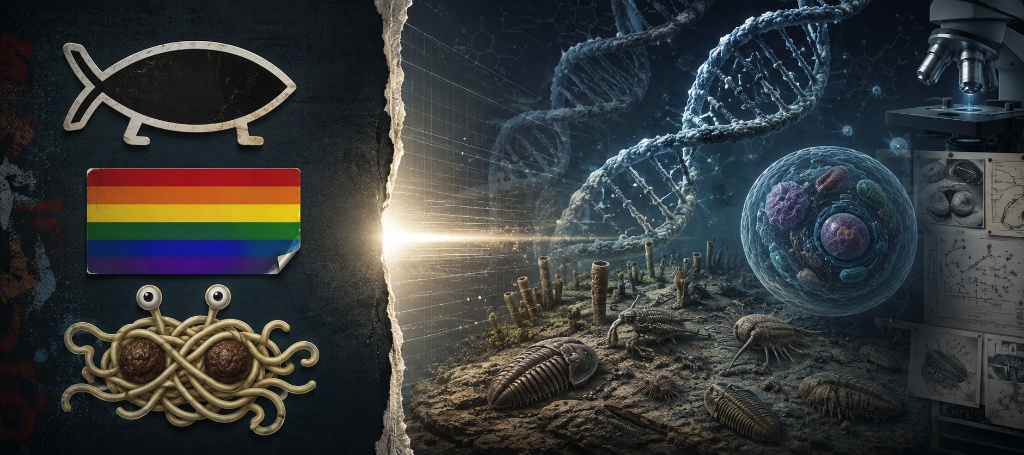
The Darwin fish (1983), the rainbow flag (a secular progressive identity marker), and the Flying Spaghetti Monster (2005) are cultural signals, not arguments. All three are designed to perform a worldview, not defend one. None engages a single empirical claim about abiogenesis, the Cambrian explosion, or the origin of biological information. This article does.
I. What Darwin Actually Wrote
The 1859 book everyone cites as the foundation of modern biology has a full title. It is almost never quoted. Read it carefully:
On the Origin of Species by Means of Natural Selection, or the Preservation of Favoured Races in the Struggle for Life
Charles Darwin, John Murray, London, 1859. First edition. The title was not changed until the sixth edition (1872), and only in some printings. Darwin never repudiated the racial hierarchy framework. His 1871 follow-up, The Descent of Man, made it explicit.Darwin's Descent of Man (1871) contains passages that would end any academic career today. Darwin ranked human "races" in an explicit hierarchy of civilizational fitness, placing "the civilised races" at the top and predicting the elimination of "lower races" through the same competitive process he described in species. He was not an outlier. He was articulating what the scientific consensus of his era believed, with the machinery of natural selection to support it.
This is not an argument against natural selection as a mechanism. It is an argument against the cultural confidence that has never been asked to account for what that confidence produced. When someone says "evolution is a fact and anyone who doubts it is ignorant," they are borrowing the authority of a body of work whose full contents they have not read and whose social legacy they have not acknowledged.
II. From Darwin to Eugenics: A Straight Line
Francis Galton was Darwin's cousin. He read The Origin and drew the obvious conclusion: if natural selection improves species, directed selection could improve humanity. He coined the word "eugenics" in 1883. Darwin corresponded with Galton approvingly. The intellectual lineage is not disputed by historians of science.
The Nazi racial hygiene program (Rassenhygiene) was not a perversion of Darwinism. It was an application of it, as understood by the scientific mainstream of the early 20th century. The scientists who designed it were published, credentialed, and operating within the consensus framework. The 1933 Law for the Prevention of Hereditarily Diseased Offspring was modeled directly on the American eugenics statutes that had been validated by the U.S. Supreme Court. American eugenicists congratulated their German counterparts in writing.
The response to this history is usually one of three moves: (1) Darwin was a man of his time; (2) eugenics was a misapplication of the science; (3) none of this affects whether evolution is true. All three moves are partially legitimate. None of them answer the deeper question: how does a body of thought that generated this much institutional confidence, and this much institutional horror, still get presented to high school students as a settled fact with no asterisks?
III. Haeckel's Embryos: One Hundred Years of Fraud
Ernst Haeckel was Darwin's most influential popularizer in Europe. In 1866 he published drawings of vertebrate embryos at comparable developmental stages to demonstrate that all vertebrates pass through a common ancestral form, "ontogeny recapitulates phylogeny." The drawings were published in textbooks. They were reproduced for over a century. They were used in biology classrooms worldwide as evidence for common descent.
In 1997, embryologist Michael Richardson and colleagues published a comparative study in Anatomy and Embryology showing that Haeckel's drawings were fabricated. The embryos did not look like Haeckel's drawings. He had altered proportions, removed features, and in some cases used the same woodcut for species that look nothing alike. Stephen Jay Gould, not an ID proponent, not a creationist, the most prominent evolutionary biologist of the late 20th century, wrote in Natural History (2000): "Haeckel had exaggerated the similarities by idealizations and omissions… but the drawings, despite their noted inaccuracies, have continued to show up in textbooks." They still do. Check yours.
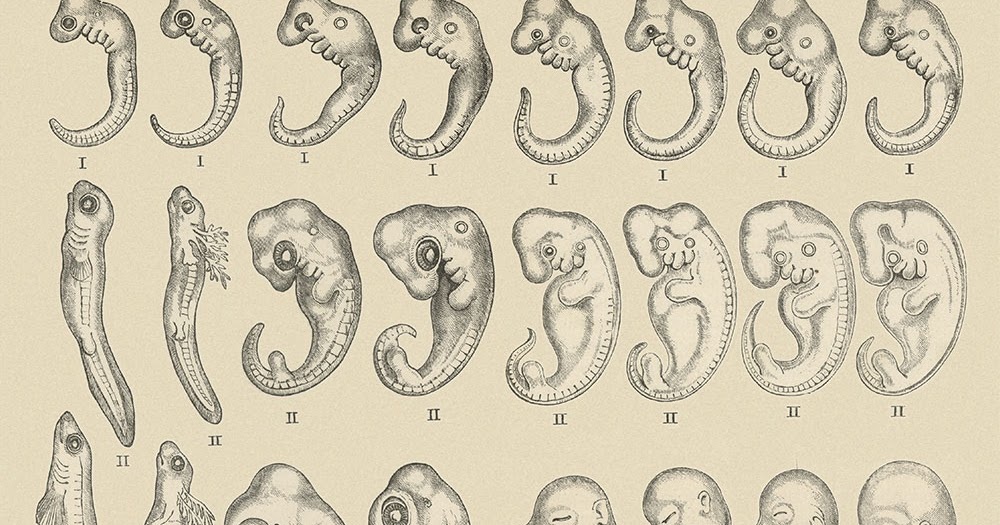
Left (aged plate): Haeckel's embryo drawings, published in Anthropogenie (1874) and reproduced in biology textbooks worldwide for over a century, showed vertebrate embryos (fish, salamander, tortoise, chicken, pig, human) appearing nearly identical at comparable early stages, purporting to demonstrate a common ancestral form. Right (modern comparison): Michael Richardson's 1997 comparative photography, published in Anatomy and Embryology, showed the same embryos at the same stages looking strikingly different. Haeckel had deleted organs, distorted proportions, and in documented cases used the same woodcut block for embryos from entirely different vertebrate classes.
He was convicted of fraud by a university court at Jena in 1875, twelve years after first publishing the drawings. They continued to appear in textbooks for 125 more years. Stephen Jay Gould, in Natural History (2000), confirmed the fraud and noted the drawings "have continued to show up in textbooks" despite being known fabrications. Gould was not a creationist. He was reporting on his own field.
Haeckel, E. (1874). Anthropogenie. Leipzig: Engelmann. · Richardson, M.K. et al. (1997). "There is no highly conserved embryonic stage in the vertebrates." Anatomy and Embryology, 196(2), 91–106. · Gould, S.J. (2000). "Abscheulich! Atrocious!" Natural History, March 2000.Haeckel was formally accused of fraud by five professors and convicted by a university court at Jena in 1875, twelve years after publishing the drawings. The drawings remained in textbooks for another 125 years. The question is not whether fraud happens in science. The question is why this particular fraud, in service of this particular conclusion, survived peer review, textbook adoption, and a century of biology education before anyone looked carefully enough to stop it.
IV. What "Fact" Actually Means: and Why the Word Is Wrong
The claim "evolution is a fact, not a theory" conflates three distinct claims that have radically different evidential bases. Separating them is not creationist obfuscation. It is basic intellectual hygiene.
Microevolution:
Populations change over generations. Allele frequencies shift.
Antibiotic resistance develops. Beaks change shape in response to
food supply. Dog breeds diverge from wolves. This is observed,
repeatable, and uncontested by anyone paying attention.
Darwin was right about this. So was everyone who came after him.
Macroevolution by unguided random mutation + selection:
That the same mechanism, scaled up over billions of years, produced
the bacterial flagellum, the vertebrate eye, the genetic code, the
spliceosome, and 200 distinct cell types from one fertilized egg
without any directing intelligence. This is an inference, not an
observation. No one has watched it happen. No one has demonstrated
the mechanism produces the required information.
Common descent:
The fossil record and molecular genetics both indicate that all
living organisms share common ancestors. The tree of life is
real. Humans and chimpanzees share ~98.8% of protein-coding DNA.
Humans and yeast share ~31% of functionally identical genes.
This is the most thoroughly confirmed large-scale claim in
biology. It is also fully compatible with design.
Origin of the mechanism itself:
Where did the genetic code come from? Who wrote the rules that
make inheritance heritable? What produced the first self-replicating
molecule? Natural selection cannot operate until self-replication
already exists. The question Darwin's theory was designed to answer (how did life arise?) is precisely the question it has never answered.
Abiogenesis remains, after 160 years, unsolved.
When someone says "evolution is a fact," they are almost always speaking from column one (observed microevolution) while implicitly defending column two (unguided macroevolution) as a complete explanation. The rhetorical move is to establish credibility with the uncontested claim and then carry that credibility into territory the data does not support. This is not dishonesty in every case. In many cases it is simply not having thought about the difference.
V. What Darwin's Own Heirs Admit
In November 2016, the Royal Society, the oldest and most prestigious scientific body in the world, convened a major meeting titled "New Trends in Evolutionary Biology: Biological, Philosophical and Social Science Perspectives." The organizers were not creationists. They were evolutionary biologists who had concluded that the neo-Darwinian synthesis (random mutation plus natural selection) was insufficient to explain the evidence.
Denis Noble, Professor Emeritus of Cardiovascular Physiology at Oxford and one of the conveners, put it bluntly in his 2017 paper "Dance to the Tune of Life":
James Shapiro, molecular biologist at the University of Chicago, published Evolution: A View from the 21st Century (2011) arguing that cells are "cognitive agents" capable of "natural genetic engineering", restructuring their own genomes in response to environmental stress in ways that are targeted, not random. Eva Jablonka and Marion Lamb's Evolution in Four Dimensions (2005) documented epigenetic, behavioral, and symbolic inheritance systems that the original neo-Darwinian model has no framework to explain.
These are mainstream evolutionary biologists, neither fringe figures nor creationists, telling each other, in peer-reviewed journals and at the Royal Society, that the textbook account is wrong. The textbooks have not been updated. The "it's a fact" rhetoric continues. The gap between what the field knows and what the public is told is a choice.
VI. The Cambrian Problem: Darwin's Own Admission
Darwin knew about the Cambrian explosion. He called it "perhaps the most obvious and gravest objection which can be urged against my theory" (Origin of Species, Chapter 9). In the Cambrian period, approximately 541 million years ago, most of the major animal body plans appear in the fossil record in what geologists call a "sudden" appearance: a window of perhaps 5–10 million years.
Darwin's prediction was that more fossil hunting would reveal the missing precursors. 160 years of the most intensive paleontological effort in history have not produced them at the body-plan level. The transitional forms that exist are transitions within lineages (fish to tetrapod, dinosaur to bird), not transitions between the fundamental body-plan categories that appear in the Cambrian. The problem Darwin admitted is still the problem. The textbooks treat it as solved. It is not.
VII. What Evolution Is and Isn't: The Honest Balance
Let the record be clear, because intellectual honesty requires it: the evidence for common descent is genuine and substantial. The fossil record, molecular genetics, comparative anatomy, and biogeography converge on a picture of shared ancestry that no serious alternative framework has dislodged. Darwin was right that organisms share common ancestors. He was right that natural selection is a real and powerful mechanism. These are not small achievements.
What Darwin did not explain, and what neo-Darwinism has not explained in 160 additional years of trying:
The origin of the genetic code. The origin of the first self-replicating molecule. The Cambrian explosion. The irreducible complexity of molecular machines. The origin of specified biological information. The mechanism by which random mutation and selection produce new body plans, new protein folds, and new functional systems; rather than merely modifying existing ones. Epigenetic inheritance. Natural genetic engineering. The 12 simultaneous, interdependent communication systems operating in every living cell.
Calling this body of unsolved problems "a fact" does not make it one. It makes you someone who has confused a confident tone of voice with a complete explanation.
VIII. The Eye That Was Never There: Visual Deception in Primate Imagery
Open any mainstream science magazine, nature documentary, or popular evolution book. Find the chimpanzee or gorilla. Look at its eyes. You will almost certainly see white sclera, the whites of the eyes, surrounding a dark iris. It looks uncannily human. It is meant to.
The biological fact: great apes have dark brown or near-black sclera. The white sclera is a uniquely human trait, one of the anatomical features that distinguishes Homo sapiens from every other primate. Researchers including H. Kobayashi and S. Kohshima (2001, Journal of Human Evolution) documented that the exposed white sclera in humans serves a specific social function: it enables others to track the direction of your gaze, a prerequisite for the kind of joint attention and cooperative communication that underlies language, culture, and theory of mind.
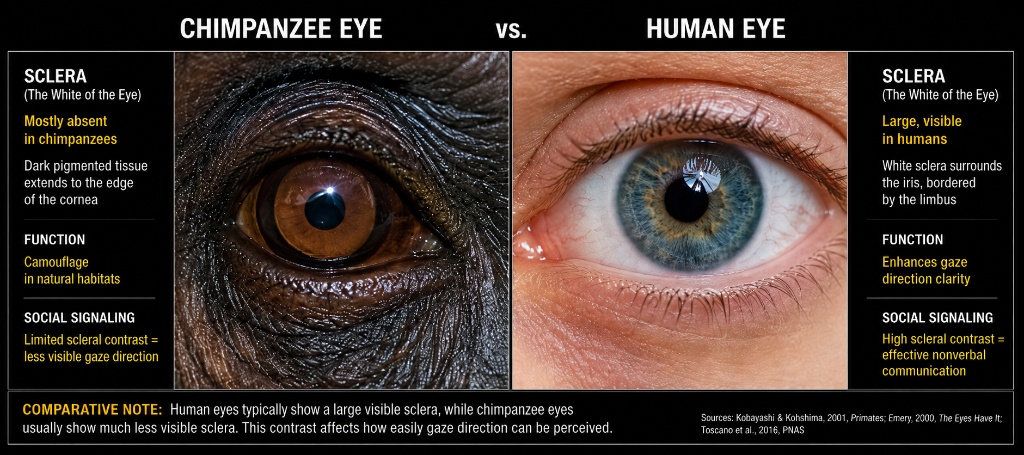
Left: what you actually see in nature: Great ape sclera is uniformly dark brown. There is no white. Gaze direction is concealed. Right: what is unique to humans: White sclera surrounding the iris is a trait found in no other great ape. It enables precise tracking of another individual's gaze direction, the biological prerequisite for joint attention, cooperative communication, and language.
Now look at the next nature documentary, museum exhibit, or popular science book cover that features a chimpanzee or gorilla. Check the eyes. In the vast majority of cases you will see white or near-white sclera, the animal made to look emotionally legible, nearly human. This is no photographic accident. A selection effect runs through every stage of the publication pipeline, including photographer, editor, art director, and publisher, producing a cumulative visual argument for cognitive continuity between humans and apes that no caption states, no peer reviewer checks, and no reader questions. The image does the arguing. The text gets the credit.
Kobayashi, H. & Kohshima, S. (2001). "Unique morphology of the human eye and its adaptive meaning." Journal of Human Evolution, 40(5), 419–435. · Ueda, S. et al. (2021). "Ocular pigmentation in humans, great apes, and gibbons is not suggestive of communicative functions." Scientific Reports, 11, 12994. · Tomasello, M. et al. (2007). "Reliance on head versus eyes in the gaze following of great apes and human infants." Journal of Human Evolution, 52(3), 314–320.This is a pattern rather than a conspiracy. Photographers choose shots. Editors choose photographs. Publishers choose covers. At every stage, the image that most powerfully communicates the intended evolutionary narrative, our kinship with the apes, our animal origins, the continuity of consciousness across species, is the image that gets selected. The result is a visual argument that runs beneath the text, never cited, never sourced, never subjected to the same scrutiny as a claim in a peer-reviewed journal. And it is far more persuasive than the text.
IX. What the Museum Does Not Show You: Fossil Reconstruction and the Gap Between Evidence and Display
The Piltdown Man hoax lasted 41 years. From 1912 to 1953, a forged fossil: a human skull paired with an orangutan jaw, both chemically stained to appear ancient, the jaw's teeth filed down to look more human, was accepted by the scientific community as a genuine hominid ancestor. It was displayed in the Natural History Museum in London. It was cited in hundreds of papers. It appeared in textbooks. When fluorine dating finally exposed it in 1953, the reaction was not a reckoning with the methodology that had failed. It was relief that the fraud had been caught, and a resumption of confidence in all the other reconstructions.
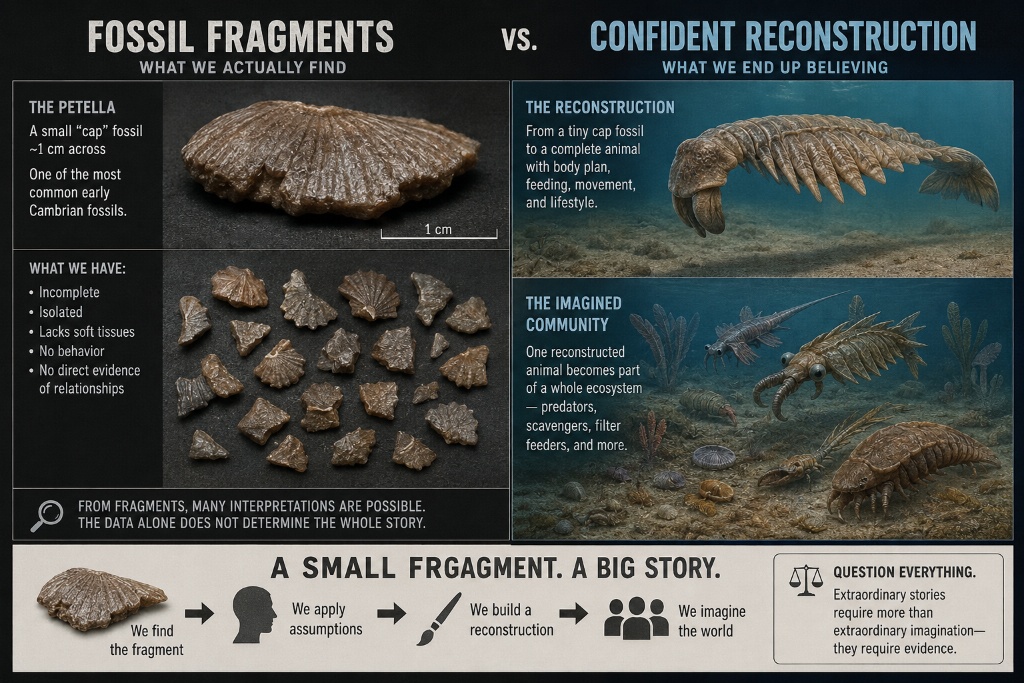
Foreground: What was actually found: fossil skull fragments, a partial jaw, small miscellaneous bone pieces, mounted under glass with scale bar. This is the complete physical evidence. Background: What the public encounters: a confident, fully rendered reconstruction portrait: skin colour, hair texture, expression, gaze, the whole biography of a face. Every element of that portrait beyond the bones themselves is informed speculation. Skin colour, hair, soft tissue, musculature, expression, none of it survives in the fossil record. None of it is labelled as reconstructed in the final display.
Nebraska Man (1917): The Illustrated London News published a full double-page spread, including body, face, posture, tools, habitat, and mate, reconstructing a new hominid species from a single tooth. In 1927 the tooth was identified as Prosthennops serus, an extinct peccary. A pig. The Scopes Trial had already cited Nebraska Man as evidence. The correction ran as a brief note in Science. The centrepiece reconstruction had run across two magazine pages. It is a documented pattern, catalogued in Roger Lewin's Bones of Contention (University of Chicago Press, 1987).
Lewin, R. (1987). Bones of Contention: Controversies in the Search for Human Origins. University of Chicago Press. · Tattersall, I. (1995). The Fossil Trail. Oxford University Press. · Gregory, W.K. (1927). "Hesperopithecus apparently not an ape nor a man." Science, 66, 579–281.The issue is not that reconstruction happens; it must, given what survives. The issue is that the final display does not show its work. The museum visitor sees a complete ancestor. They do not see the 60–80% of the skeleton that was never found. They do not see the assumptions embedded in the reconstruction. They do not see the debates among specialists about whether the fragments even belong to the same individual.
Nebraska Man (1917): an entire hominid species reconstructed, including body, face, tools, habitat, and family, from a single tooth. The tooth was later identified as belonging to an extinct peccary, a type of pig. The Illustrated London News had already run the full reconstruction. The correction ran nowhere near as large.
Piltdown Man (1912–1953): 41 years, forged. Nebraska Man (1917–1927): 10 years, a pig's tooth. Haeckel's embryos (1866–1997): 131 years, fabricated drawings. In each case: confident consensus, textbook adoption, public education; and then a correction that received a fraction of the original coverage. The question is not whether science self-corrects. It does. The question is what gets taught in the interval, and what cultural momentum it generates before anyone looks carefully.
Here is the challenge: If you believe evolution is a settled fact, read the full title of Darwin's 1859 book. Read The Descent of Man (1871). Read Stephen Jay Gould's 2000 admission about Haeckel's fraudulent embryo drawings. Read the proceedings of the 2016 Royal Society meeting on evolutionary theory. Read James Shapiro on natural genetic engineering. Read Eva Jablonka on epigenetic inheritance. Read Perry Marshall's Evolution 2.0.
Then tell us what, exactly, is the fact, and what is the confidence that outlasted the evidence.
The mechanism is not settled. The history is not clean. The textbook version is not the scientific version. And the scientists who know this are not keeping quiet about it; they are publishing at Oxford and presenting at the Royal Society. They are just not on your news feed.
The following sources constitute the primary intellectual foundations for this argument. The strongest version of the "evolution is fact" position is presented here alongside the evidence that complicates it. Read both. That is the only honest approach.
- Darwin, C. (1859). On the Origin of Species by Means of Natural Selection, or the Preservation of Favoured Races in the Struggle for Life. John Murray, London. The actual title. Free on Project Gutenberg. Darwin is a careful, honest writer who acknowledges the difficulties his theory faces, particularly the Cambrian problem, which he calls the "most obvious and gravest objection." Reading the original is more productive than reading summaries, which tend to smooth over what Darwin himself was troubled by. Read free (Gutenberg) ↗
- Darwin, C. (1871). The Descent of Man, and Selection in Relation to Sex. John Murray, London. The follow-up in which Darwin applies his theory explicitly to human races. Contains passages ranking races in a hierarchy of fitness. Not a peripheral text; it is the direct application of the Origin's framework to humanity. Rarely assigned. Freely available. Read it before forming a settled opinion about what Darwin believed and taught. Read free (Gutenberg) ↗
- Richardson, M.K. et al. (1997). "There is no highly conserved embryonic stage in the vertebrates." Anatomy and Embryology, 196(2), 91–106. The paper that formally documented Haeckel's embryo drawings as fabrications. Richardson photographed actual vertebrate embryos at the stages Haeckel depicted and showed the drawings did not match. Gould's confirmation in Natural History (2000) is the most widely accessible summary. The drawings remain in some textbooks to this day. Search this source ↗
- Kevles, D.J. (1985). In the Name of Eugenics: Genetics and the Uses of Human Heredity. Harvard University Press. The definitive scholarly history of the eugenics movement: its scientific foundations, its application in the United States (33 states, 60,000+ forced sterilizations), and its relationship to Darwinian theory. Kevles is not a creationist; he is a historian of science. His account of how eugenics was mainstream, credentialed, and explicitly Darwinian is essential reading for anyone claiming the eugenics connection was a misappropriation. View on WorldCat ↗
- Shapiro, J.A. (2011). Evolution: A View from the 21st Century. FT Press Science. University of Chicago molecular biologist arguing that cells are cognitive agents capable of natural genetic engineering, targeted, non-random genomic restructuring in response to environmental stress. This is a secular scientist saying the neo-Darwinian mechanism is insufficient, rather than a case for intelligent design. His position is representative of a growing number of evolutionary biologists who accept common descent and reject the random-mutation-plus-selection account as complete. View on WorldCat ↗
- Noble, D. (2017). Dance to the Tune of Life: Biological Relativity. Cambridge University Press. Oxford cardiovascular physiologist and Royal Society Fellow arguing that the gene-centric neo-Darwinian view is wrong at the systems level. Noble argues that the organism, not the gene, is the unit of selection, and that the modern synthesis cannot accommodate epigenetic inheritance, developmental plasticity, or the systems biology evidence. One of the clearest statements of why working scientists at the highest level no longer accept the textbook account. View on WorldCat ↗
- Meyer, S.C. (2013). Darwin's Doubt: The Explosive Origin of Animal Life and the Case for Intelligent Design. HarperOne. The most thorough treatment of the Cambrian explosion as an argument against neo-Darwinism. Meyer reviews the paleontological literature extensively and argues that the information-generation problem: producing new body plans requires new genetic information, and random mutation cannot generate specified functional information. This is unsolved. Paleontologist Charles Marshall's critical review in Science is worth reading alongside it for the best available mainstream response. Library ↗
- Jablonka, E. & Lamb, M.J. (2005). Evolution in Four Dimensions: Genetic, Epigenetic, Behavioral, and Symbolic Variation in the History of Life. MIT Press. The most rigorous academic treatment of inheritance systems beyond the genetic. Jablonka and Lamb document four distinct inheritance channels, genetic, epigenetic, behavioral, and symbolic, each of which transmits heritable information across generations by different mechanisms. The neo-Darwinian synthesis has a framework for exactly one of these. This is an MIT Press book, cited approvingly by mainstream evolutionary biologists. View on WorldCat ↗
- Pennock, R.T., ed. (2001). Intelligent Design Creationism and Its Critics: Philosophical, Theological, and Scientific Perspectives. MIT Press. ISBN 0262661241. The definitive academic anthology on the ID debate, published by MIT Press, not a religious publisher. Includes original essays by the leading ID proponents (Dembski, Behe, Meyer, Johnson, Nelson) alongside the most rigorous critical responses from Dawkins, Dennett, Kitcher, Sober, and Fitelson. Pennock's central contribution: methodological naturalism is not a philosophical prejudice arbitrarily imposed on science: it follows from science's own requirement for testability. Supernatural explanations cannot, in principle, generate testable predictions or be falsified, which is not a theological judgment but a structural one. Essential for understanding what the strongest version of the ID argument actually claims, and what the most careful critics actually show. Read on Libgen ↗
- Dembski, W.A. & Witt, J. (2010). Intelligent Design Uncensored: An Easy-to-Understand Guide to the Controversy. InterVarsity Press. ISBN 0830837426. Read this alongside Pennock. Dembski's accessible summary of the ID case: complex specified information is the reliable signature of intelligent causation; it is recognised by this method in archaeology, cryptography, forensics, and SETI; DNA contains functional, specified digital information; therefore intelligence is the most causally adequate explanation. The book is direct about what ID claims and does not claim: it explicitly states ID does not identify who the designer is, only that design is the best inference from the data. Whether or not you accept the argument, understanding it clearly is more productive than arguing against a misrepresentation of it. Read on Libgen ↗
Where Does This Argument Lead You?
Select the conclusion that most honestly fits your assessment.