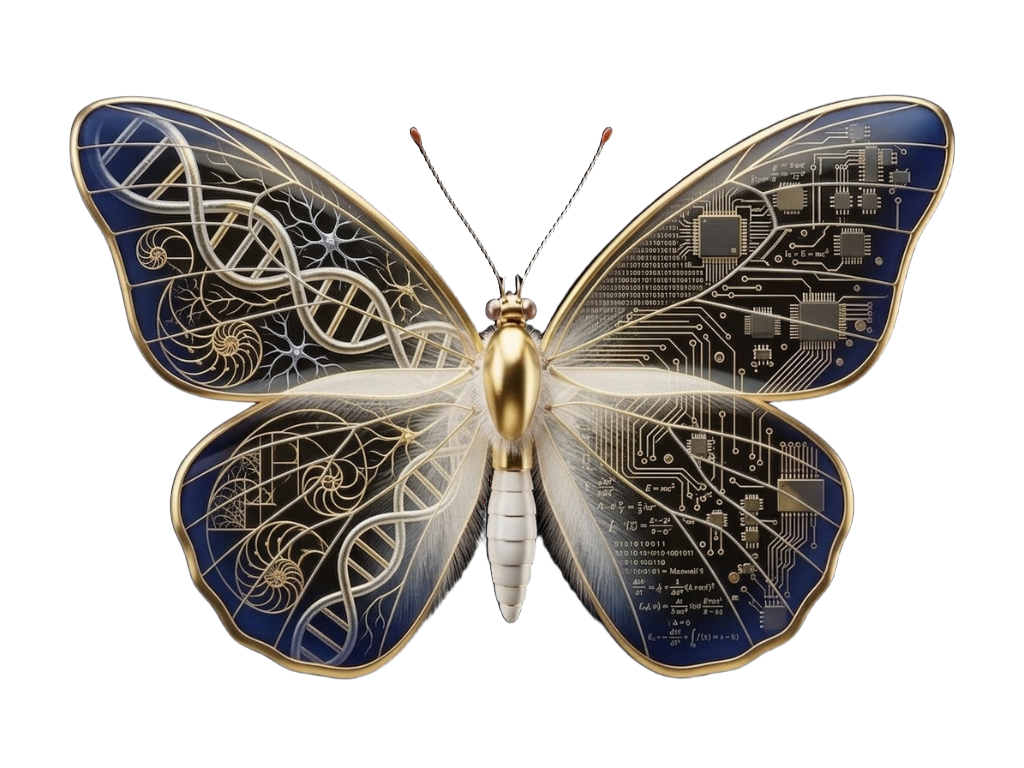
THE CODE
IN EVERYTHING

Information science, irreducible sophistication,
and a fine-tuned cosmos distilled into a simple,
visually stunning mosaic, revealing the code
written into everything.

A clear three-step advance toward truth.

Follow the Evidence
3.2B
Base pairs in
human DNA
A written code in every cell, longer than a thousand encyclopedias.
10⁻¹⁵⁰
Probability of
random protein
The odds of one useful protein forming by chance, effectively zero.
500 RPM
ATP synthase,
min. motor speed
A real motor smaller than a germ, spinning inside you right now.
10¹²⁰
Fine-tuning
precision factor
One cosmic dial set so precisely that nothing natural accounts for it.
37
Physical constants,
all precisely set
37 dials, every one tuned right, or there is no universe at all.
12
Simultaneous cell
communication systems
The first working cell already ran all twelve at once.

Three Panels · One Conclusion

Every discovery reveals the true sophistication of life: a life that runs on information.

Everything alive runs on a written code. Writing comes from a mind. So Someone wrote it. He is now here.

Step 1
Life runs on a written code.
Your body follows 3.2 billion tiny letters, spelled with just four symbols and copied with almost no mistakes. That is real information, the kind that stores instructions.
Writing only ever comes from a writer.
1 in 1,000,000,000
Copy-error rate, better than any human system
Step 2
Your cells contain real motors.
ATP synthase is a spinning rotary motor smaller than a germ, over 95% efficient, faster than a jet turbine. Take one part away and it stops. There is no simpler version that still works.
Machines that fail without every part point to a maker.
500 RPM
Idle speed of the motor inside you
Step 3
The whole universe is dialed in.
Physics has 37 settings that all have to be exactly right. Nudge one and there are no stars, no chemistry, no you. The precision runs to 1 part in a number with 120 zeros.
Settings this exact point to Someone who set them.
37
Constants, every one tuned for life

The quick read is above. Choose Deep for the full arguments, the animations, the data, and the sources.

ATG · START CODON
10⁹ BASE PAIRS / ERROR
3.2 BILLION LETTERS
4-SYMBOL ALPHABET
ARBITRARY TO CHEMISTRY
NOW · Argument I: Biological Coherence

The Code

The cell reads and writes instructions all day, like a language processing sub-station.

5'-ATG-CAA-CGT-TTA-GCT-GAA-···-3' ||| ||| ||| ||| ||| ||| ||| 3'-TAC-GTT-GCA-AAT-CGA-CTT-···-5' ↳ ATP SYNTHASE α-SUBUNIT · error rate: 1 per 10⁹ bases

Every living cell contains a four-letter digital code: adenine, thymine, guanine, cytosine, specifying protein assembly with error-correction rates that surpass every human-engineered system. One mistake per billion base pairs. No factory, no data center, no language operates at this fidelity.

The genetic code is arbitrary with respect to chemistry. The codon AUG could map to any amino acid. Instead it maps to methionine: always, everywhere, by convention. This is the signature of information, not physics. Information requires a sender.

"DNA behaves like digital information, spelling out molecular machines and control networks that chemistry alone would never choose."

Informed by Hood & Galas, Nature, 2003
3.2B
Base pairs per human cell
9.5 yrs
To read aloud, 1 per second
10⁻¹⁵⁰
Probability of random protein
12
Simultaneous comm. systems

Time does not write code. Chance does not produce arbitrary symbolic systems. The genetic code is the fingerprint of Mind in matter — present before we could read it.

Read the Full Argument: Deep Sophistication
NOW · Argument III: Irreducible Sophistication

The Motor

We built one. Biology had one first, and it's better in every measurable way.

"

If anyone found a motor in biology, a true rotary motor, that would be genuinely difficult for a Darwinian to explain.

Richard Dawkins, in discussions on irreducible complexity, The Blind Watchmaker era & interviews
FOUND.

ATP synthase. A true rotary motor. 10 nanometers wide. 9,000 RPM. 95%+ efficiency. In every living cell on Earth. Before the first human ever turned a wheel.

HUMAN ENGINEERING Internal Combustion Engine c. 1876 — Nikolaus Otto MADE BY HAND
~40%Peak efficiency
100mm+Scale
200+Moving parts
Fossil fuelEnergy source
VS
BIOLOGICAL NANOTECHNOLOGY ATP Synthase c. 3.5 Billion Years Ago — Unknown FOUND BY MAN
>95%Mechanical efficiency
10nmScale
31+Precisely-fitted parts
Proton gradientEnergy source

Side-by-Side Comparison

Feature Combustion Engine ATP Synthase Verdict
Rotary mechanism Crankshaft converts linear → rotary c-ring directly rotates (true rotary) Both rotary
Stator / rotor architecture Fixed block + rotating crankshaft Fixed αβ-F₁ head + rotating γ-shaft & c-ring Same principle
Energy transduction Chemical → mechanical (combustion) Electrochemical gradient → mechanical → chemical (ATP) Both transduce energy
Directional control Transmission reverses direction Reverses in ¼ turn, no gearbox needed Both reversible
Modular sub-assemblies Pistons, valves, crank, cam, fuel system F₀ (membrane) + F₁ (catalytic): two distinct domains Both modular
Mechanical efficiency 25–40% (heat loss) >95%, near thermodynamic limit Biology wins
Scale ~100–500 mm across 10 nanometers (10 million times smaller) Biology wins
Self-assembly Requires factory, tooling, human labor Assembles spontaneously from genetic instructions Biology wins
Self-replication Cannot reproduce itself Encoded in DNA, reproduced every cell division Biology wins
Waste product CO₂, NOₓ, heat, noise Water — also generated by the system Biology wins
Output quantity Varies — depends on fuel supply ~40 kg ATP / person / day from 100,000 motors / cell Biology wins
Distance traveled / year
(rotating tip)
~1,235,000 km
2,500 RPM avg · 300mm rim
~8.9 km
9,000 RPM · 10nm rotor
Same physics, vastly different scale
Reverse direction Requires full transmission system Reverses in ¼ turn; single protein subunit (IF1) acts as switch Biology wins
Origin explanation Designed by engineers with intent Claimed: random mutation + selection The open question
Irreducibility Partial engines exist — can simplify Remove any one of 31 parts — it stops completely Darwin requires intermediates
Bootstrap problem Parts sourced externally — no self-dependency Requires ~300–700 ATP to build — but IS the source of ATP Where did the first ATP come from?

When Otto built the first combustion engine in 1876, it was recognized immediately as the product of an intelligent mind. It has a rotor. It has a stator. It has modular sub-assemblies and directional control. Nobody asked: "Could this have self-assembled?"

ATP synthase has every one of those features, and exceeds the combustion engine in every performance metric by orders of magnitude. It has been running in every living cell for what evolutionary biology dates to 3.5 billion years. It is 10 million times smaller. It operates at over 95% efficiency. It self-assembles from genetic instructions. It self-replicates.

The question is not whether ATP synthase looks designed. It does. Undeniably. The question is whether the prior commitment to naturalism is strong enough to override the inference that any honest engineer would draw from the evidence.

And then there is the question that stops the room: how many ATP does it take to build one ATP synthase motor? Roughly 300 to 700 — to power the ribosomes, fold the proteins, and insert the subunits. ATP synthase is the primary source of ATP in the cell. The first motor had to be built before the motor existed to power its construction. That is a structural feature of the system, built into how the parts depend on each other.

"An honest man, armed with all the knowledge available to us now, could only state that in some sense, the origin of life appears at the moment to be almost a miracle, so many are the conditions which would have had to have been satisfied to get it going."

Francis Crick, co-discoverer of DNA structure, Life Itself (1981)

"The more I study science the more I believe in God."

Albert Einstein

"I now believe that the universe was brought into existence by an infinite Intelligence. I believe that this universe's intricate laws manifest what scientists have called the Mind of God… The only satisfactory explanation for the origin of such 'end-directed, self-replicating' life as we see on earth is an infinitely intelligent Mind."

Antony Flew, lifelong atheist philosopher, changed his position after studying DNA's motor systems. There Is a God (2007)

Flew spent 50 years as the world's most prominent academic atheist. He debated C.S. Lewis. He wrote the atheist manifesto Theology and Falsification. Then he saw the motor. DNA's information density. ATP synthase's irreducible architecture. He changed his position, not from faith, but from the evidence.

He didn't find God in a church. He found the motor in the cell.

Read the Full Argument: ATP Synthase & Irreducible Complexity →

On Discovery

"Every experiment assumes a logic that no experiment can prove. Philosophy is not an obstacle to science. Philosophy is the condition under which science knows what it is doing."

— On the entanglement of discovery and first principles

Ω = 1.00002 ± 0.00002
Λ / 10¹²⁰ FINE-TUNED
α = 1/137.036
37 CONSTANTS · ALL PRECISE
CHANGE ANY ONE. NO STARS.
NOW · Argument II: The Fine-Tuned Universe

The Universe

37 constants. All precisely set. All required for any complexity to exist.

The cosmological constant, the energy density of empty space, is fine-tuned to one part in 10¹²⁰. If it were slightly larger, the universe would have expanded too fast for gravity to form stars. Slightly smaller, it would have collapsed before a single star ignited.

The count is 37, not one. The ratio of electromagnetic to gravitational force. The mass difference between proton and neutron. The strength of the strong nuclear force. Every one is set within a narrow band that permits chemistry, which permits life, which permits you to be reading this.

The multiverse works as an assumption used to dilute probability, and it requires an explanation of its own.

Fine-tuning moves the problem back one step; the multiverse generator itself requires fine-tuning.

A common-sense interpretation of the facts suggests that a superintellect has monkeyed with physics, as well as chemistry and biology, and that there are no blind forces worth speaking of in nature.

Sir Fred Hoyle, astrophysicist and self-described atheist
37
Physical constants, all required
10¹²⁰
Cosmological fine-tuning
1/137
Fine structure constant α
13.8B
Years to produce you

Chance names our ignorance of causes rather than any cause of its own. 37 precisely-set constants describe specification, and specification requires a specifier.

Read the Full Argument: Fine-Tuned Universe

The butterfly dies and is rebuilt, far more than it simply transforms.

Inside the chrysalis the caterpillar digests itself completely, its whole body reduced to a cellular soup. What survives are the imaginal discs, clusters of cells that already carry the full plan for the adult. From that soup, guided by code written in advance, a butterfly assembles.

The glory was latent in the caterpillar, encoded before the dissolution began. Information that precedes structure. Design that precedes assembly.

We Are the Caterpillars →
The Deepest Question, After Leibniz, 1714

"Why is there something rather than nothing? Ask it as a demand, not a slogan. Every atom in the observable universe, every law of physics that governs it, every mind capable of noticing it: all of it contingent, none of it self-explaining, none of it required to be here. Yet here it is."

After Leibniz, Principles of Nature and Grace, 1714. The question has not been answered. It has only been deferred.

Exhibit A · The Constants

"Change the strong nuclear force by 2% and hydrogen never forms: no stars, no chemistry, no you. The cosmological constant is tuned to 1 part in 10¹²⁰, a precision beyond the atom-count of the observable universe. These are measured values, and they read as a universe configured for life to a tolerance nothing natural accounts for."

Fine-tuning data: Rees, M. Just Six Numbers, 1999; Penrose, R. The Road to Reality, 2004 · Configuration requires a configurator, or an explanation of why it does not.

"You are a temporary arrangement of atoms asking whether arrangements of atoms can have meaning. If materialism is true, the question is an electrochemical event, no more significant than a spark. If it is not true, the question is the most important thing happening in this universe right now. The fact that you cannot stop asking it is itself evidence. Rocks do not wonder. You do."

GODISNOWHERE · Truth Is Known

Three arguments. One conclusion.

The fingerprint
has a name.

The evidence opens the only question that matters: where do you belong in Him?

Enter the Evidence → Read the Objections The Historical Case