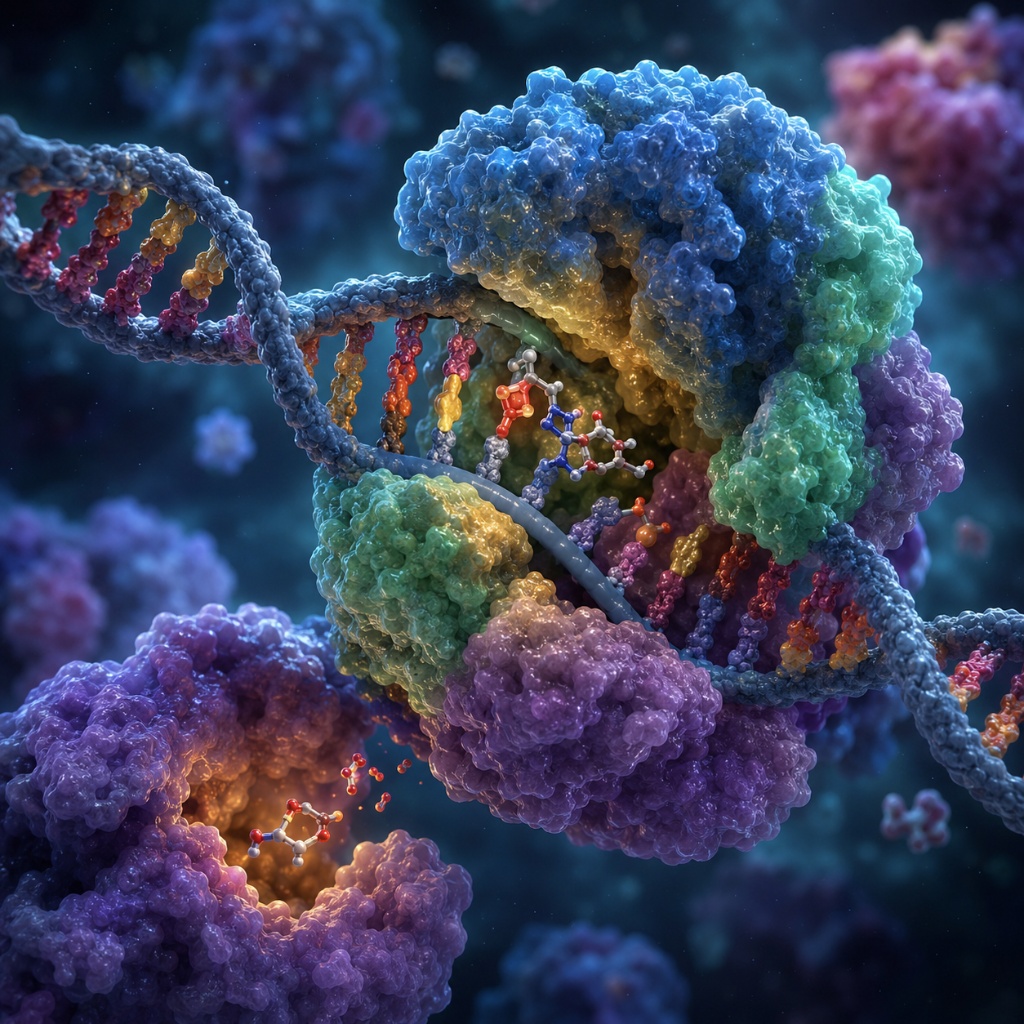
A Digital Code in Molecular Biology
Before Crick and Watson, biology had no vocabulary for information. After 1953, it did. The DNA double helix turned out to be not merely a stable molecule but a linear digital code: four symbols in a quaternary alphabet, read three at a time, producing instructions for a polymer of twenty types of monomer. The architecture is mathematical before it is chemical.
In 1961, Crick's team demonstrated that the code is a triplet code: every three bases specifies one amino acid. With 4³ = 64 possible triplets and only 20 amino acids to encode (plus 3 stop signals), the code is redundant (multiple codons per amino acid) but not ambiguous (one codon never specifies two different amino acids). This redundancy is not random. Synonymous codons are clustered, so a single-base change in the third position of a codon (a wobble mutation) usually still encodes the same amino acid. The code does not merely work; it is optimized against error.
"The genetic code is so efficient at minimizing error consequences that the odds of finding a random code equally good is less than 1 in a million." — Freeland & Hurst, 1998
The code's universality is equally astonishing. From E. coli to sequoia trees to human neurons — the same 64-codon table, with only three known minor variant codes in mitochondria and a handful of microorganisms. Every living thing uses the same language. This is not because alternatives are chemically impossible. Synthetic biology has demonstrated alternative codes. The universal code exists because something set it first, and everything descended from it.
Bases: adenine, thymine, guanine, cytosine. A binary code (2 bases) would require longer words. 5+ bases would be chemically less stable. 4 is optimal.
Triplet codons: 4³ = 64 possible words. Minimum needed to encode 20 amino acids. Doublet code (4² = 16) is insufficient; triplet is the minimum sufficient word length.
The 20 standard amino acids cover the key chemical space: charged, polar, hydrophobic, aromatic, flexible. Removing any one eliminates protein classes; adding more requires new biosynthesis machinery.
The genetic code has been essentially unchanged since the last universal common ancestor (LUCA), approximately 3.8 billion years ago. Not one of the 64 assignments has changed in the standard code.
The Code's Parameter Windows
The genetic code has specific parameter windows that determine whether it functions at all. Move the sliders to explore what happens when the code's characteristics deviate from the observed biological values.
Score
An Optimized Code
The genetic code is not merely functional. It is optimized. Freeland and Hurst (1998) ran a computer analysis of one million random genetic codes and found that the actual code is in the top 0.0001% for minimizing the amino acid changes caused by single-base mutations. The code does more than work; it works better than almost any alternative arrangement of the same 64 codons.
Three independent facts converge here: the code is universal (set once, propagated to all life), the code is error-minimizing (selected or specified for robustness), and the code is minimally sufficient (triplet word length at 4-base alphabet is the logical minimum for the task it performs). No known chemical law requires any of these properties. They are the properties of a designed symbol system.