There is a place in Jerusalem where more of the story of God converges than anywhere else on Earth. It centers on Mount Moriah. On its ridgeline stood Solomon’s Temple. In the land of Moriah, a father named Abraham once raised a knife over his only son. And on a skull-shaped outcrop just outside the same city, a Roman execution squad crucified a carpenter from Nazareth. These are three related events that happen to share the same mountain. One pattern, told three times, until the Messiah is revealed.
I. What a “Type” Is, and Why It Is Evidence
In biblical interpretation a type is an earlier event, person, or object that foreshadows a later one, deliberately, by the same Author who arranged both. A type is a structural match, far more than a loose resemblance: the same shape of story repeating across centuries, in a text where the earlier telling was fixed in writing long before the later fulfillment occurred. That last point is what turns typology from a devotional reading into an evidential one. Anyone can find a pattern after the fact. The question is whether the pattern was recorded in advance. Typology is strongest when it is cumulative: repeated motif, fixed earlier text, later fulfillment, and theological location all converging on the same point.
The account of Abraham offering Isaac on Mount Moriah is in Genesis 22, a text whose composition predates the crucifixion by well over a thousand years. Even on the most skeptical late-dating of the Pentateuch, Genesis was fixed centuries before Jesus of Nazareth was born. Whatever else one concludes, the parallels below cannot be a case of Christians writing the Gospel back into Genesis. Genesis was already there, already fixed, already read aloud in synagogues, long before there was a Gospel to retroject.
II. The Moriah Thread: The Parallels Laid Side by Side
Read Genesis 22 and the Passion accounts next to each other and the pattern assembles itself. The graphic below places the two side by side. The center column names the motif that links them.
Beloved Son
Wood Uphill
Submission
& the Thorns
Received Back
Will Provide
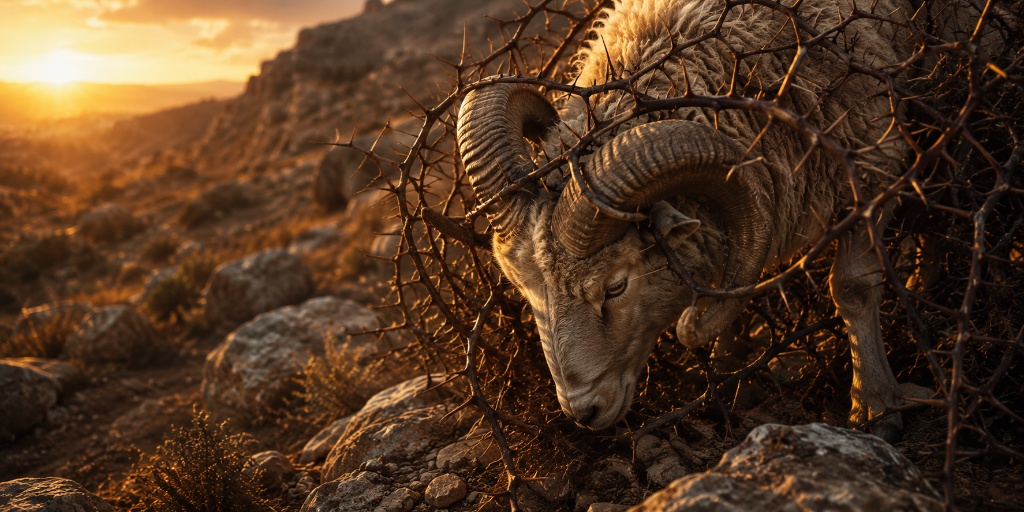 Hover to reveal
Take the parallels one at a time and each is striking. Take them together, in order, on the same Moriah-associated sacred geography, recorded in a text fixed centuries before the fulfillment, and the cumulative force is what the documentary this article draws on calls simply “a mountain of evidence.” No single parallel is a proof. The pattern is the argument.
III. The Location Is Divine
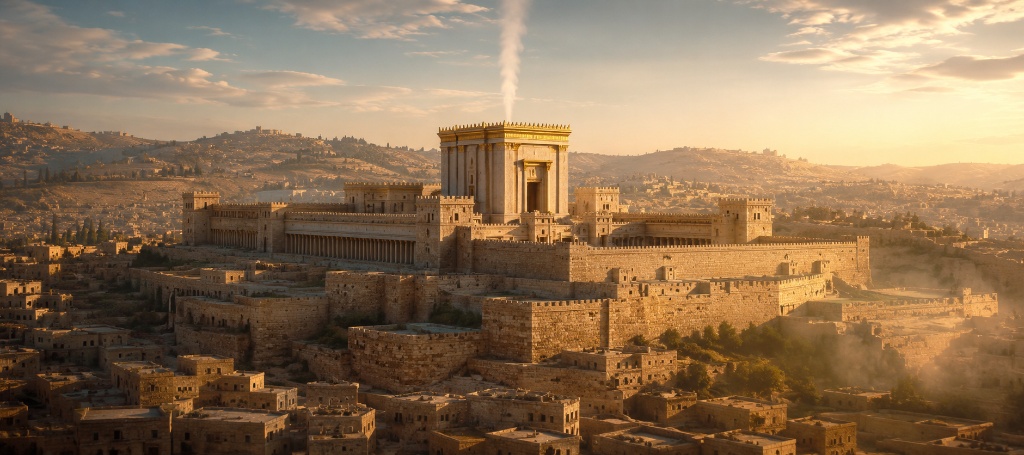
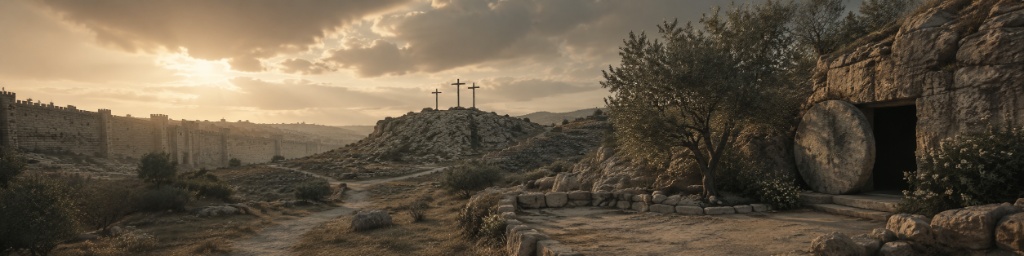
The geography does real work here, though it should never be overstated. Genesis 22 sends Abraham to “the land of Moriah,” to a mountain God would show him. 2 Chronicles 3:1 later identifies Mount Moriah as the place where Solomon built the Temple, the center of Israel’s sacrificial system. The Gospels then locate the crucifixion at Golgotha, outside the city wall, near a garden and a rock-hewn tomb.
The argument does not require that Abraham stood on the precise square footage later occupied by the cross. The stronger claim is more careful: Moriah, Temple, sacrifice, substitution, Jerusalem, outside-the-gate death, and the Lord’s own provision converge in one sacred geography. The pattern is geographic enough to matter without pretending we possess a surveyor’s pin for every event.
IV. The Geography Confirms It
A careful reader will press on the geography, and should. The argument does not require that Abraham stood on the precise square footage later occupied by the cross, and it is stronger for not claiming it. What Scripture actually gives us is the convergence: Genesis 22 ties Moriah to sacrifice, substitution, and provision; 2 Chronicles 3:1 fixes the Temple, the sacrificial system of Israel for a thousand years, on Mount Moriah in Jerusalem; and the Gospels locate the crucifixion at Golgotha, outside the city wall, beside a garden with a rock-hewn tomb. The pattern is geographic enough to matter without pretending we possess a surveyor’s pin for every event. Moriah is the sacrificial mountain. The Temple is the sacrificial system. Golgotha is the final sacrifice outside the gate. The point is authorial convergence.
The traditional site is also archaeologically plausible in exactly the ways the Gospel account predicts. The Church of the Holy Sepulchre, long identified with Golgotha, lay beyond the earlier city wall and shows a history of quarry and burial use, consistent with a first-century place of execution and rock-cut tombs. Recent excavation beneath the church has reported traces of olive and grape cultivation, compatible with the garden setting that John 19 describes near the place of crucifixion. This does not prove the exact tomb of Jesus, and it should not be sold as if it did. It shows something more modest and more durable: the place the tradition points to is the kind of place the text leads us to expect, outside the wall, near a quarry and burials, and compatible with a garden.
V. Confirmed by Sources Outside the Faith
The typology matters only if the person at the center of it was real, and here even hostile and secular sources cooperate. That a man named Jesus lived, gathered followers, and was executed by crucifixion under Pontius Pilate during the reign of Tiberius is affirmed by non-Christian witnesses: the Roman historian Tacitus, the Jewish historian Josephus, and standard secular reference works such as the Encyclopaedia Britannica. The prophecies that describe His death in detail, Psalm 22 with its pierced hands and feet and divided garments, Isaiah 53 with its pierced and stricken Suffering Servant, are contained in manuscripts that predate the events by centuries, a point conceded even by secular historians of the text. The framework of the argument does not require the reader to first believe the Bible. It requires only that the reader grant that the earlier texts are genuinely earlier.
VI. The Two Sources This Article Draws On
Bob Enyart’s contribution was synthesis rather than any new archaeological site. He took the biblical typology of Genesis 22, the Temple location of 2 Chronicles 3:1, the Gospel geography of Golgotha and the tomb, and the external historical evidence for Jesus’ execution, and presented them as one cumulative resurrection argument. That was Enyart at his best: the plot of Scripture tightening across centuries until the fulfillment becomes difficult to dismiss.
This article follows two presentations of that case. The primary source is Enyart’s full apologetics video; the second is a short, focused presentation of the same typology. Both are provided below.
VII. Supplement: The Tetramorph
There is a second pattern worth naming, one that a traveler to the Holy Land encounters everywhere: the tetramorph. From the earliest centuries of the church, the four Gospel writers have been represented by four living creatures, drawn from the visions of Ezekiel 1 and Revelation 4: a man, a lion, an ox, and an eagle. The four faces recur in mosaics, manuscripts, church ceilings, and stonework across Jerusalem and the wider Christian world.
The assignment has not always been identical. The familiar medieval convention usually gives Matthew the Man, Mark the Lion, Luke the Ox, and John the Eagle. That reading is understandable: Matthew opens with Christ’s human genealogy; Mark begins with the wilderness voice; Luke opens in the Temple with priestly service; John soars into the eternal Word. Augustine preferred a different assignment altogether, giving Matthew the Lion, Mark the Man, Luke the Ox, and John the Eagle. He explicitly judged that application more reasonable than the rival mappings, because Matthew presents the King, Luke the priestly-sacrificial emphasis, and John the highest contemplation of Christ’s divinity.
GODISNOWHERE follows a third, typological reading because it best fits the fourfold presentation of the one Christ: King, Servant, Man, God. Hover over each of the four creatures below (tap on a touch screen) to see the Gospel it carries and why.
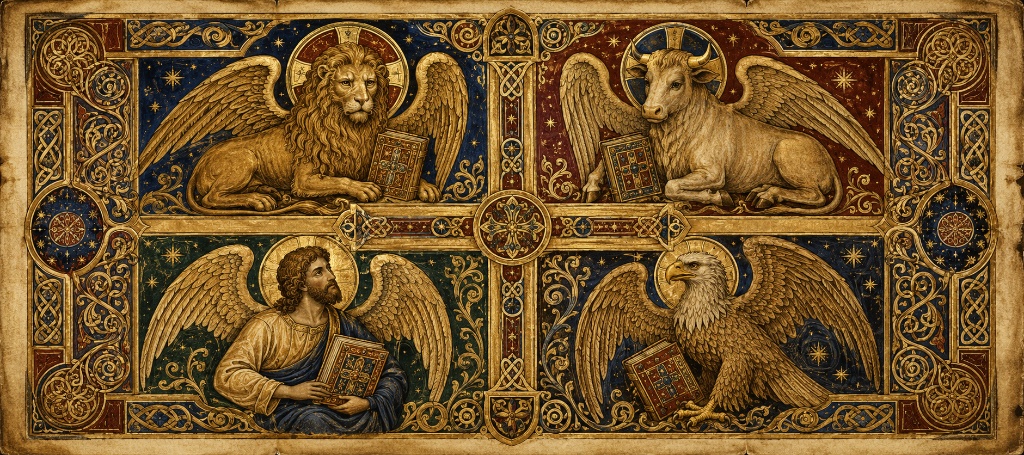 Hover or tap each creature
Lion
Ox
Man
Eagle
Hover or tap each creature
Lion
Ox
Man
Eagle
Mark has no genealogy because Mark is the Gospel of the Servant. The ox is there to bear the burden, never to reign, trace descent, or soar.
This does not erase the older iconographic tradition. It explains why this article uses the tetramorph the way it does. The question is what each Gospel emphasizes about the one Christ: King, Servant, Man, God.
In 2011 I traveled to Israel with RSR, Bob Enyart’s Real Science Radio. We walked the land, and one thing I have never forgotten is how often the four faces appeared. The man, the lion, the ox, and the eagle were worked into churches, mosaics, ceilings, and stone. Once you learn to recognize them, you cannot stop seeing them.
That trip is part of why the Mount Moriah case means what it does to me. I did not merely read about that mountain. I stood on that ground.
Daniel K. Hedrick, GODISNOWHEREVII. What This Does, and Does Not, Prove
The Mount Moriah typology does not, by itself, prove the Resurrection. It does something subtler and cumulative: it raises the cost of disbelief. A skeptic must explain why an earlier text, fixed long before Christ, contains a father, a beloved son, wood carried uphill, willing submission, a substitute in thorns, third-day reception from death, and a future-tense promise that the Lord would provide, all converging later in the sacrificial geography of Jerusalem.
No single parallel carries the whole case. The pattern carries it. And the question left on the table is what kind of Author writes the ending into the beginning.
This is the third article in the Resurrection track. The first made the historical case. The second answered the strongest secular objections. This one steps back and looks at the shape of the thing: a pattern too precise, too early, and too located to be an accident. God will provide the Lamb. On the mount of the Lord, it was provided.
Sources and further study for the Mount Moriah typology and the historical case for the Resurrection.
- Mount Moriah: Compelling Evidence Jesus Rose from the Dead. Bob Enyart / BEL / KGOV · original apologetics video, later republished online by Enyart Theology · approx. 1h 27m. The primary source for this article. Enyart presents the Genesis 22 typology, the geography of Mount Moriah, Golgotha, and the tomb, the pre-dated prophetic texts, and the historical confirmation of Jesus’ execution as one cumulative resurrection argument. Watch on YouTube ↗
- Bergman, D. (2026). Only GOD Could Have Done THIS: The 2,000 Year Old Prophecy. A short-form presentation of the same Mount Moriah typology. Companion to the documentary above. Watch on YouTube ↗
- Genesis 22; 2 Chronicles 3:1; Psalm 22; Isaiah 53; Hebrews 11:17–19. The primary biblical texts. Genesis 22 and 2 Chronicles 3:1 anchor the location; Psalm 22 and Isaiah 53 supply the pre-dated prophetic detail; Hebrews 11 names the three-days-as-dead-and-received-back reading explicitly. Read Genesis 22 ↗
- Wright, N.T. (2003). The Resurrection of the Son of God. Fortress Press. The definitive historical case for the bodily resurrection; essential background for the evidential weight the typology is meant to add to. Library ↗