Everything else on this site is probabilistic. The arguments from fine-tuning, biological information, the problem of evil, they shift probabilities. They make theism more or less likely. They are important. But the Resurrection claim is different in kind. It is a specific historical claim about a specific person at a specific time and place. If it is true, the probability of God's existence is not shifted, it is established. And if it is false, the largest religion in human history was built on a documented and testable lie. Either way, this is the most consequential historical question ever asked.
I. Why History? Why Not Just Faith?
Paul of Tarsus, writing approximately twenty years after the crucifixion in his first letter to the Corinthian church, made a claim that no apologist since has made more starkly: "If Christ has not been raised, your faith is futile and you are still in your sins... we are of all people most to be pitied." (1 Corinthians 15:17–19)
This is not mysticism. This is a refutability claim. Paul is saying: if the resurrection did not happen as a matter of historical fact, Christianity is not merely incomplete, it is false and its adherents are fools. He is explicitly staking the entire enterprise on a verifiable event. That is either the most intellectually honest statement in the history of religion, or the most reckless. It is not an invitation to faith despite the evidence. It is an invitation to examine the evidence.
This is why the Resurrection belongs here. It is not on the NOW HERE side because it fits the philosophical pattern of design arguments. It is here because it is a different kind of claim entirely, a historical claim that, if true, settles the question from a different direction. You cannot get to the Resurrection by reason alone. But you can get to its probability by historical method.
II. The Twelve Minimal Facts
Gary Habermas, a historian and philosopher at Liberty University, has spent forty years compiling what he calls the "minimal facts" of the Resurrection, historical data points accepted by the overwhelming majority of historians, including skeptical historians and non-Christian scholars, based purely on the strength of the historical evidence rather than theological commitment.
- Jesus died by Roman crucifixion under Pontius Pilate, confirmed by Josephus, Tacitus, Lucian of Samosata, and the mocking passage in the Talmud.
- He was buried. The existence of a known tomb is supported by the unanimity of early sources and the fact that Jewish enemies of the movement never disputed the tomb's location.
- The tomb was found empty on the third day, attested in all four gospel accounts, the earliest of which dates to within decades of the event.
- The disciples sincerely believed they had seen Jesus alive after death. Paul confirms this, listing named witnesses, within 3 to 8 years of the crucifixion.
- Paul himself, a persecutor of the church, underwent a sudden and total transformation, attributing it to a personal appearance of the risen Jesus.
- James, the brother of Jesus, a known skeptic during Jesus's ministry, became a leader of the Jerusalem church after the crucifixion.
- The disciples were willing to die for their testimony, not merely for a belief, but for their claim to have personally seen the resurrected Jesus.
- The movement began in Jerusalem, the precise location where it was most easily falsifiable, within the lifetime of the witnesses and enemies of Jesus.
- The early proclamation centered on bodily resurrection, not spiritual survival or vision, but a physical, touchable, eating-and-drinking body.
- The conversion of the 500: Paul claims over five hundred people saw the risen Jesus simultaneously, most of whom were still alive when he wrote. It is an implicit invitation to check.
- The change in the day of worship — from the Jewish Sabbath (Saturday) to Sunday, the "first day of the week," specifically commemorating resurrection day. A theologically enormous shift for Jewish Christians, requiring an enormous cause.
- The creed in 1 Corinthians 15:3–8 — almost universally accepted by New Testament scholars as pre-Pauline, dating to within 3–5 years of the crucifixion. It is the earliest direct testimony we possess.
III. The Naturalistic Alternatives — and Why They Fail
The historian's task is to propose the hypothesis that best explains all the available data. The minimal facts enumerated above are the data. Every explanation of the Resurrection must account for all of them. The naturalistic alternatives have been proposed, refined, and debated for two centuries. None has gained traction among historians, whether or not those historians accept the Resurrection.
The Swoon Theory: Jesus did not actually die but was revived in the tomb. This requires that a man who had been beaten, flogged, crucified, stabbed in the side (John 19:34), and wrapped in burial cloths survived, pushed aside a sealed stone in a guarded tomb, and then convinced his followers he had conquered death — thereby inspiring them to die for that claim. David Strauss, the 19th-century rationalist critic of Christianity, demolished this theory on its own merits: a half-dead Jesus would not have produced the Resurrection faith.
The Hallucination Theory: The disciples experienced collective psychological projections of a dead teacher they loved. This requires that over five hundred people had the same hallucination simultaneously — an event with no known psychological parallel. It also does not explain the empty tomb. Hallucinations do not empty tombs; they presuppose the body is there.
The Legend Theory: The Resurrection was a gradually developed legend that grew up after the original eyewitnesses died. This fails on chronology. The 1 Corinthians 15 creed dates to within 3–8 years of the crucifixion — Paul received it from Peter and James (Galatians 1:18), themselves primary witnesses. The legend hypothesis requires decades for development. The evidence allows months.
The Conspiracy Theory: The disciples stole the body and fabricated the story. This requires that a group of frightened, demoralized followers of an executed criminal — hiding behind locked doors (John 20:19) — coordinated a successful deception, maintained it under persecution and torture, and every single one of them died without recanting. People die for what they believe. People do not die for what they know to be false.
Mt. Moriah, Jerusalem
The tomb is a specific physical location, not a metaphor. The Garden Tomb — situated near the hill of Mt. Moriah, outside the Damascus Gate in Jerusalem — is one of the primary candidate sites for the burial and resurrection of Jesus of Nazareth, identified in 1867 by General Charles Gordon as consistent with the Gospel description of a garden tomb near a place of public execution.
Pastor Bob Enyart of Denver Bible Church produced an on-location documentary examination of the Mt. Moriah site, presenting the geographical, archaeological, and scriptural case for the site's historical significance. The documentary engages the physical evidence on its own terms — not as a faith claim, but as a historical and topographical question demanding the same rigor applied to any other ancient site.
"I stood at the entrance of that tomb in awe of the possibility that the Lord had risen from this very place but in another very special moment that is not now, but very very near. I was moved with great emotion and Pastor Enyart encouraged me to pray over those that joined us at the Garden Tomb."
— Daniel K. Hedrick
Daniel's account — About page ↗
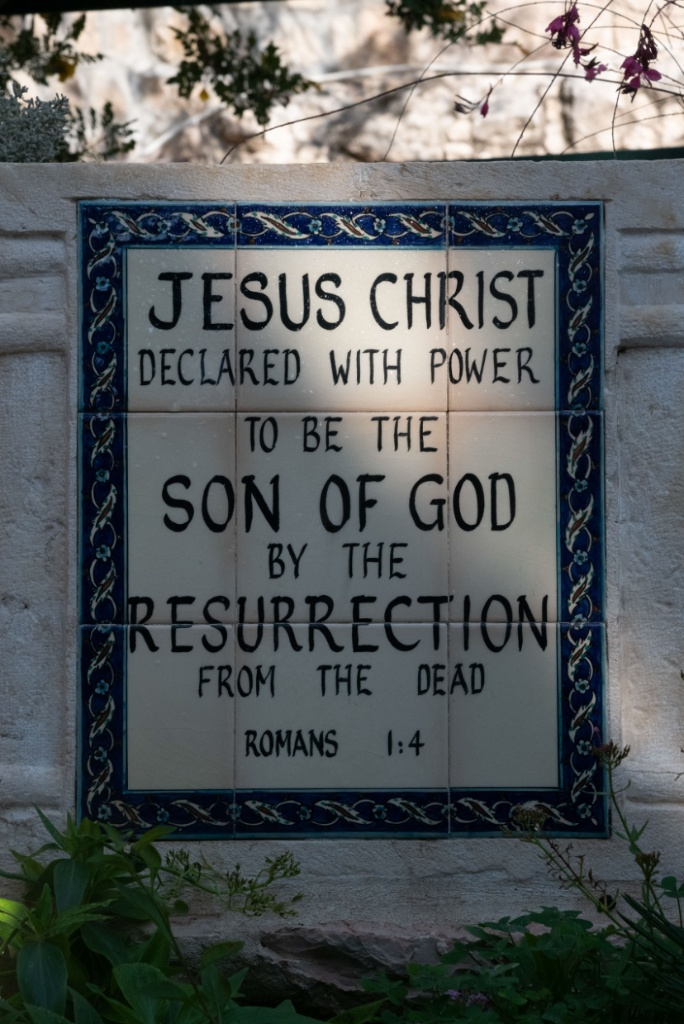 The actual sign · Garden Tomb · Jerusalem
"Jesus Christ declared with power
to be the Son of God
by the Resurrection
from the dead"
This tile mosaic is mounted on the wall at the entrance to the Garden Tomb — the very site identified as a candidate for the burial and resurrection of Jesus. It stands as a declaration in stone rather than a theological abstraction, at the location where the claim was made flesh.
IV. The Skeptic Scholars
The most remarkable feature of the minimal facts approach is not that Christian scholars accept these points. It is that skeptical and non-Christian scholars accept most of them.
Gerd Lüdemann — a German NT scholar and atheist who spent his career attempting to demolish the Resurrection claim — accepts the empty tomb, the appearances to Peter and Paul, and the transformation of the disciples. He explains them naturalistically (through hallucination theory), but he does not dispute the data. His disagreement is about interpretation, not facts.
Bart Ehrman — arguably the most prominent skeptical New Testament scholar in the English-speaking world — accepts that the disciples genuinely believed they had seen the risen Jesus, that Paul genuinely had an experience he attributed to the risen Jesus, and that James genuinely converted. His explanation: the disciples experienced grief-related visions. But he is doing history, not theology. And the minimum historical data he accepts is extraordinary.
V. The Honest Question
The Resurrection argument is not the problem of evil run backwards. It is a specific historical claim with specific historical evidence, and it demands a specific historical assessment. The question is not whether you are comfortable with miracles. The question is: given the data — the early creed, the empty tomb, the transformed lives, the dying witnesses, the conversion of Paul and James — what is the best historical explanation?
Every alternative hypothesis leaves data unexplained. The Resurrection hypothesis explains all of it, at the cost of requiring a miracle — an act of God that, if God exists, is not improbable at all. The circularity here is not a flaw. It is the structure of the argument: if the prior probability of God's existence is even modestly positive, the posterior probability of the Resurrection given the historical evidence is significant. The two inquiries — does God exist? did Jesus rise? — are not independent. They inform each other.
Truth is knowable. The question of the Resurrection is not a question of whether you are a person of faith. It is a question of whether you are willing to follow historical evidence to its most probable conclusion — whatever that conclusion is. We are the ones who refuse. But refusal is not an answer.
Then comes the inner question, and it is not historical or philosophical but personal. None of us is capable of keeping the law — not the law we set up for ourselves, not the commandments handed down. We write our own standards. Then we break them. We demand honesty from others and lie to ourselves. We resolve to be better and repeat the same failures. The law exposes us. It does not fix us.
I asked a woman there: what percentage of Christian believers fail? The shock on her face was immediate. She said 80%. I said: you could not be more wrong. One hundred percent. Every single one. Paul said it plainly: "All have sinned and fall short of the glory of God." Not most. Not the weak ones. All.
So perhaps now is the perfect time.
Get on your knees. Repent for the foolish things you have done —
to yourself, to others. Not as a ritual. As an honest accounting.
Then embrace peace. Embrace forgiveness — the kind
that is not earned but received. And get up and do everything you can,
every day, to be a better man.
A better father.
And don’t forget your own father — because one day you will be that father.
What you model is what your children will carry.
Lift the name of the Lord on high.
His name is Jesus Christ.
The following sources constitute the primary intellectual foundations for reviewing and preparing for this kind of argument.
- Habermas, G.R. & Licona, M.R. (2004). The Case for the Resurrection of Jesus. Kregel. The definitive minimal facts methodology. Habermas has catalogued over 2,200 scholarly sources on the Resurrection and synthesized the data points that have near-universal scholarly acceptance. Search this source ↗
- Wright, N.T. (2003). The Resurrection of the Son of God. Fortress Press. The most comprehensive historical treatment of the Resurrection from a scholar. 800 pages of rigorous historiography. Wright argues the Resurrection is the only hypothesis that fully accounts for the emergence of early Christian belief. Search this source ↗
- Lüdemann, G. (1994). The Resurrection of Jesus: History, Experience, Theology. Fortress Press. The most rigorous skeptical treatment from a non-Christian NT scholar who accepts most of the minimal facts. His hallucination theory is the best naturalistic response available — and its weaknesses are instructive. Search this source ↗
- Ehrman, B.D. (2014). How Jesus Became God. HarperOne. Ehrman's skeptical account of the development of Christology. Read alongside Wright. Ehrman accepts the historical core while explaining it naturalistically — the disagreement is about what best explains agreed-upon data. Search this source ↗
- 1 Corinthians 15:1–8. Written c. AD 53–55. Contains creed dated by scholars to within 3–8 years of crucifixion. The primary source. The creed Paul "received" — almost universally dated earlier than the letter — is the earliest testimony to the Resurrection we possess. Reading it as a historian, not a theologian, is essential. Read primary source ↗
- Tacitus, Annals XV.44. Written c. AD 116–117. The Roman historian's confirmation of Jesus's execution under Pontius Pilate and the subsequent movement. One of the key non-Christian primary sources. Not disputed by skeptical historians. Read primary source ↗
- Hopkins, M. (1867). "The Resurrection: Historical Evidence and Philosophical Presuppositions." Bibliotheca Sacra 24. Written eight years after Darwin's Origin, Hopkins applies standard historical evidentiary method to the resurrection accounts. Identifies the three facts that any historical hypothesis must explain — the same three Habermas uses today. A remarkable anticipation of the minimal facts method. Full entry in The Stacks → Bibliotheca Sacra Archive ↗
- Gardiner, F. (1870). "The Credibility of the Apostolic Witnesses." Bibliotheca Sacra 27. Applies ancient historiographical standards to the apostolic testimony — the same methodology used to evaluate Caesar, Thucydides, and Livy. Anticipates N.T. Wright's criterion of embarrassment and multiple attestation arguments by 130 years. See The Stacks → Bibliotheca Sacra Archive ↗
Where Does This Argument Lead You?
Engage the historical question on its own terms.