We have shown the fingerprint. Twelve simultaneous communication systems, each layered on the others, each presupposing the others. A digital code written in a four-symbol alphabet, before matter had a chance to matter. The argument from information is airtight. Every fingerprint has an author. The question is whether anyone had the precision to name him — before the science existed to confirm it.
IWhat Logos Meant: Before John Used the Word
The Greek word Logos (λόγος) did not mean a simple utterance. It was the most loaded philosophical concept in the ancient world, carrying five centuries of serious intellectual weight before John 1:1 was written.
It meant: reason, order, the rational principle behind all things, the source of intelligible structure. Not a metaphor. Not religious poetry. A precise technical term used by the finest minds of Greece and Rome to describe whatever it was that made the universe comprehensible, lawful, and coherent.
— Stoic maxim
— John 1:1–3 (ESV)
When educated Greeks and Romans in the first century read the opening of John's Gospel, they did not read a foreign concept. They read their own deepest philosophical category, the Logos, and found it given a specific identity. The audacity of the claim is almost beyond calculation. John was not borrowing the term loosely. He was issuing a precise philosophical assertion: the rational principle behind the universe is a person. The blueprint is the architect. The code is the coder.
II
What Information Theory Says: Before We Get to John
Claude Shannon formalised information theory in 1948. His central insight was clean: information stands as a third category, apart from matter and energy. It requires a source. It requires a receiver. And it requires a code that both share.
The genome is information. Every biologist agrees on this. The four DNA bases, adenine, thymine, cytosine, guanine, function exactly as Shannon's alphabet. They carry meaning. Remove any codon and the protein either misfolds or is not built. The code specifies the product. The sequence is not random noise. It is specified complexity, the only known signature of intelligence.
Information → Transcription → Translation → Protein → Function
DNA is not a molecule that happens to carry information. Information came first.
The molecule is the medium, not the message.
Hubert Yockey, the information theorist who applied Shannon's equations directly to the genome, concluded that the probability of a functional cytochrome-c protein sequence arising by chance is approximately 1 in 1075. The universe contains an estimated 1080 atoms. The numbers are not close. There is no probabilistic resource in the observable universe sufficient to account for even one functional protein by accident.
Shannon's law: information requires a sender.
The genome is information.
Therefore the genome required a sender.
The sender wrote in code before the receiver existed to read it.
That points to authorship rather than naturalism.
Logos — Myth or Mystery
In the beginning was the Word,
and the Word was with God,
and the Word was God.
He was in the beginning with God.
All things were made through him,
and without him was not any thing made that was made.
In him was life, and the life was the light of men.
And the Word became flesh
and dwelt among us,
and we have seen his glory...
Unpack this claim with the precision it demands.
"In the beginning was the Word." Before creation. The Logos existed. Order preceded creation. Information preceded the medium that carries it. This is not poetic licence — it is a cosmological claim about causal priority.
"The Word became flesh and dwelt among us." The claim is not that a wise man appeared and taught wisdom about the Logos. The claim is that the Logos itself — the cosmic rational principle, the source of all information, the blueprint of all creation — entered the creation in person. John 1 is not warm religious sentiment. It is the sharpest metaphysical claim ever committed to writing.
IVDNA as Logos — The Code Before the Creation
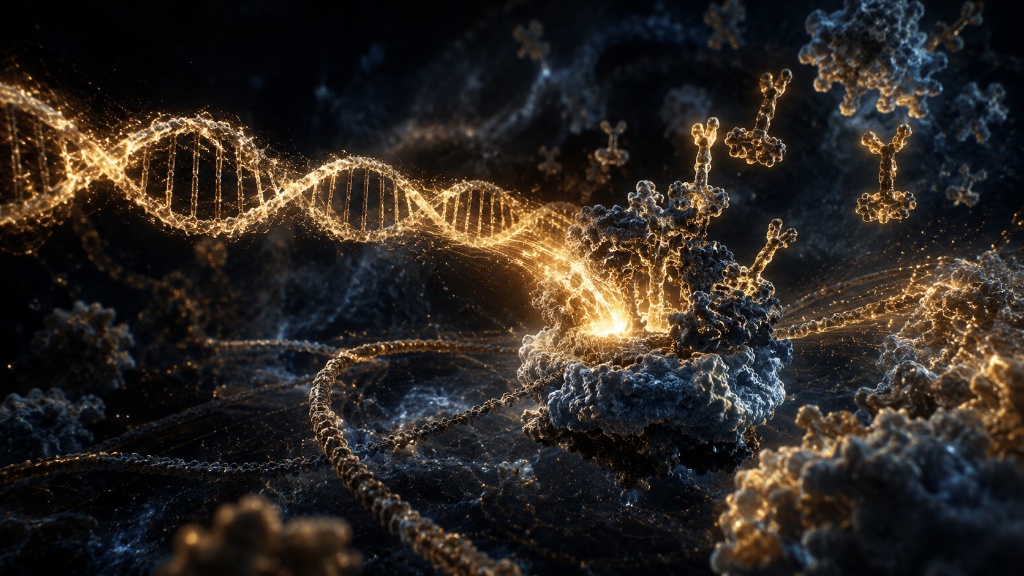
The genetic code specifies which proteins to build. The proteins build the machinery. The machinery reads the code. The code had to come first — before the reader existed. Information logically precedes the physical medium that instantiates it.
No physical or chemical law assigns meaning to a sequence. The relationship between codon and amino acid is arbitrary — it had to be chosen. Chosen relationships are the signature of mind. The code is conventional, not necessary. Convention requires a convention-maker.
John says: all things were made through the Word. Information theory says: all biological function flows from the information encoded in DNA. The structure is identical. The Logos is the source of the code. The code is the fingerprint of the Logos.
The Incarnation is the Logos entering matter — not as a passenger, but as its author revisiting the work. Jesus is not merely a teacher about the Logos. He is the Logos. The one through whom the code was written entered the world that the code built.
V
The Logos Chain — From Principle to Person
Logos → Order → Code → Life → Incarnation → Resurrection
The chain of causation the New Testament claims — animated in its logical sequence.
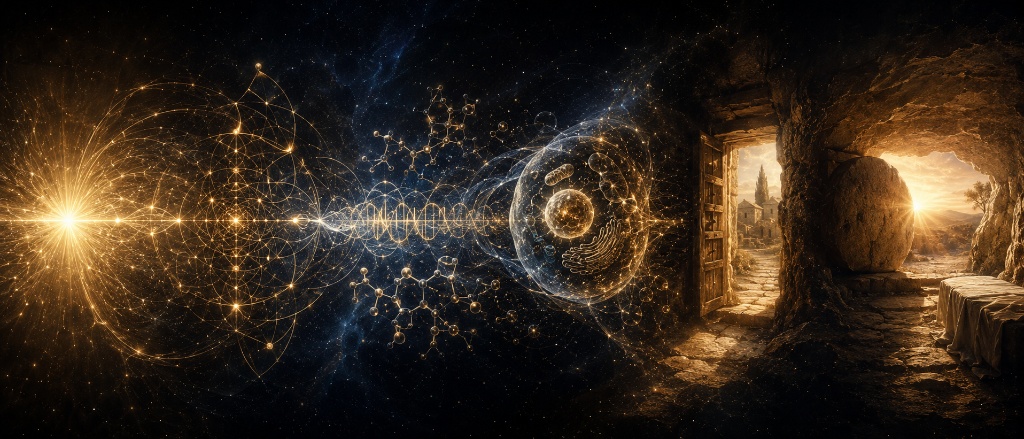
The chain of causation, from cosmic light to open tomb.
VI
The Fingerprint Has a Name
John 1 gives the name. The claim was made in the first century by eyewitnesses, in a specific historical context, with a testable event at its centre. The tomb was checked. It was empty. People die for what they believe. They do not die for what they know to be a lie.
You are without excuse.
The Lord desires to be known.
Does He know you?