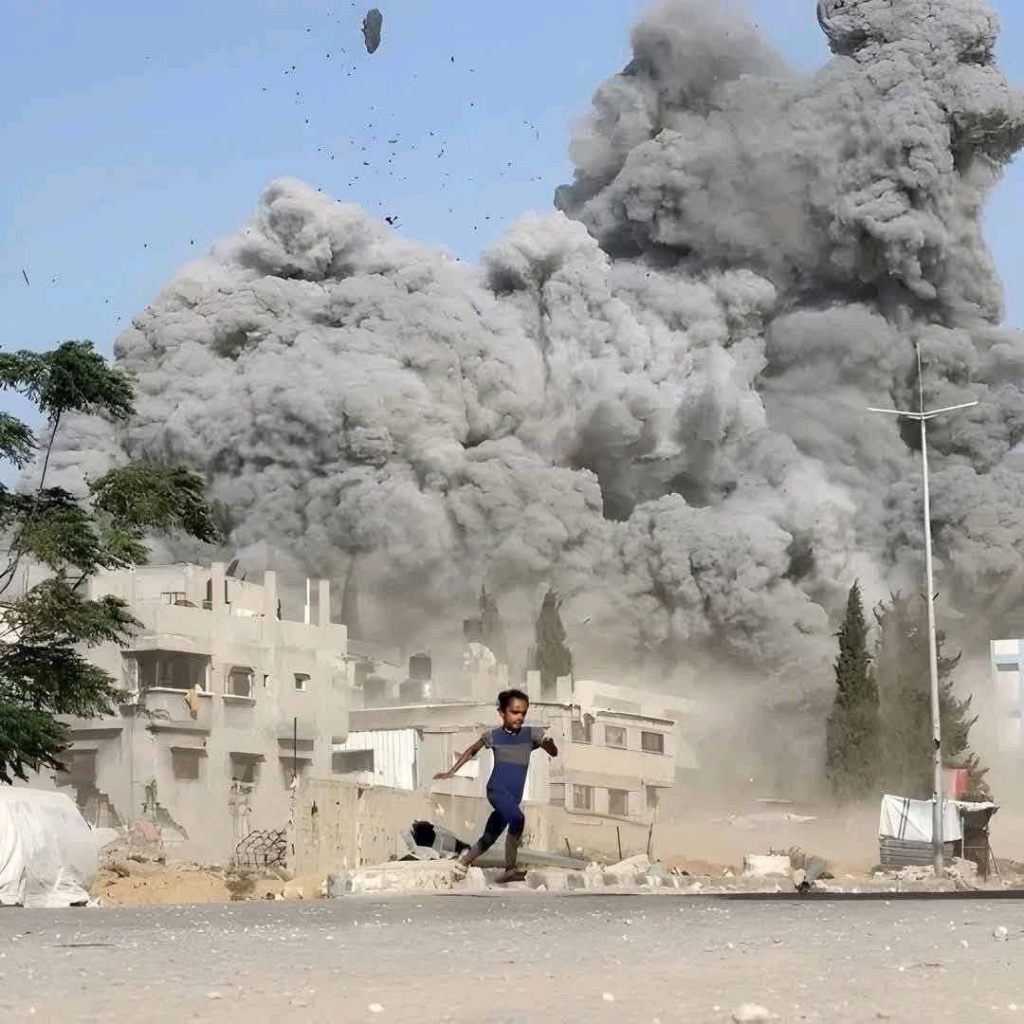
The extinction template is copied and relaunched by one government after another
with updated kill lists, fresh mass graves and
Epicurus never asked why heaven permits every new cycle.
The problem of evil gives philosophers a clean problem to work.
It has formal structure, logical premises, and a literature
that stretches from Epicurus to Alvin Plantinga.
It is the kind of problem you can argue about at a conference
without raising your voice.
The problem of genocide is different.
It has death certificates.
It has survivors with numbers tattooed on their arms.
It has mass graves found by satellite and forensic teams with brushes.
It has children's shoes.
The problem of genocide is not a thought experiment.
It is a pattern: documented, repeated, industrialized;
and it does not stop.[1]
This article is organized chronologically,
from the Armenians in 1915 to Lebanon in 2025,
because the chronology is the argument.
Each case carries the same anatomy:
a government decision, a racial or religious target,
a technology of death, an international silence,
and a theological question that no theodicy conference
has fully answered.
I. The Anatomy of Genocide: Race, Religion, Government, and Culture
Genocide is not spontaneous. It follows a pattern documented
by Gregory H. Stanton of Genocide Watch, who identified
ten stages every genocide passes through:
classification, symbolization, discrimination, dehumanization,
organization, polarization, preparation, persecution,
extermination, and denial.[2]
The terrifying consistency of this pattern across cultures,
centuries, and governments is not coincidental.
It is structural. It reflects something about human nature
when it is given political permission to act.
Four variables recur in virtually every case:
Race
The target is defined biologically or ethnically. Armenians, Jews, Tutsis, Kurds: identity determines death sentence.
Religion
The target is defined by faith: often Christian minorities, Jewish communities, or Muslim populations. Faith marks the condemned.
State
Government authorizes, organizes, or funds the killing. Without state apparatus (budgets, railways, death camps, armies) industrial genocide cannot happen.
Culture
Dehumanizing language, art, and narrative precede the killing. Victims are made into vermin, cockroaches, enemies of civilization, before the first bullet is fired.
What makes genocide a distinct theological problem
is not merely the scale, though the scale is staggering.
It is the systematization. An individual murderer may act
from passion, fear, or psychopathy.
A government conducting genocide acts from policy.
The evil is organized. Budgeted. Staffed.
When the problem of evil meets the problem of genocide,
the question becomes: not "why did God allow suffering?"
but "why did He allow entire bureaucracies dedicated to murder
to operate for years without intervention?"
II. The Armenians: 1915–1923, Where the Century Began
1915The Armenian Genocide
Ethnic: ArmenianReligious: Christian (Armenian Apostolic)State: Ottoman Empire / Committee of Union and ProgressCultural: Dehumanized as "gavur" (infidels), traitors
1.5M
Killed Est. Armenian Genocide Research Center
500K
Deported or displaced
2/3
Of Armenian population in Ottoman Empire eliminated
32
Nations officially recognize it as genocide
The 20th century began with Christianity's oldest continuous
national church being systematically annihilated.
The Armenian Apostolic Church traces its origins to the
apostles Thaddeus and Bartholomew in the first century AD.
The Ottoman government, under the direction of the
Committee of Union and Progress (the Young Turks),
ordered deportation marches into the Syrian desert.
These were death marches with no pretense.
They were accompanied by mass shootings,
drownings in the Euphrates, and outright burning
of villages with inhabitants inside.[3]
Ambassador Henry Morgenthau Sr., the U.S. Ambassador to the
Ottoman Empire from 1913 to 1916, witnessed the deportations
firsthand and cabled Washington repeatedly:
"When the Turkish authorities gave the order for these deportations,
they were merely giving the death warrant to a whole race;
they understood this well, and in their conversations with me
they made no particular attempt to conceal the fact."
Ambassador Henry Morgenthau Sr., Memorandum to U.S. Secretary of State, 1915
Turkey still does not officially recognize the Armenian Genocide.
The United States Congress recognized it in 2019.
The theological note: Armenia was the first nation in history
to adopt Christianity as its state religion, in 301 AD.
The first industrial genocide of the 20th century
targeted the oldest Christian nation on earth.
III. Assyrians and Syriac Christians: The Forgotten Genocide
1914Seyfo: The Assyrian Genocide
Ethnic: Assyrian, Syriac, ChaldeanReligious: Christian (Church of the East, Chaldean Catholic, Syriac Orthodox)State: Ottoman Empire + Kurdish tribal militiasCultural: Labeled as fifth column, enemies of the Caliphate
250K–750K
Killed Hannibal Travis, researcher
⅔
Of Assyrian population in the region eliminated
0
Major nations with full formal recognition
The Assyrians are the indigenous Christians of Mesopotamia,
the descendants of the ancient Assyrian empire,
speaking a modern form of Aramaic, the language of Jesus.
They predate Islam in their homeland by six centuries.
Simultaneous with the Armenian deportations, Ottoman forces
and Kurdish tribal militias conducted massacres of
Assyrian, Syriac, and Chaldean communities in the
Hakkari mountains, Urmia plain, and Tur Abdin.
Seyfo means "sword" in Syriac.
It is the name the Assyrians give to their genocide.
Most of the world has never heard of it.
IV. The Holocaust: 1941–1945, The Bureaucracy of Death
1941The Holocaust (Shoah)
Racial: Jewish (Nuremberg racial laws)Religious: Jewish, also Romani, Polish Catholic clergy, Jehovah's WitnessesState: Third Reich, SS, Einsatzgruppen, Wannsee Conference bureaucratsCultural: Decades of eliminationist antisemitism; Nazi propaganda machine
6M
Jewish victims Yad Vashem; U.S. Holocaust Memorial Museum
5–6M
Other victims Romani, Poles, Soviets, disabled, political prisoners
6
Industrial death camps in occupied Poland
11M
Total murdered in the systematic program
The Holocaust is the most documented genocide in history,
precisely because the perpetrators documented it themselves.
The Wannsee Conference (January 20, 1942) produced minutes
of a government meeting planning the murder of 11 million people
with the bureaucratic tone of a logistics review.
They called it the "Final Solution to the Jewish Question."
Hannah Arendt's term for what she observed at the Eichmann trial:
"the banality of evil" is the most precise philosophical
description of industrialized genocide.
The perpetrators were not monsters in the classical sense.
They were clerks, engineers, and railway administrators.[4]
The theological problem is sharpest here.
Auschwitz-Birkenau killed an estimated 1.1 million people,
a million of them Jewish, at a processing rate of
up to 6,000 per day in peak operational months.
The camp's designers were not deranged.
They were competent. The gas chambers were refined
from the T4 euthanasia program that preceded them.
Six million of God's chosen people, the nation through whom
the Messiah entered history, were systematically murdered
while church leadership in much of Europe stayed silent.
Theological Problem
God made a covenant with Abraham. He delivered Israel
from Egypt. He gave the Law, the prophets, the temple.
And He allowed, or did not prevent, the organized
murder of two-thirds of European Jewry within living memory.
Elie Wiesel, who survived Auschwitz and Buchenwald,
put the question plainly: "Never shall I forget those flames
which consumed my faith forever."
The Orthodox Jewish response to this question,
the silence of God at Auschwitz, remains the most serious
unresolved problem in modern theology.
Misinformation Audit · World Almanac MythThe "90 million Christians killed / Jews unchanged" claim: source, correction, and context
The Circulating Claim: What the Image Shows
A table sourced from almanac-style publications (World Almanac or similar) circulates widely online,
displaying worldwide religious population figures for 1933 and 1948 alongside the annotation:
"90 million Christians killed" with Jewish figures appearing nearly unchanged.
The caption concludes: "But it is the Jews who claim they were the victims of a genocide."
This framing is used as evidence that no Holocaust occurred, or that the Jewish death toll is fabricated.
It is factually wrong in every material respect. Here is why.
Religion
1933 Figure (Claimed)
1948 Figure (Claimed)
Implied Narrative
Christians (total)
~682,400,000
~592,400,000
"90 million killed: more than Jews"
Jews (total)
~15,315,000
~15,753,000
"+438,000 more: no genocide occurred"
▲ This table is used to argue the Holocaust is a fabrication. Every number in the 1948 Jewish row is wrong, and the reason is documented.
What the Numbers Actually Show
Jewish Population: Corrected
15.3M
Jews worldwide, 1933 USHMM; American Jewish Year Book
~11M
Jews worldwide, post-war (1945–1948) 1949 World Almanac revised estimate; AJYB
5.5–6M
Jewish lives lost, 1941–1945 Yad Vashem; USHMM; Nuremberg tribunal
Why did early almanacs show ~15.7M? Because they recycled pre-war 1938–39 estimates.
Reliable post-war data did not exist by print deadline in 1948. The 1949 World Almanac
corrected the figure to approximately 11 million, a drop of 4.3 million from the 1933 baseline,
consistent with 5.5–6 million killed (accounting for wartime births and migration).
Christian Population: Context
~682M
Christians worldwide, 1933
70–85M
Total WWII deaths (all causes, all groups) Historians: Overy, Dear, Foot; WHO; ICRC
0
Documented instances of a Christian-targeted extermination program analogous to the Holocaust
The ~90M apparent drop in the Christian count reflects:
(a) WWII casualties across all demographics: soldiers, civilians, all religions and nationalities;
(b) revised methodologies between the two census periods;
(c) famine, disease, and displacement deaths across six continents over a 15-year span.
There was no government program targeting Christians for extermination as Christians.
There was a government program targeting Jews for extermination as Jews.
These are not comparable events.
Four-Point Correction
01
The Claim
"The 1948 World Almanac shows Jewish population at 15,753,000, more than in 1933.
No genocide happened. The Holocaust is a lie."
The Fact: Data Lag
Early post-war editions of the World Almanac (1947, 1948) carried forward
pre-war Jewish population estimates from 1938–1939 because no reliable
post-war census data existed at time of printing. The war had destroyed
the communities and institutions that produced demographic data.
This is not evidence of no deaths; it is evidence of the data infrastructure
being destroyed along with the people.
Source: Nizkor Project, "The 'World Almanac' Canard"; USHMM Holocaust Encyclopedia
02
The Claim
"If the figures were revised, why trust them? Any revision is just Jews changing
the numbers to support their narrative."
The Fact: The 1949 Correction
The 1949 World Almanac revised the global Jewish population estimate
to approximately 11,266,600, down from the pre-war 15.3 million.
This revision was corroborated independently by the American Jewish Year Book,
the Anglo-American Committee of Inquiry (1946), and demographic analysis
by the Institute of Jewish Affairs.
The post-war figure of ~11 million is consistent with 5.5–6 million deaths
plus wartime births and migration adjustments.
The 1948 figures were not a cover-up; they were an uncorrected editorial carry-forward,
which was acknowledged and corrected the following year.
Source: 1949 World Almanac, p. 289; American Jewish Year Book, vol. 47 (1945–46); Benz, W. (ed.), Dimension des Volkermords (1991)
03
The Claim
"90 million Christians were killed: that is bigger than any alleged Jewish death toll.
Christians were the real genocide victims."
The Fact: What WWII Deaths Were
Total WWII deaths (1939–1945) are estimated at 70–85 million across all nations,
religions, and demographics: soldiers, civilians, famine victims, and those killed
in every theater of war. Most of these were not killed because they were Christian.
They were killed because they were Russian, German, Japanese, British, French,
Chinese, Polish: in a world war driven by nationalism, imperialism, and fascism.
No state issued an order to exterminate Christians as a religious group.
The Nazis did issue the Wannsee Protocol (January 20, 1942) explicitly ordering
the extermination of Jews as a racial-religious group. That document exists.
It is in the German Federal Archives. Its full text is available at the
Holocaust Memorial Museum.
Source: Overy, R. (2005), Why the Allies Won; Dear, I.C.B. & Foot, M.R.D. (eds.), The Oxford Companion to WWII; USHMM, "Wannsee Conference and the 'Final Solution'"
04
The Claim
"The Jewish population before the war was only 15 million.
You can't kill 6 million out of 15 million and have 11 million left.
The math doesn't work."
The Fact: Population Arithmetic
The math does work. Pre-war Jewish population: approximately 15.3 million (1933).
Deaths: ~5.7–6 million (1941–1945). Wartime births (reduced but non-zero): est. 300,000–500,000.
Post-war population: approximately 11 million. The arithmetic is:
15.3M − 6M + 0.4M (births, migration adjustments) ≈ 9.7–10M minimum,
consistent with the ~11 million figure given the range of uncertainty
in pre-war estimates (some sources: 15.3M; others: 16.6M).
The U.S. Holocaust Memorial Museum documents 9.5 million Jews in Europe alone in 1933;
post-war European Jewish population was approximately 3.8 million.
European Jews lost: approximately 5.7–6 million. The numbers converge from multiple
independent sources across multiple methodologies.
Source: USHMM, "Jewish Population of Europe in 1933"; Yad Vashem, "The Holocaust: The Unique Characteristics"; Pew Research Center, "World's Jewish Population" (2012)
V. Cambodia: 1975–1979, Atheist Ideology as Engine of Mass Murder
1975Cambodian Genocide: The Killing Fields
Ethnic: Vietnamese, Chinese, Cham Muslims, educated KhmerReligious: Buddhist clergy targeted; religion abolishedState: Khmer Rouge / Pol Pot, Year Zero ideologyCultural: "Year Zero": eradication of all pre-revolutionary culture
1.7–2.5M
Killed (est.) Yale Cambodian Genocide Program
25%
Of Cambodia's population killed in 4 years
90%
Of Buddhist monks killed or forced to defrock
The Cambodian genocide is unique in this list in one dimension:
it was perpetrated by a government with an explicitly
atheist-utopian ideology. The Khmer Rouge declared "Year Zero",
erasing all history, religion, education, and culture,
and executed anyone who wore glasses (a sign of literacy),
spoke a foreign language, or practiced Buddhism.
The killing was not racial in the classic sense;
it was ideological, with ethnicity as a secondary marker.
Entire Buddhist temple communities were murdered.
This case is the counter-argument to the claim
that religion causes genocide:
in Cambodia, the elimination of religion was the genocide.
The Yale Cambodian Genocide Program estimates 1.7–2.5 million deaths
between 1975 and 1979: 25% of the entire Cambodian population.[10]
VI. Bosnia: 1992–1995, Europe Watched
1992Bosnian Genocide: Srebrenica
Ethnic: Bosniak (Muslim South Slavs)Religious: Islam; perpetrators Serbian Orthodox ChristianState: Republika Srpska paramilitaries + Yugoslav People's ArmyCultural: "Ethnic cleansing": a new euphemism for an old crime
100K+
Killed (total war) ICTY estimates
8,000+
Murdered at Srebrenica July 1995, ruled genocide by ICJ
2.2M
Displaced throughout the war
400
UN Dutch troops present; stood down as massacre began
Srebrenica was a designated UN "Safe Area."
In July 1995, Dutch UN peacekeepers watched as General Ratko Mladić's
forces separated Bosniak men and boys from women,
a recognized precursor to mass execution under the Genocide Convention,
and did not intervene. Over three days, 8,372 men and boys
were executed and buried in mass graves that were subsequently
excavated and the bodies moved to secondary graves to conceal the crime.
The International Court of Justice ruled Srebrenica a genocide in 2007.
The perpetrators wore crosses around their necks.[5]
VII. Rwanda: 1994, One Hundred Days
1994Rwandan Genocide
Ethnic: Tutsi (target); Hutu moderates also killedReligious: Predominantly Christian nation; churches were massacre sitesState: Rwandan Interahamwe militia, Habyarimana governmentCultural: Radio Mille Collines incited killing; Tutsi called "inyenzi" (cockroaches)
500K–800K
Killed in 100 days UN estimates; Rwandan government: 1M+
75%
Of Tutsi population in Rwanda killed
2,000
Average daily kill rate during peak weeks
0
Foreign interventions despite UN knowledge
The Rwandan genocide is the fastest mass killing in recorded history.
It was accomplished primarily with machetes, consumer goods,
not military technology. Radio broadcasts named individuals
and their hiding places. Churches that sheltered Tutsi
were surrounded and burned, or the occupants were killed inside.
The Ntarama church massacre killed approximately 5,000 people.
The Nyamata church massacre killed over 10,000.
The Catholic Church in Rwanda, whose clergy had helped
establish the Hutu power structure, has since acknowledged
its complicity.[6]
"When the Rwandan genocide happened, God was not absent.
He was weeping. The question is: why did His people not act
on His behalf? Because many of His people were doing the killing."
Philip Gourevitch, We Wish to Inform You That Tomorrow We Will Be Killed With Our Families (1998), paraphrased
VIII. Iraq: The Anfal Campaign Against the Kurds, 1986–1989
1986Anfal: The Kurdish Genocide
Ethnic: Kurdish (Sunni Kurdish, Yazidi, Christian Assyrian)Religious: Mixed, Sunni Muslim, Yazidi, ChristianState: Ba'athist Iraq under Saddam Hussein / Ali Hassan al-Majid ("Chemical Ali")Cultural: Kurds dehumanized as separatist traitors
50K–182K
Killed Human Rights Watch; Kurdish sources higher
5,000
Killed by chemical weapons at Halabja, March 16–17, 1988
4,500
Villages destroyed
1M
Displaced
The Halabja chemical attack, a coordinated strike of mustard gas
and nerve agents on a civilian Kurdish city, killed between
3,200 and 5,000 people, the majority women and children,
in a matter of hours. It remains the largest chemical weapons
attack against a civilian population in history.[7]
The weapons were supplied, in part, with components from
Western companies during the period when Iraq was a U.S. ally
against Iran. The full Anfal campaign lasted three years.
The U.S. government possessed intelligence on the chemical
attacks and chose not to intervene or impose sanctions.
IX. Ukraine: 2022–2026, Industrial-Scale Atrocity in Europe
2022Ukraine: Bucha, Mariupol, Ongoing War Crimes
Ethnic: Ukrainian, characterized as sub-ethnic by Russian state mediaReligious: Ukrainian Orthodox (Kyiv Patriarchate) vs. Russian Orthodox (Moscow Patriarchate)State: Russian Federation: systematic targeting of civilian infrastructureCultural: Russian state denial of Ukrainian national identity
60K+
Civilian deaths confirmed UN OHCHR, 2026
10M+
Displaced (internal + refugees) UNHCR 2026
19,546
Confirmed civilian deaths through Feb 2025 (UN verified)
6,923
Attacks on civilian objects documented by UN, 2022–2025
The International Criminal Court has issued arrest warrants
for Vladimir Putin for the deportation of Ukrainian children,
the unlawful transfer of children from occupied Ukrainian territory
to Russia. This meets the legal definition of genocide under
Article II(e) of the Genocide Convention.
The Russian Orthodox Church, whose Patriarch Kirill has called
the invasion a "metaphysical struggle" against Western decadence,
has provided theological cover for the war.
A church that blesses tanks is not a church that fears God.
It is a state apparatus in vestments.
The ICC arrest warrant for Putin (ICC-01/22, March 2023) marks the first
time a sitting head of state of a UN Security Council permanent member
has been indicted for crimes against children.[11]
X. Gaza: 2023–2026, The Ongoing Catastrophe
2023Gaza: The Destruction of a Civilian Population
Ethnic: Palestinian, ArabReligious: Predominantly Muslim; Christian Palestinians also killedState: Israeli military operation; armed with U.S. Foreign Military SalesCultural: Palestinian identity denied; Israeli ministers' eliminationist statements on record
57,000+
Confirmed killed Gaza Health Ministry / WHO, 2026
186,000
Projected deaths Lancet, direct + indirect, 2024
92%
North Gaza destroyed UNOSAT satellite assessment, 2025
$40B
Reconstruction cost World Bank, 2025
The UN Special Rapporteur on Palestine, Francesca Albanese,
submitted a report to the UN General Assembly in March 2024
titled "Anatomy of a Genocide," concluding that
the threshold for genocide under the Genocide Convention
had been met in Gaza.[8]
The International Court of Justice, ruling in South Africa's
genocide case against Israel, issued provisional measures
ordering Israel to "take all measures within its power
to prevent acts which could fall within the scope of the
Genocide Convention."
The Church of Saint Porphyrius, the oldest active church
in the world (founded in 407 AD), was struck by an Israeli
airstrike on October 19, 2023, killing 18 people
who had sought refuge inside.
The Vatican protested.
Evangelical American leaders did not.
"We are watching a genocide in real time.
This is neither a conflict nor a war.
A war is between parties with military equivalence.
This is the eradication of a civilian population
with the active material support of the United States government."
Multiple UN agency heads and Special Rapporteurs, 2024–2025
Primary Source EvidenceFive Primary Sources · Religion Used as Political Cover · 2025
The following posts were selected from X (formerly Twitter) as primary source evidence for a single, specific argument:
that Western evangelical Christianity has provided the theological cover that enabled the conditions shown here,
through the doctrine of Christian Zionism, uncritical support for Israeli military operations framed as biblically mandated,
and institutional silence on civilian casualties among Lebanon's Christian population.
These posts are presented as evidence, not as a political position.
The theological problem of genocide is not abstract. It has names, addresses, and uniforms.
Gaza, 2025. A child flees as an airstrike destroys a residential block. The child is barefoot. The buildings behind them were homes.
Source: Primary source image ↗
The 30-Year Nuclear Countdown.
Video compilation of Benjamin Netanyahu claiming, repeatedly across three decades (1990s–2020s), that Iran is "days" or "weeks" from a nuclear weapon.
The same warning. The same language. Year after year. The argument used to justify ongoing military operations in the region has never had an expiry date, because it was never designed to.
Theological relevance: The framing of Iran as an existential apocalyptic threat has been adopted wholesale by American evangelical dispensationalism, providing the theological mandate for uncritical support of military operations. A 30-year-old talking point works as a doctrine rather than intelligence.
A Christian Village. Solar Farms. 1948 Redux.
Israeli forces destroying infrastructure, including solar farms, in a Christian village in southern Lebanon.
The caption draws the direct parallel to the Nakba of 1948 and asks: why have Palestinians resisted for 80 years? Because this is what was done to them then. And this is what is being done now.
Theological relevance: American evangelicals who frame Israeli military action as biblically mandated must account for the fact that the villages being destroyed contain Christian populations, people who share their faith. The silence from Western evangelical leadership on Lebanese Christian casualties is documented and conspicuous.
The Map on the Uniform.
Israeli Ministry of Defense personnel placing badges on soldiers. The badge shows a map of "Greater Israel", an expansionist territorial vision encompassing parts of Lebanon, Syria, Jordan, Egypt, Iraq, and Saudi Arabia.
This symbol is on the uniform, and it is official, far from fringe.
Theological relevance: The "Greater Israel" concept is derived from biblical land promises (Genesis 15) and is actively promoted by Christian Zionist theology in the United States. When a soldier wears a map of regional conquest on his uniform, the theological infrastructure that put it there is American evangelical dispensationalism. This is religion in the name of God, with consequences for Lebanon, Syria, Jordan, and beyond.
Maryam, Age 9. Gaza. And the Met Gala.
Side-by-side: Beyoncé at the Met Gala in a diamond skeleton gown. Maryam, a nine-year-old Palestinian girl, in Gaza, emaciated, her own skeleton visible through her skin from famine.
The post is in Spanish. The image requires no translation.
Theological relevance: The problem of genocide is inseparable from the problem of selective attention. The West spent more words on a celebrity's outfit than on a starving child with a name. Maryam is not a statistic. She is a person. The theological question (where is God?) is secondary to the political one: where are His people, and what are they looking at?
Gaza Can Be Rebuilt. The West's Credibility Cannot.
Footage of widespread destruction in Gaza. The caption — from Trita Parsi, founding president of the National Iranian American Council — argues that whatever moral authority Western governments claimed has been irreparably destroyed by their conduct in Gaza. Buildings can be rebuilt. Institutions of moral legitimacy, once forfeited, take generations to restore. Some never are.
Theological relevance: The article's core argument holds that His people are absent, more than God. The credibility of Western Christianity — which aligned itself with the political framework that enabled this — now carries the same question. Gaza can be rebuilt. Can the testimony?
XI. Lebanon — 2024–2026 — The Expansion[12]
2024Lebanon — Civilian Infrastructure Destroyed
Ethnic: Lebanese — Arab, with significant Christian minorityReligious: Mixed — Shia, Sunni, Maronite Catholic, Greek Orthodox, ArmenianState: Israeli military campaign against Hezbollah; civilian infrastructure repeatedly struckCultural: 33% Christian population; Christian sites and communities also destroyed
4,000+
Killed Lebanon MoPH, 2024–2026
1.2M
Displaced UN OCHA, 2025
25
Towns >80% destroyed UNOSAT, 2025
33%
Lebanese population is Christian
Lebanon's Christian population — Maronite, Greek Orthodox,
Armenian Apostolic, Syriac — represents one-third of the country.
The Maronite Patriarch, Bechara Boutros al-Rahi,
has condemned the bombardment of civilian infrastructure
and called for an immediate ceasefire.
International evangelical leadership — which has consistently
provided theological cover for Israeli military operations
under the banner of Christian Zionism —
has remained largely silent about Lebanese Christian casualties.
Christians are killing Christians
because the political alliance precedes the theological one.
Lebanon's Health Ministry confirmed over 4,000 deaths in the 2024 conflict;
UNOSAT satellite assessment documented over 25 towns with more than 80% destruction.[12]
XII. The Century in Numbers — The Problem Stated Statistically
These are not casualties of war in the conventional sense.
These are people murdered because of who they were —
their race, their religion, their culture, their language.
The pattern repeats because the conditions repeat:
a government with enough power to act,
a minority with insufficient power to resist,
an international community with insufficient will to intervene,
and a cultural narrative that has stripped the victims
of their humanity before the first bullet is fired.
Kiernan (2007) documents this cross-cultural mechanism across every
major genocide from Sparta to the present.[13]
XIII. The Theological Problem — Stated Without Flinching
The evidential problem of evil is at its most severe here.
It is not a question of natural evil — earthquakes, cancers,
the suffering built into biological systems.
That has theodicies: the free will defense, the soul-making argument,
the necessity of a world with genuine physical laws.
These arguments have genuine philosophical weight.
Genocide is different.
Genocide is moral evil, executed by agents with full choice,
at industrial scale, over years, with the explicit sanction
of governments, the silence of churches,
and the knowledge — in most cases — of the outside world.
The theodicy arguments that work for natural evil
do not scale to Auschwitz, to Srebrenica, to the children
of Gaza buried in rubble they had never left.
The Theological Verdict
If the free will defense holds, then God is waiting —
allowing human freedom to play out with full consequences,
refusing to override it even at this cost.
That is a position. It is a consistent position.
But it requires acknowledging that the price of human freedom,
as God has permitted it to operate, includes Auschwitz.
It includes Rwanda's churches.
It includes children with fractured skulls under concrete
in Gaza City.
A God who could prevent this and chose not to
is either constrained by the logic of freedom He created,
or He is something more complicated
than the Sunday school version suggests.
The Open Theism response — articulated by theologians like
Greg Boyd, Clark Pinnock, and John Sanders —
holds that God genuinely limits His own omniscience
in the realm of future free choices.
He does not override them. He grieves them.
He works within them.
This is not the same as saying God is indifferent.
It is saying that the cost of genuine creaturely freedom
is genuine creaturely evil — and God absorbs that cost
rather than eliminating freedom to prevent it.[9]
The traditional Calvinist response — that all of this
is within God's "permissive will" and serves His greater plan —
creates a God whose plan requires the Holocaust
as a stage-managed event.
That response has its own theological problems
that are at least as serious as the question it claims to answer.
XIV. Where Nations Have No Sense — A Common Sense Solution
The pattern is not mysterious.
Its solution is not mysterious either, even if it is difficult.
Every genocide in this list required five conditions
to proceed: dehumanization, state authorization, weapon supply,
international silence, and impunity.
Remove any one of these and the genocide either does not begin
or does not reach industrial scale.
The Five-Point Prevention Framework
1. Criminalize dehumanization before it becomes policy.
Genocide Watch's early-warning system identifies the precursor
stages. Calling a people "cockroaches," "vermin," "infidels who don't belong"
is not protected speech — it is Stage 4 preparation.
The Genocide Convention requires signatories to prevent,
not merely punish after the fact.
2. Withdraw state authorization immediately.
No government should receive diplomatic recognition, trade benefits,
or military aid while conducting operations meeting the Genocide Convention's
criteria. The ICJ's provisional measures in the Gaza case
are the mechanism — they must be enforced, not noted.
3. Stop supplying weapons to active genocide operations.
The United States supplied weapons to Saddam Hussein's Iraq
during the Anfal campaign. It supplied weapons to Israel
during the Gaza operations. It supplied weapons used in
drone strikes across Yemen, Somalia, and Pakistan.
A nation cannot simultaneously claim to stand against genocide
and be the primary weapons supplier to operations
meeting the legal definition of genocide.
4. Enforce an international obligation to intervene.Romeo Dallaire, the UN force commander in Rwanda,
had intelligence and requested permission to act
before the genocide began. He was told to stand down.
The UN Security Council has a veto structure that allows
the permanent members to protect their allies from accountability.
The structure must change, or the obligation is meaningless.
5. End impunity — without exception.
The ICC has issued an arrest warrant for Vladimir Putin.
It should equally issue warrants for the documented targeting
of civilian populations in Gaza, the use of starvation as a
weapon of war, and the deliberate targeting of hospitals,
schools, and religious sites. International law without equal
application is not international law — it is geopolitical preference
dressed in legal language.
The theological conclusion is not atheism.
It is accountability.
A God who is genuinely good — not just nominally good —
is not honored by a political community that claims His name
while funding operations that massacre His children.
Every Christian who pays taxes to a government
that supplies weapons to an active genocide operation
is complicit in that operation.
That is not a political statement.
That is the logical implication of the doctrine
of moral responsibility.
The problem of genocide does not disprove God.
It indicts us.
It exposes the gap between what we confess on Sunday
and what we fund on Monday.
The God who entered history and was tortured to death
by the state knows what it costs to be
on the receiving end of organized violence.
The question is not where He was at Auschwitz.
The question is where His church was.
And where it is now.
BBC InvestigationDocumented Pattern of Conduct · 2024
"IDF snipers are deliberately hunting children for sport."
160+
Children shot
Head
Primary target zone
BBC
Source / investigation
A BBC investigation documented a consistent sniper pattern across the West Bank:
Palestinian children struck by single shots to the head or upper body
in contexts where no active combat was taking place. Medics, witnesses, and
ballistic evidence converged on the same conclusion. The BBC reporting determined
the pattern was not consistent with collateral damage from urban
warfare but with deliberate, targeted fire. The phrase "hunting for sport"
appeared in testimony gathered by the investigation from medical and eyewitness
sources on the ground.
The God Who Was Tortured By the State Knows This
He Entered History
The Incarnation is the answer that the theodicy literature keeps
missing. God did not watch suffering from a distance.
He was stripped, beaten, falsely accused by a rigged religious-political
tribunal, tortured, and executed by the state —
in real time, in a documented historical moment,
before hostile witnesses who could not make the body disappear.
That does not explain the Holocaust.
It does not explain Gaza.
But it means the God of the universe is not immune from the problem
He is accused of ignoring.
Notes, citations, and primary sources for The Problem of Genocide.
Click any footnote number [n] in the article to scroll to the corresponding entry.
Footnotes · 13 Notes
[1] · UN DEFINITIONUnited Nations Office on Genocide Prevention and the Responsibility to Protect"Definition of Genocide." un.orgThe foundational legal definition under international law: acts committed with intent to destroy a national, ethnic, racial, or religious group.UN.org ↗
[2] · GENOCIDE PREVENTION"The Ten Stages of Genocide."Stanton, G.H. (2013). Genocide Watch.Classification, symbolization, discrimination, dehumanization, organization, polarization, preparation, persecution, extermination, denial. Every documented genocide passes through these stages.GenocideWatch.com ↗
[3] · ARMENIAN GENOCIDEAmbassador Morgenthau's StoryMorgenthau, H. (1918). Doubleday, Page & Co. Reprinted by Wayne State University Press (2003).First-hand account by the U.S. Ambassador to the Ottoman Empire documenting the mass killings of Armenians.Kévorkian, R. (2011). The Armenian Genocide: A Complete History. I.B. Tauris.
[4] · HOLOCAUSTEichmann in Jerusalem: A Report on the Banality of EvilArendt, H. (1963). Viking Press.The defining philosophical account of how ordinary bureaucrats became mass murderers.U.S. Holocaust Memorial Museum. "Holocaust Encyclopedia." ushmm.org.USHMM ↗
[5] · LEGAL · ICJBosnia and Herzegovina v. Serbia and MontenegroInternational Court of Justice. Application of the Convention on the Prevention and Punishment of the Crime of Genocide. Judgment of 26 February 2007.First ICJ ruling to find a state responsible for failing to prevent genocide under the Genocide Convention. Srebrenica 1995 confirmed as genocide.ICJ.org ↗
[6] · RWANDAThe Rwanda Crisis: History of a GenocidePrunier, G. (1995). Columbia University Press.Gourevitch, P. (1998). We Wish to Inform You That Tomorrow We Will Be Killed With Our Families. Farrar, Straus and Giroux.Vatican News. "Pope Francis asks forgiveness for role of Catholics in Rwanda genocide." (2017).
[7] · IRAQ / KURDSGenocide in Iraq: The Anfal Campaign Against the KurdsHuman Rights Watch. (1993). Human Rights Watch.Comprehensive documentation of Saddam Hussein's campaign against the Kurdish population, including chemical weapons attacks at Halabja (1988) and mass graves.HRW.org ↗
[8] · UN REPORT · GAZA"Anatomy of a Genocide"Albanese, F. (2024). Report of the Special Rapporteur on the situation of human rights in the Palestinian territories occupied since 1967. UN Document A/HRC/55/73.Formal finding that the threshold for genocide under the Genocide Convention has been met in Gaza.OHCHR.org ↗
[9] · THEOLOGYSatan and the Problem of Evil: Constructing a Trinitarian Warfare TheodicyBoyd, G. (2001). IVP Academic.Warfare Theodicy: genuine creaturely freedom requires genuine creaturely evil.Pinnock, C., Rice, R., Sanders, J., Hasker, W., & Basinger, D. (1994). The Openness of God: A Biblical Challenge to the Traditional Understanding of God. IVP Academic.
[10] · CAMBODIADocumentation Center of CambodiaYale Cambodian Genocide Program. (2019). Yale University.Comprehensive documentation of the Khmer Rouge's "Year Zero" genocide (1975–1979), including the 1.7–2.5 million killed and the targeting of Buddhist clergy, ethnic minorities, and the educated class.CGP Yale ↗
[11] · ICC · UKRAINE"Situation in Ukraine: ICC Pre-Trial Chamber II issues warrants of arrest for Vladimir Vladimirovich Putin and Maria Lvova-Belova"International Criminal Court. (2023). ICC-CPI-20230317-PR1699.First ICC warrants against a sitting head of state of a permanent UN Security Council member — for the unlawful deportation of Ukrainian children.ICC-CPI.int ↗
[12] · LEBANONLebanon Conflict Casualty Reports / Satellite-Detected Building Damage AssessmentLebanon Ministry of Public Health. (2024–2025). Conflict casualty reports. United Nations OCHA Lebanon Situation Reports, 2024–2025.UNOSAT. (2025). "Lebanon: Satellite-Detected Building Damage Assessment." United Nations Satellite Centre.
[13] · CORE REFERENCEBlood and Soil: A World History of Genocide and Extermination from Sparta to DarfurKiernan, B. (2007). Yale University Press.The most comprehensive single-volume cross-cultural history of genocide. Documents the structural mechanisms — land, race, religion, utopian ideology — that recur in every major case from ancient Sparta to Darfur.
Primary Source Library
BOOK — GENOCIDE HISTORYBlood and SoilKiernan, B. — Yale University Press, 2007The most comprehensive single-volume history of genocide. Essential background for understanding genocide as a recurring human phenomenon rather than an aberration.
UN REPORTAnatomy of a GenocideAlbanese, F. — UN A/HRC/55/73 (2024)UN Special Rapporteur's formal finding that the threshold for genocide under the Genocide Convention has been met in Gaza.Read at OHCHR.org ↗
BOOK — THEOLOGYIs God to Blame?Boyd, G.A. — IVP Books, 2003Boyd's accessible treatment of Open Theism as a theodicy for large-scale moral evil. The Warfare Theodicy provides a theological framework for genocide that respects both divine goodness and human freedom.
BOOK — RWANDAWe Wish to Inform You That Tomorrow We Will Be Killed With Our FamiliesGourevitch, P. — Farrar, Straus and Giroux, 1998The definitive first-person account of the Rwandan genocide. Essential reading for anyone who wants to understand how ordinary communities become complicit in mass murder.
LEGAL — ICJSouth Africa v. Israel — Gaza Genocide CaseInternational Court of Justice — Provisional Measures, Jan 26, 2024ICJ found plausible risk of genocide and ordered Israel to take measures to prevent genocide. The case under the Genocide Convention continues.Read at ICJ.org ↗
BOOK — US FOREIGN POLICY"A Problem from Hell": America and the Age of GenocidePower, S. — Basic Books, 2002 · Pulitzer PrizeComprehensive examination of U.S. foreign policy responses to 20th-century genocides. Demonstrates the systematic pattern of inaction that allows genocide to proceed.
VIDEO — THEOLOGYThe History of Christian ZionismYouTube · Darby, Nelson, and the Dispensationalist RootsTraces the theological lineage from John Nelson Darby's 19th-century dispensationalism through the modern Christian Zionist movement and its political consequences.Watch on YouTube ↗
USHMM — DATAJewish Population of Europe, 1933U.S. Holocaust Memorial Museum — Holocaust EncyclopediaPopulation data by country. 9.5 million Jews in Europe in 1933; post-war European Jewish population approximately 3.8 million. Loss: ~5.7–6 million.USHMM.org ↗
Where Does This Argument Lead You?
The open theism position: God grieves this.
Boyd, Pinnock, and Sanders argue that genuine creaturely freedom
requires genuine creaturely evil — and that God works within history
to redeem it rather than eliminating freedom to prevent it.
This is the most theologically coherent response to genocide
that preserves both divine goodness and human responsibility.
The secularist position: There is no God, and that's why this keeps happening.
The empirical record of genocides committed by explicitly atheist states
(Cambodia, Soviet purges) does not support the premise that
removing religion from the equation removes genocide.
The problem is power, dehumanization, and impunity —
which are equally available to secular and religious actors.
⬡This article connects to the Knowledge Graph — explore The Problem of Genocide and its network of related concepts, arguments, and thinkers.Open in Graph ↗