The standard cosmological model puts the universe at approximately 13.8 billion years old. This site does not accept that figure as settled fact; the number is model-dependent, currently contested at the 4–6 sigma level, and under fresh pressure from JWST observations (a 2023 peer-reviewed paper in Monthly Notices of the Royal Astronomical Society proposes the figure may be closer to 26.7 billion, which rather defeats the argument by making the waiting problem even worse). The rebuttal, rooted in the distinction between distance and time, and in what Scripture says about a universe that was stretched, is embedded throughout. Read the lede below. Then read the Hedrick interlude before you decide what the number means.
The objection as stated: Earth is approximately 4.5 billion years old. Complex multicellular life appears roughly 600 million years ago. Anatomically modern humans arrive approximately 300,000 years ago. Civilization, including agriculture, writing, and cities, appears roughly 10,000 years ago. If you compress the entire history of the universe into a single calendar year, human civilization occupies the last 0.2 seconds of December 31st. The argument: if a personal God created all of this for us, the staging is extraordinarily inefficient.
I. The Scale Problem: Making It Real
Human intuition was not designed to handle numbers this large. We understand what a thousand looks like. A million is harder. A billion is effectively incomprehensible without forcing the imagination. So let us force it.
If one second represents one year, the age of the universe is 437 years, roughly the time from the Spanish Armada to now. At that scale, human civilization is 0.3 seconds old. The entire history of homo sapiens is about 9.5 seconds. The age of the Earth is roughly 142 years. The universe existed, expanding, cooling, forming stars, exploding them, reformed them, built galaxies, distributed heavy elements across billions of light-years, for the equivalent of 295 years before the Earth existed at all. And then for another 142 years before a species capable of asking this question arrived.
Move the slider to feel what "billions of years" means at the speed of light. Each landmark represents a transition point in cosmic and Earth history.
The Scissors and the Stars
I want to try something. Bear with me for sixty seconds.
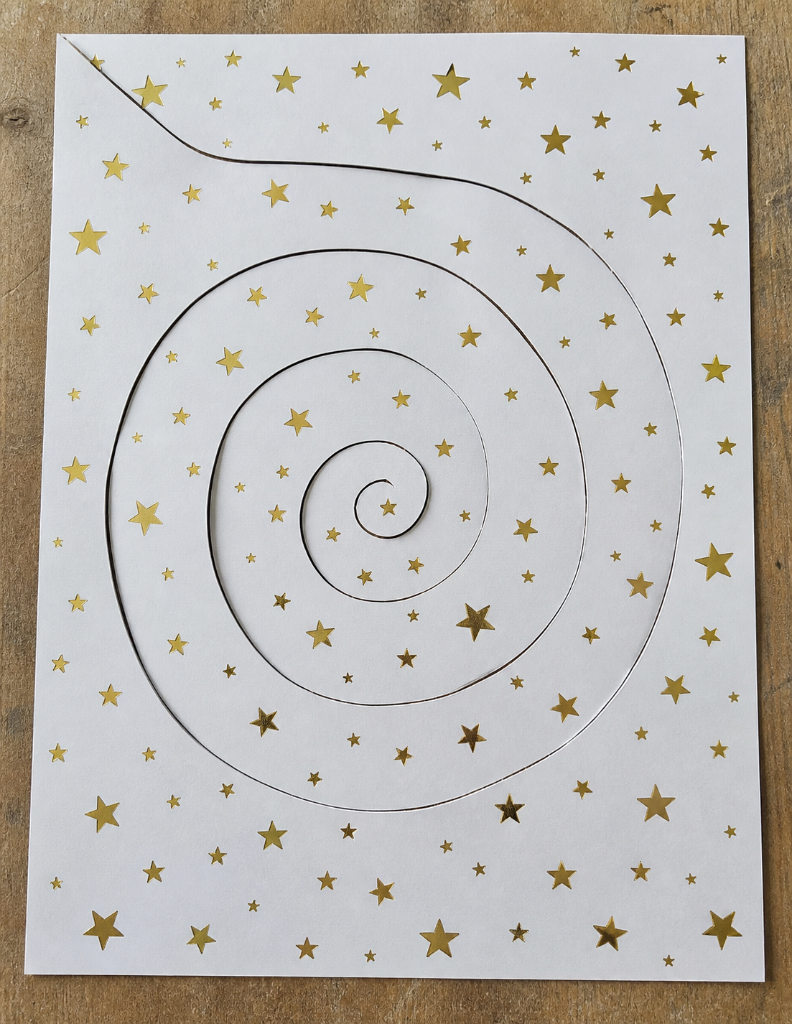
Take a blank sheet of paper. Cover it with stick-on stars, the kind you put on a child's homework. Take your time. Place them at random, one by one. Let's say it takes you a couple of minutes to get a hundred stars spread across that paper. Now pick up the paper and pick any corner near the edge and start cutting; as you cut, move towards the center. You will end up with a long spiral in just a few moments. The cut takes thirty seconds.

I really felt the Lord directed me to this
Here is my question: does the distance of the stars before and after the cut relate to distance and time?
No. Stars that were an inch apart on the flat sheet are now separated by the full length of a spiral arm, yet the cut that created that distance took thirty seconds. The stars didn't move relative to each other during the cutting. The geometry of the cut redistributed the distance between them. The distance is enormous. The event was moments.
This is what I think about when the argument says: 13.8 billion light-years means 13.8 billion years. That assumption only works if space did not expand. But Scripture says, repeatedly, that God stretched out the heavens, not once but as a present-tense activity, an ongoing description of how the universe was built. Job says it. Isaiah says it three times. Zechariah says it. These carry physics intuition from people who had no physics vocabulary.
If the fabric of space was stretched, rapidly, the way the current inflationary model already requires in the first fractions of a second, then distance and time are not the same thing. Distant light works as a ruler rather than a clock. And rulers do not tell you when; they only tell you how far apart the points are now.
I am not asking you to accept a young universe. I am asking you to notice that the argument "this took 13.8 billion years because it is 13.8 billion light-years away" contains an assumption that is not established: that expansion did not accelerate, that the ruler did not stretch.
The stars on that paper did not move when you cut across the spiral. The distance between them, measured along the spiral, got compressed into three seconds of real time. Distance is not time. God stretched the heavens. That changes the calculation.
II. The Spatial Problem: Scale in Every Direction
The temporal problem has a spatial mirror. The observable universe contains approximately two trillion galaxies. Each galaxy contains, on average, hundreds of billions of stars. The Milky Way alone, our galaxy, contains an estimated 100 to 400 billion stars. The nearest star to our sun, Proxima Centauri, is 4.24 light-years away, a distance so vast that light, traveling at 299,792 kilometers per second, requires more than four years to traverse it.
Of the two trillion galaxies, the vast majority are so distant that no light from them will ever reach us again. The expansion of space is accelerating faster than light can travel across it. We live in one galaxy, on one planet, orbiting one unremarkable star in the outer arm of a spiral, in a universe whose observable portion spans 93 billion light-years, and beyond our observable horizon, the universe likely extends indefinitely further.
This spatial enormity is not philosophically neutral. A God who designed the universe specifically for humanity would have had no reason to create two trillion other galaxies, none of which, as far as we can observe, contain anything that matters to the ostensible purpose of creation. The theist has several responses available: that the universe's size is a necessary consequence of its age (because the universe expands as it ages), or that other galaxies contain beings who also matter. Both are defensible. Neither is supported by evidence.
III. The Timing Problem: A Story About Waiting
Even granting that the universe needed time to build up the heavy elements necessary for life, including carbon, oxygen, and iron, which were not present in the Big Bang and had to be forged in stellar furnaces and distributed through supernova explosions, and the question remains about the waiting. The universe spent approximately nine billion years building and exploding stars before Earth formed. Earth spent approximately four billion years developing life before complex multicellular organisms appeared. Complex life spent another 600 million years before a species capable of theology existed.
The theistic interpretation frames this as patient purpose: that an eternal God has no reason to rush, that the development of the conditions for human existence required exactly the time it took. This is a coherent response. But it requires a commitment to the importance of humanity so enormous that it justifies 13.8 billion years of cosmic prologue during which, on the theistic account, the primary concern, the creation of beings who can know and love God, had not yet been realized.
The familiar label is Young Earth Creationism, but that framing concedes too much. Genesis 1:1 does not say In the beginning, God created the Earth. It says "In the beginning God created the heavens and the earth." The earth is named second. The heavens come first. The creation claim is cosmological before it is geological.
A more precise term is Young Universe Cosmology (YUC), a framework that challenges the age of the cosmos itself, not merely the age of sedimentary rock layers. This is a more accurate description of what the biblical text actually claims, rather than a semantic retreat and what the scientific challenge is actually about. The Hubble tension, JWST anomalies, and alternative starlight models (white hole cosmology, Carmeli's five-dimensional relativity, variable speed of light proposals) are all cosmological challenges, not geological ones.
This site does not advocate for a specific number of years. It advocates for intellectual honesty about what the consensus number rests on and for taking seriously the frameworks that challenge it. The universe's age is an inference from a model. The model is currently under measurable pressure. That is not a creationist talking point. It is the conclusion of the Planck team's successors working with the largest 3-D galaxy survey ever conducted.
IV. The Anthropic Principle: The Best Defense Available
The most philosophically sophisticated theistic response to deep time and cosmic scale is the anthropic principle. In its weak form: we should not be surprised to find ourselves in a universe compatible with our existence, because we could not be asking the question from any other kind of universe. The vast, old, apparently wasteful universe may simply be the only kind of universe that produces observers capable of marveling at its wastefulness.
This is a serious and non-trivial point. The size of the universe may indeed be a necessary consequence of its age, and its age may be a necessary consequence of the time required for stellar nucleosynthesis to produce the elements that permit chemistry. The universe is not big despite needing to produce us; it may be big because producing us required a universe with enough time to forge carbon.
But the anthropic principle in its weak form is descriptive rather than explanatory. It tells us why we observe what we observe; it does not tell us whether observation requires a designer. The multiverse hypothesis, that ours is one of an enormous number of universes, and we happen to inhabit one compatible with life, offers a naturalistic analog to the anthropic principle. Neither hypothesis is currently falsifiable. They are postulated, not confirmed.
V. The Number Itself Is Under Pressure
There is a problem the argument from deep time rarely acknowledges: the number at its foundation, 13.8 billion years, is not as settled as it is routinely presented. It is a model-dependent figure derived from several interlocking assumptions, and the assumptions are currently under measurable stress.
In 2023, astrophysicist Rajendra Gupta of the University of Ottawa published a peer-reviewed analysis in the journal Monthly Notices of the Royal Astronomical Society proposing, on the basis of JWST observations and a re-examination of cosmological constants, that the universe may be approximately 26.7 billion years old, nearly double the standard figure. Gupta's model combines a tired-light mechanism with an evolving coupling constant to account for the anomalous maturity of early galaxies observed by JWST that do not fit within the 13.8-billion-year timeline.
Gupta is not a fringe figure and the journal is not a fringe publication. The paper's reception was mixed; mainstream cosmologists dispute the tired-light component, but its very existence in peer-reviewed literature is significant. It means the foundational number of the deep-time argument is contested within professional cosmology, not merely by young-earth critics.
Separately, the Hubble tension, a 4–6 sigma discrepancy between two independent methods of measuring the universe's expansion rate, has remained unresolved since at least 2019. One camp measures the Hubble constant from the cosmic microwave background (H₀ ≈ 67.4 km/s/Mpc); another measures it from local distance indicators such as Cepheid variables and Type Ia supernovae (H₀ ≈ 73 km/s/Mpc). The two methods do not agree. A 4–6 sigma discrepancy is not a rounding error. In particle physics, 5 sigma is the threshold for a confirmed discovery. The expansion rate of the universe, the number that determines how old it is, is not known to the precision the argument from deep time assumes.
That statement has since been confirmed, not resolved, but confirmed as a real and deepening crisis. In 2025, the Dark Energy Spectroscopic Instrument (DESI) released its Year 2 results after mapping 14 million galaxies, the largest 3-D survey of the universe ever conducted. DESI's data strengthened evidence that dark energy, the term assigned to explain accelerating cosmic expansion, may itself be evolving or weakening over time, reaching 3–4 sigma significance. A cosmological constant that is not constant is not a minor adjustment. It is a crack in the foundation of the standard model (ΛCDM). Since the age of the universe is derived from the expansion rate and its assumed driver, an evolving dark energy directly unsettles the figure downstream of those assumptions. The headline number is not settled. The instrument that was supposed to confirm it made the problem worse.
None of this resolves the argument from deep time in either direction. Whether the universe is 13.8 billion or 26.7 billion years old, the fundamental question, why so long before the species who asks this question, remains. But intellectual honesty requires stating what the argument actually stands on: a model currently producing anomalies it cannot fully explain, at the frontier of what the most powerful space telescope ever built is now revealing. The number is real. Its precision is not.
VI. The Strongest Objection, and the Honest Answer
The most serious form of this argument is not the popular one about a lonely dot in a big sky. It is the probabilistic one, stated most sharply by writers working in a Bayesian frame: a universe that is ancient, enormous, and almost entirely lethal is far more likely on the hypothesis that no one made it than on the hypothesis that Someone made it for us. Old, vast, and empty is what undirected physics predicts. Snug, small, and recent is what a cosmos built around human beings would predict. We do not observe the second. We observe the first. On this reading, scale reads as evidence rather than a mood, and it points away from design.
That is the objection at full strength, and it deserves better than a slogan in reply. The answer turns on a single distinction the objection quietly skips: the difference between a universe built for us to fill and a universe built so that we could exist at all. The physics that lets carbon form, that lets a stable star burn long enough for chemistry to become biology, is physics that requires a universe roughly this old and roughly this large. Barrow and Tipler laid this out in detail: the elements a human body is made of are forged in generations of dying stars, and that forging takes on the order of billions of years. A cosmos small enough or young enough to look "efficient" is a cosmos with no observers in it to call it wasteful. On any theism that works through nature rather than around it, an old and enormous universe becomes the expected outcome rather than the surprising one.
The timing half of the objection meets the same distinction. "Why so long before we arrived?" assumes a Maker who is waiting, drumming His fingers inside the same time we inhabit. Classical theism never held that. Augustine argued that God created not in time but with it, so there is no stretch of empty ages during which a Creator delayed. Aquinas separated the age of a thing from its dependence on a cause: a universe could be indefinitely old and still, at every instant, be held in being. Read that way, the long prologue stops being a wait at all and becomes the shape of a creation allowed to make itself.
None of this forces the theistic reading, and this page will not pretend that it does. The measure problem is real: precise "odds against" claims about universes are harder to define than either side usually admits, which cuts at confident probability talk in both directions. The honest position is that scale neither proves nor disproves a Maker. What it does is retire one bad argument on each side: the atheist cannot treat vastness as a knockdown, and the believer cannot treat the night sky as a billboard. The universe is old and immense because that is what a universe containing us has to be. Whether Anyone intended that is a question scale itself cannot settle.
VII. What Remains After the Argument
The argument from deep time does not prove that God does not exist. It demonstrates that the universe, as we actually find it, does not look like what we would expect if it were designed primarily for human habitation. A good engineer builds to specification. This universe's specifications include 13.79 billion years of uninhabited prologue, most of the observable matter in forms humans will never interact with, and a timeline in which we appear so late that in cosmic terms, we have barely arrived.
What this means is not that God is absent, but that the naive picture of a universe built around human significance struggles to accommodate what we actually observe. A God who exists outside of time and space for whom a billion years is as a day, that is a coherent conception. But that conception requires abandoning the intuitive picture of a God who created the universe for us in any straightforward spatial or temporal sense.
And if that picture must be abandoned, if divine purpose is so far removed from human experience and cosmic chronology as to be effectively hidden, then the argument from deep time asks: what, exactly, is left of the hypothesis that the universe has a personal author who cares about the inhabitants of this one small planet? That question does not have an easy answer. Good. Easy answers have not earned this question.
The following sources constitute the primary intellectual foundations for reviewing and preparing for this kind of argument.
- Planck Collaboration. (2020). "Planck 2018 results. VI. Cosmological parameters." Astronomy & Astrophysics, 641, A6. The definitive measurement of the age of the universe from cosmic microwave background radiation. The most precise cosmological data available as of publication. Read source ↗
- Sagan, C. (1994). Pale Blue Dot: A Vision of the Human Future in Space. Random House. Sagan's meditation on humanity's place in the cosmos. The most eloquent popular statement of the argument from scale, and paradoxically, also one of the most moving arguments for the preciousness of what is here. Search this source ↗
- Barrow, J.D. & Tipler, F.J. (1986). The Anthropic Cosmological Principle. Oxford University Press. The most comprehensive treatment of the anthropic principle and its implications. Essential for understanding both the strength of the theistic response and its philosophical limitations. Search this source ↗
- Conselice, C.J. et al. (2016). "The Evolution of Galaxy Number Density at z < 8 and Its Implications." Astrophysical Journal, 830(2). The revised estimate of two trillion galaxies in the observable universe, a tenfold increase over previous figures. Recalibrates the sheer scale of the spatial argument. Read source ↗
- Craig, W.L. (1994). Reasonable Faith: Christian Truth and Apologetics. Crossway Books. Craig's response to the cosmic scale argument, arguing that the universe's size is a necessary consequence of the physical conditions required for life. The strongest theistic counter-argument in the popular literature. Search this source ↗
- Gupta, R.P. (2023). "JWST early Universe observations and ΛCDM cosmology." Monthly Notices of the Royal Astronomical Society, 524(3), 3385–3395. Peer-reviewed challenge to the 13.8-billion-year standard age. Combines a tired-light mechanism with evolving coupling constants (CCC+TL model) to propose a universe age of ~26.7 billion years, nearly double the consensus figure. Published in response to JWST observations of anomalously massive early galaxies that do not fit standard chronology. Contested by mainstream cosmology but not dismissable as fringe. The paper's existence in MNRAS demonstrates the foundational number is under genuine professional revision. Read via DOI ↗
- Freedman, W.L. (2021). "Measurements of the Hubble Constant: Tensions in Perspective." The Astrophysical Journal, 919(1), 16. Comprehensive review of the Hubble tension, the 4–6σ discrepancy between CMB-derived (H₀ ≈ 67.4) and local-distance-indicator (H₀ ≈ 73) measurements of the expansion rate. Since the age of the universe is derived from the expansion rate, a factor-of-two uncertainty in the age is implicit in this unresolved tension. Freedman's conclusion: the standard model is missing something fundamental. Read in ApJ ↗
- Labbe, I. et al. (2023). "A population of red candidate massive galaxies ~600 Myr after the Big Bang." Nature, 616, 266–269. The JWST paper that triggered the age debate: observed galaxies at z > 7 with stellar masses implying they formed far earlier and more rapidly than standard ΛCDM permits. Lead author Ivo Labbé: "These galaxies should not exist in our current understanding." Provides the empirical pressure behind the Gupta and related proposals to revise the universe's age upward. Read in Nature ↗
Where Does This Argument Lead You?
Select the conclusion that most honestly fits your assessment.