Most arguments for atheism attack the evidence. They say the universe looks undesigned, that suffering counts against a good God, that religious experience can be explained away. Michael Huemer’s new argument does something different and more dangerous. It does not dispute the evidence for a designer. It argues that one of the central attributes of the God of classical theism, infinite power, infinite knowledge, is incoherent rather than merely unproven: that an actually infinite quantity of anything real cannot exist. If he is right, the omni-God is ruled out before the evidence is even consulted. This is a serious argument from a serious philosopher, and it deserves a serious answer.
I. Three Kinds of Infinity (and Why the Difference Is Everything)
The whole argument turns on a distinction most people never make: there is more than one kind of infinity, and Huemer’s argument targets only one of them. Before the argument can be evaluated, the three must be kept apart. Use the interactive panel and the three illustrations below, then read on.
You can always add one more. Count 1, 2, 3, and there is no largest number, but at no point do you ever hold an actually infinite collection. The infinity is in the endlessness of the process, not in any finished total. This is Aristotle’s infinity, and almost nobody thinks it is impossible.
The set of all natural numbers is an actually infinite object, with a size (cardinality) that mathematicians reason about rigorously. Cantor showed there are even different sizes of infinity. This works fine in mathematics, though whether an infinite set can be physically instantiated (Hilbert’s Hotel) is a separate and contested question.
This is the target. Not a never-ending process, not an abstract set, but an actually infinite degree of a real property possessed by a real being: omnipotence as literally unlimited power, omniscience as literally unlimited knowledge. Huemer’s new argument is that an intensive infinity of this kind is impossible, and therefore the omni-God, defined by exactly these attributes, cannot exist.
- Aristotle, Physics III.6
- Aristotle & Mathematics (SEP)
- Cantor, Grundlagen (1883)
- Early Set Theory (SEP)
- M. Huemer, argument via M. Donahue (2026)
- Omnipotence (SEP)
Hover (or tap) each panel for a note and its sources.
The distinction is doing all the work. If you fail to separate these three, the argument sounds either trivially false (of course infinity is fine, mathematicians use it every day) or trivially true (of course you can never finish counting). Huemer is not confused about either of those. He grants potential infinity and the mathematics of cardinal infinity. His claim is narrower and sharper: that an intensive infinity, an actually unlimited magnitude of a real quantity, cannot be instantiated in reality.
II. Huemer’s Argument, Stated Fairly
Presented on Miles Donahue’s Uncertainty podcast (June 2026), the argument runs roughly as follows. Stated as its own best advocate would state it:
(Michael Huemer’s novel argument, presented by Miles Donahue, June 2026)
III. The Response
The argument is strong precisely because it does not overreach: Huemer explicitly presents it as a serious challenge, not a knockdown proof. So the response should match that register. The goal is not to “refute” it with a slogan but to show where each premise can be resisted by classical theism without special pleading.
Premise 2: a being with infinite power or knowledge must instantiate a completed actual infinity in the concrete world, importing all the paradoxes of physical infinities.
Classical theism does not model omnipotence as an infinite stockpile of discrete power-units, nor omniscience as an infinite list of separate facts. The dominant tradition (Aquinas) treats God’s power and knowledge as a single, simple act, not an aggregated quantity. If the divine attributes are not quantities built from countable parts, the paradoxes of completed numerical infinities do not obviously transfer. The argument may be attacking a quantitative caricature of the attributes.
Premise 3: intensive infinities are impossible because an unlimited magnitude yields contradictions, such as a quantity that is already unlimited yet could still be increased.
“Increasable yet unlimited” is a contradiction only for quantities on a scale with units and a next-step operation. Classical omnipotence is standardly defined not as “the largest amount of power” but as “the power to bring about any metaphysically possible state of affairs.” That is a scope, not a magnitude on a number line. A scope can be complete (nothing possible is outside it) without being a number that could be made bigger. The alleged contradiction assumes the very quantitative model classical theism rejects.
Even granting the distinction, the theist still owes an account of how omniscience, knowing infinitely many truths, avoids being a completed infinite set of the very kind the argument says is impossible.
Two moves are open. First: divine knowledge may not be enumerative at all. Knowing all truths by knowing one’s own essence (the ground of all being) is knowledge by a single act, not by traversing an infinite list. Second: even if one grants completed infinite sets in mathematics, the theist can hold that God’s knowing is the very thing that grounds those abstracta, rather than a mind that must contain them as parts. Either way, omniscience need not be the impossible completed-infinite-collection the argument requires.
IV. The Mathematicians Knew Better
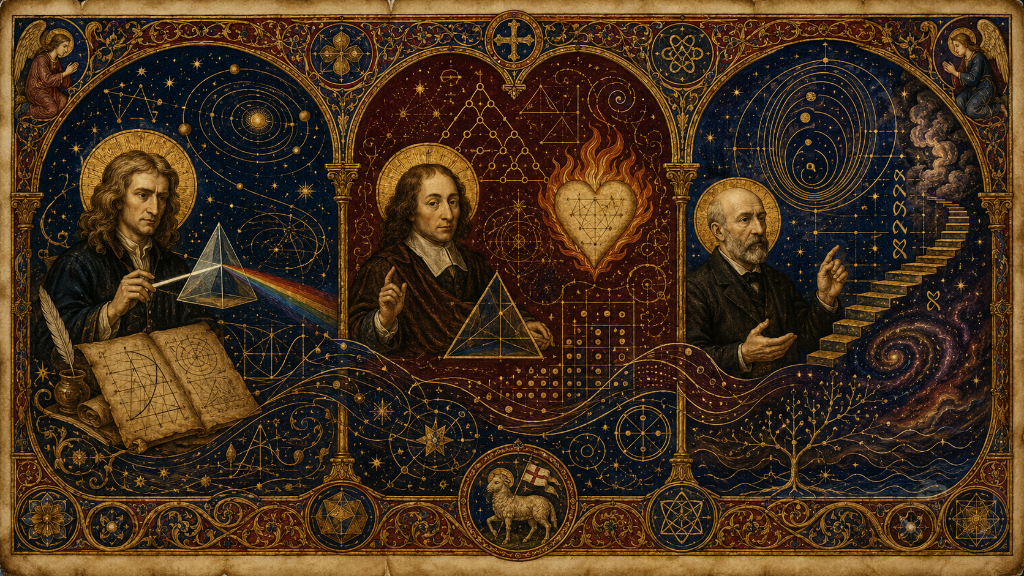
It is worth pausing on a fact the argument quietly assumes and never earns: that to be infinite is to be an enormous quantity, and that God, if he existed, would be the largest such quantity on the scale. The three mathematicians who did more than anyone to make the infinite precise did not believe that for a moment. They handled the infinite for a living, and each of them drew a line between the infinite of mathematics and the God they worshipped.
The man who wrote the mathematics of the infinitely small called God the
Pantokrator, the Universal Ruler, and insisted that God is not eternity and
infinity, but eternal and infinite.
Dominion, not size, is what makes him God.
A founder of probability who meditated on the two infinities sewed a note into his coat
after his night of fire: the God of Abraham, God of Isaac, God of Jacob, not of the
philosophers and scholars.
The God who is met is a person, not a maximum on a scale.
The founder of set theory, who proved the infinities never stop climbing, reserved a separate word for God: the Absolute Infinite, a completeness beyond every number, which he said could not be increased or captured by any cardinal at all.
Isaac Newton gave us the calculus, the whole machinery of limits and the infinitely small, and he was as comfortable with mathematical infinity as any man who has ever lived. When he turned to God at the end of the Principia he did not describe a very large object. He wrote that God is not eternity and infinity but the one who is eternal and infinite, and that it is dominion, lordship over all things, that makes God to be God. The infinite of his mathematics measured the world he was studying. It was never offered as the measure of its maker.
Blaise Pascal helped invent probability theory and spent long passages of the Pensées suspended between the two infinities, the unthinkably large and the unthinkably small. He knew exactly how strange the infinite is. Yet the God he confessed on the night of 23 November 1654, and carried sewn into his coat for the rest of his life, was not the abstraction the philosophers argued over but the God of Abraham, of Isaac, and of Jacob, a covenant partner who is met rather than computed. For Pascal the mathematical infinite was real and dizzying, and it still was not the thing he meant by God.
Georg Cantor is the decisive witness, because he is the one who made the actual infinite mathematically respectable in the first place. He proved that infinities come in different sizes, and that there is no largest one: for any set S, the set of its subsets is strictly bigger, so the cardinal numbers climb forever with no summit. If God were simply the biggest infinity, Cantor of all people had the tools to say so. Instead he did the opposite. He drew a sharp line between the transfinite numbers, which are ordinary mathematical objects, and what he called the Absolute Infinite, which he identified with God and said could never be increased, numbered, or captured by any cardinal. The man who counted the infinities put God on the far side of the count.
Cantor’s theorem says that for every set there is a strictly larger one: |ℙ(S)| > |S|. There is no greatest cardinal. So “the largest possible amount” of anything countable is not a coherent target to begin with. A God defined as the top of that ladder would be defined as something the mathematics forbids, which is roughly the argument’s point, and also why no serious theology has ever defined God that way.
Classical omnipotence is a scope rather than a magnitude on that ladder: the power to bring about anything that is genuinely possible. ∀p (◊p → CanActualize(God, p)) A scope can be complete, with nothing possible left outside it, without being a number that could be made larger. The paradox of a quantity that is unlimited yet still increasable simply never arises, because there is no scale and no next step.
Classical omniscience is likewise not an infinite list of facts that God must store and traverse. On the older account God knows all truths in a single act, by knowing his own essence as the ground of everything that is. Knowing everything in one act is not the same as holding an actually infinite collection in mind, so the paradoxes of completed infinite sets do not automatically transfer.
The word infinite, in short, is not used in one single sense. The infinite of the number line, the infinite cardinals of set theory, and the infinite perfection the tradition ascribes to God are three different things wearing one word. An argument that proves something impossible about the first two has not yet said anything about the third.
This is why the reply does not require any exotic move. Newton, Pascal, and Cantor were not evading the mathematics; they were the ones who wrote it. They simply declined to confuse the tool with its maker. Huemer’s argument is powerful against a God imagined as the biggest number in the room. It has nothing yet to say against the God none of these three men ever mistook for a number.
V. What the Argument Costs the Atheist
Notice the price of the argument, and it is a real price. Huemer’s case works by declaring actual intensive infinities impossible. But that same blade cuts toward theism in the cosmological arguments. If a completed actual infinity of real things is impossible, then an infinite regress of past causes is impossible too, which is precisely the premise of the Kalam cosmological argument for a first cause. An atheist who adopts Huemer’s hostility to actual infinities to kill the omni-God has handed the theist a beginning of the universe that demands a cause. The argument does not come free.
There is also the matter of what survives even if the argument succeeds. By Huemer’s own framing, it targets the omni-God specifically, the being defined by literally unlimited attributes. It does not touch a maximally great being whose power and knowledge are complete in scope rather than infinite in magnitude, nor a designer inferred from the fine-tuning and information evidence elsewhere on this site. At most the argument would force a more careful statement of the divine attributes, not the removal of God from the field.
VI. The Honest Position
This is one of the better new arguments for atheism precisely because it is modest about itself. It does not claim to disprove God. It claims that one traditional way of describing God is incoherent, and it forces the theist to say clearly whether the divine attributes are magnitudes (on a scale, and so vulnerable) or scopes and simple acts (complete without being quantities, and so untouched). The classical tradition has, for eight centuries, said the latter. Huemer’s argument is a sharp reminder that the theist must actually say it, and mean it, rather than picturing God as merely a very large thing.
There is an obvious response, and it is the same one I have made before. If the omni-God really were the incoherent, very-large-thing that this argument describes, I would not believe in that God either. I have said as much in I’d Be an Atheist Too. The honest theist does not defend every picture of God that has ever been drawn. He agrees with the atheist that some of them collapse, and then asks whether the God actually confessed by the classical tradition is one of them. Huemer’s target is a magnitude on a scale. The God of that tradition is not a magnitude at all. Reject the caricature with him, and the real question is still standing.
Do you know how to answer this one? Not by denying that infinity is strange. By distinguishing the three infinities, refusing the quantitative caricature of omnipotence, and noticing that the atheist’s weapon against divine infinity is also a weapon against an infinite past. The argument is worth its weight. So is the reply.